



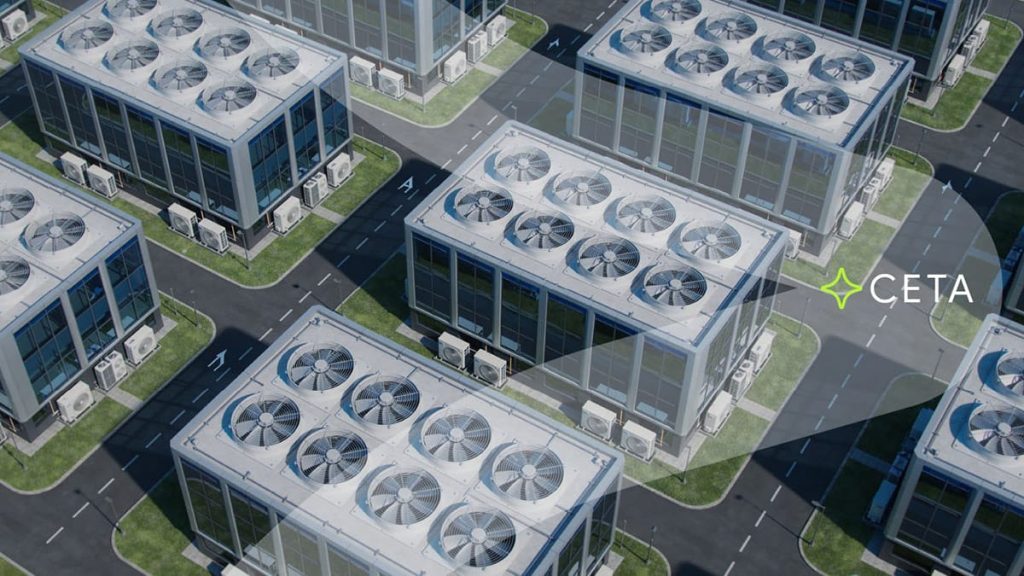
Earlier visibility of thermal demand lets operators pre-position chiller staging, time maintenance to predicted load and absorb rising rack densities, while site-by-site learning feeds building-management and DCIM systems under operator oversight.
CETA System Co., Limited has extended the forecast horizon of its data-centre cooling model, giving operators earlier visibility of thermal demand and the lead time to act on it before instability takes hold. The model learns site by site, examining how a cooling plant responds across weather, IT load and control sequences, and feeds forecasts into existing building-management and DCIM environments without infrastructure replacement. Conditions inside a data centre rarely arrive one at a time, and when a warm afternoon meets a scheduled compute batch while a chiller sits offline for service, reactive cooling leaves a costly gap between when a problem develops and when a response is mounted.
The operational case for earlier visibility rests on cost and exposure that thermal behaviour directly governs. Cooling and ventilation account for approximately 40% of a data centre’s total energy consumption, and across the latest reporting window the average financial impact of downtime reached $9,962 per minute. Reactive thermal management leaves much of that exposure intact, because the response begins only after conditions have already deteriorated.
The model is calibrated to each facility rather than to a generic template. Sensor arrays spanning server inlet and outlet temperatures, ambient conditions, humidity and equipment power draw feed machine-learning algorithms that map the relationships between cooling settings, IT load and thermal response, and the model combines meteorological inputs, temporal patterns and physics-informed load components to produce day-ahead hourly cooling demand forecasts. Where historical data is limited, physics-based heat-transfer calculations are injected as auxiliary inputs, holding forecast robustness before the model has accumulated site history.
The development is framed around lead time rather than raw speed, with forecast lead time cast as “what decides the options an operator can exercise, not merely how fast a problem is noticed,” in the words of Lee Tsz-Hin, Chief Executive Officer of CETA System Co., Limited, who treats anticipation as the operator’s real advantage. A generic, utility-level forecast applied to a specific site introduces compounding inaccuracies that erode the value of any forecast horizon, whereas a model tuned to local infrastructure, load behaviour and environmental conditions reflects the facility as it actually operates. The capability matures with use, its accuracy and horizon length improving as the system accumulates operational history across seasonal cycles and load-pattern variations, with refinements applied incrementally rather than through disruptive reconfiguration.
Earlier visibility changes the set of responses available to an operator before thermal stress takes hold. With demand anticipated hours ahead, chiller staging sequences, pump-speed adjustments and valve pre-positioning are carried out during stable operating periods rather than during rapid load transitions, when options narrow quickly. Worst-case static setpoints require over-cooling as a hedge against uncertainty, whereas forecasts that track actual demand let setpoints follow it rather than its upper bound, producing tighter thermal bands at lower energy expenditure.
CETA System pairs those forecasts with asset-health signals so that maintenance can be timed to predicted low-load windows. Condition-based monitoring detects compressor bearing degradation and cooling-coil fouling up to 48 to 72 hours before failure, and aligning that intelligence with demand forecasts reduces the disruption of preventive maintenance. The same lead time supports rising rack densities, with GPU servers now drawing around 132 kW per rack: earlier forecasts coordinate flow rates, valve positions and cooling-distribution staging with predicted workload as facilities adopt direct-to-chip and two-phase cooling, holding die temperatures within limits during steep load transients.
Across each of these functions, the deployment model stays advisory-first and operator-supervised. The platform recommends cooling adjustments, surfaces efficiency opportunities and operational options, while execution stays with the operator at every point. Lee characterises the design as controlled augmentation rather than autonomous substitution, a model that “delivers analytical value while engineers keep decision-making authority.” When thermal conditions approach tolerance limits, the control logic shifts to a guard mode that brings additional cooling capacity on line and restores SLA-compliant conditions, and failsafe behaviour takes precedence over efficiency targets whenever conditions fall outside acceptable bands.
Certain categories of operational event sit outside the model’s remit and are reserved for people. Security breaches, regulatory exposure and customer-facing outages call for human judgement that no forecasting system replaces, and manual override remains available through monitoring and event logs where data is incomplete, conflicting or without precedent. The platform also supports audit-ready compliance reporting aligned with EED, CSRD and ISO standards, letting operators meet those obligations within existing workflows, not through separate reporting infrastructure.

Forecast lead time determines which options an operator can exercise as conditions shift. Managed reactively, those options narrow to damage limitation; informed by a site-specific model that has learned the interplay of weather, IT load and control sequences, they widen to pre-positioned staging, maintenance scheduled around predicted demand and densities absorbed within defined thermal limits. CETA System carries that capability into existing BMS and DCIM environments without infrastructure replacement and holds operator oversight at every decision point, an approach Lee frames around “operational resilience, not precision for its own sake.”
About CETA System
CETA System Co., Limited is a Hong Kong-incorporated technology company that builds artificial-intelligence solutions for data-centre infrastructure. Its platform combines HVAC and chiller-plant energy optimisation with predictive maintenance for critical assets such as UPS systems, generators and chillers on a single vendor-agnostic system that integrates with existing building-management and DCIM environments. Working to an advisory-first deployment model, it serves colocation, enterprise and hyperscale operators across the Asia-Pacific region and beyond.
- Website: https://cetasystem.com