Enterprise investment in analytics has grown steadily for years. Cloud migration, modern data stacks, and expanding analytics teams have made data more available than ever. Yet access alone has not translated into consistent improvement in decision-making.
In many organizations, data remains underused, mistrusted, or confined to specialist teams. The problem is not ambition or tooling. It is structural. Most enterprises continue to build data platforms as technical initiatives rather than as products designed to serve users and make decisions over time.
A product-oriented approach changes how platforms are conceived, delivered, and sustained. It reframes success around platform adoption and decision impact, not architectural completeness. For leaders responsible for enterprise-wide platforms, this shift is critical to building durable analytical capability.
Why Traditional Data Platforms Fail to Scale
Data platforms often fail quietly. Systems go live, pipelines run, and dashboards exist, yet organizational behavior barely changes. Understanding why this happens requires examining the assumptions built into traditional platform design.
Infrastructure-first thinking vs user-first outcomes
Most enterprise platforms are designed bottom-up. Teams begin with ingestion, storage, and processing concerns, then layer on access and analytics. While technically sound, this approach rarely starts with how people actually use data.
Gartner research identifies organizational and human challenges as the primary barriers to realizing analytics value. Platforms that are technically robust but poorly aligned to user workflows struggle to embed into daily decision-making.
When users must adapt to platforms rather than platforms adapting to users, friction becomes the default experience.
Low adoption, duplicated tooling, and decision distrust
Low usage creates predictable side effects. Teams extract data into spreadsheets. Local pipelines appear. Metrics diverge. Over time, the organization supports multiple versions of the same logic.
Industry assessments consistently show that 87 percent of organizations operate at low analytics maturity, relying on fragmented, opportunistic use rather than enterprise-wide platforms.
As inconsistencies multiply, confidence erodes. Leaders question the numbers rather than act on them. Decision cycles slow, and the platform becomes a liability rather than an asset.
Reframing Data Platforms as Products
Scaling analytics requires redefining the platform itself. Product framing provides a practical lens for doing so.
Defining platform users, use cases, and value propositions
A data-as-a-product mindset starts by identifying users and the decisions they make. Analysts need speed and flexibility. Operational leaders need timely signals. Executives need consistency and confidence.
Each use case must have a clear value proposition. Faster planning cycles. Reduced manual reconciliation. Improved forecast reliability. Without explicit value definitions, platforms accumulate features without impact.
Roadmapping data capabilities like product features
Product roadmaps sequence capabilities based on user value rather than solely on technical dependencies. Features such as metric standardization, data discovery, documentation, and access controls are planned, delivered, and refined iteratively.
Each capability is evaluated through adoption signals. When usage lags, teams investigate why. This feedback loop keeps platforms aligned with organizational reality instead of theoretical design.
Designing for Adoption and Trust
Adoption is not accidental. It emerges when platforms consistently meet user expectations and reduce cognitive effort.
Self-service analytics and usability
Broad access is essential for scale. Gartner projected that most organizations would deploy self-service analytics to reduce dependence on centralized teams and accelerate insight generation.
However, usability determines whether access translates into use: intuitive navigation, consistent naming, and guided exploration lower barriers for non-technical users. Complexity should be available, not unavoidable.
Data quality, lineage, and transparency
Trust depends on clarity. Users need to understand what data represents, how it is produced, and where it might fall short. This is where data governance supports adoption rather than restricting it.
Poor data quality has a real cost. Studies estimate average annual losses of $12.9 million per organization due to data quality issues, particularly in regulated environments.
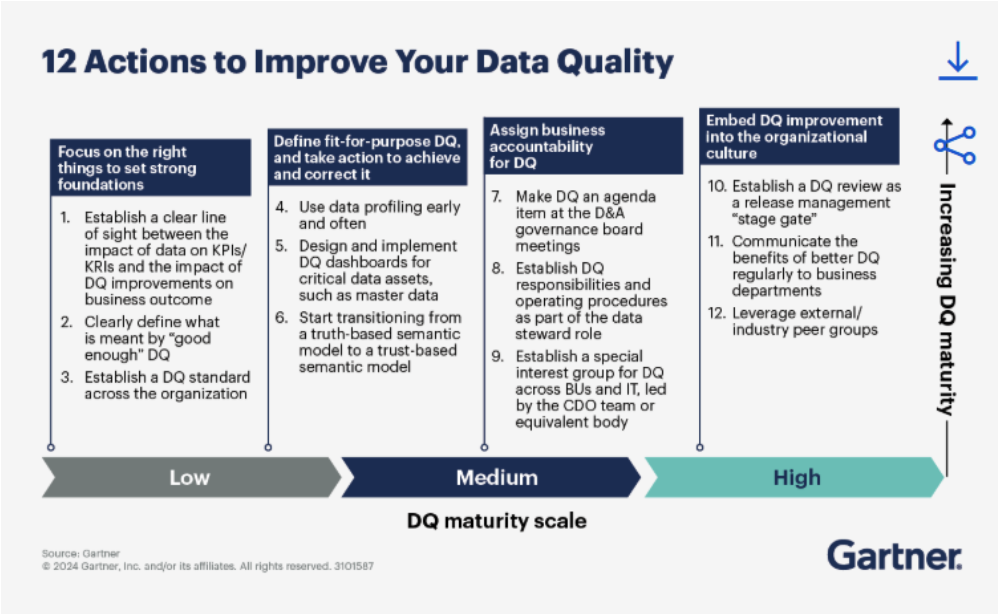
Image: Diagram showing Gartner’s data quality maturity progression from low to high | Source: Gartner
Visible lineage, quality indicators, and ownership reduce ambiguity. They allow users to make informed decisions even when data is imperfect.
SLA-driven delivery and prioritization
Service-level agreements formalize expectations. SLAs define freshness, availability, and support responsiveness. They also clarify which data products are critical to operations.
Platforms that operate with explicit commitments earn trust through reliability, not promises.
Product Governance at Enterprise Scale
Governance determines whether platforms evolve coherently or fragment over time. Effective governance enables autonomy without sacrificing consistency.
Balancing flexibility with control
Enterprise platforms must support diverse teams while enforcing essential standards. Federated governance models distribute responsibility while preserving enterprise guardrails.
Research shows that federated approaches improve scalability and trust when accountability is clearly defined.
Standardization vs customization trade-offs
Standardization supports comparability and shared understanding. Customization supports relevance and speed. Product governance frameworks make these trade-offs explicit.
Decisions are evaluated based on long-term platform health rather than short-term convenience.
Ownership models for shared platforms
Shared platforms require clear ownership. Product owners manage prioritization and roadmap coherence. Data stewards maintain definitions and quality. Engineering teams deliver capabilities aligned with user feedback.
Without ownership, platforms stagnate and lose credibility.
Measuring Platform Impact
Measurement keeps platforms grounded in outcomes rather than activity.
Adoption, engagement, and time-to-decision metrics
Adoption metrics track active users and frequency. Engagement metrics reveal the depth of usage. Time-to-decision metrics capture whether access to data actually accelerates action.
Together, these indicators show whether the platform changes behavior.
Operational efficiency and cost avoidance
Reducing duplicated tooling lowers licensing and maintenance costs. Consolidated pipelines reduce manual reconciliation and error correction.
Efficiency gains may be incremental, but they compound over time.
Influence on strategic and financial decisions
The strongest signal of maturity appears when leaders rely on shared data for planning and governance. McKinsey analysis shows that organizations that embed analytics into core processes outperform peers in productivity and profitability.
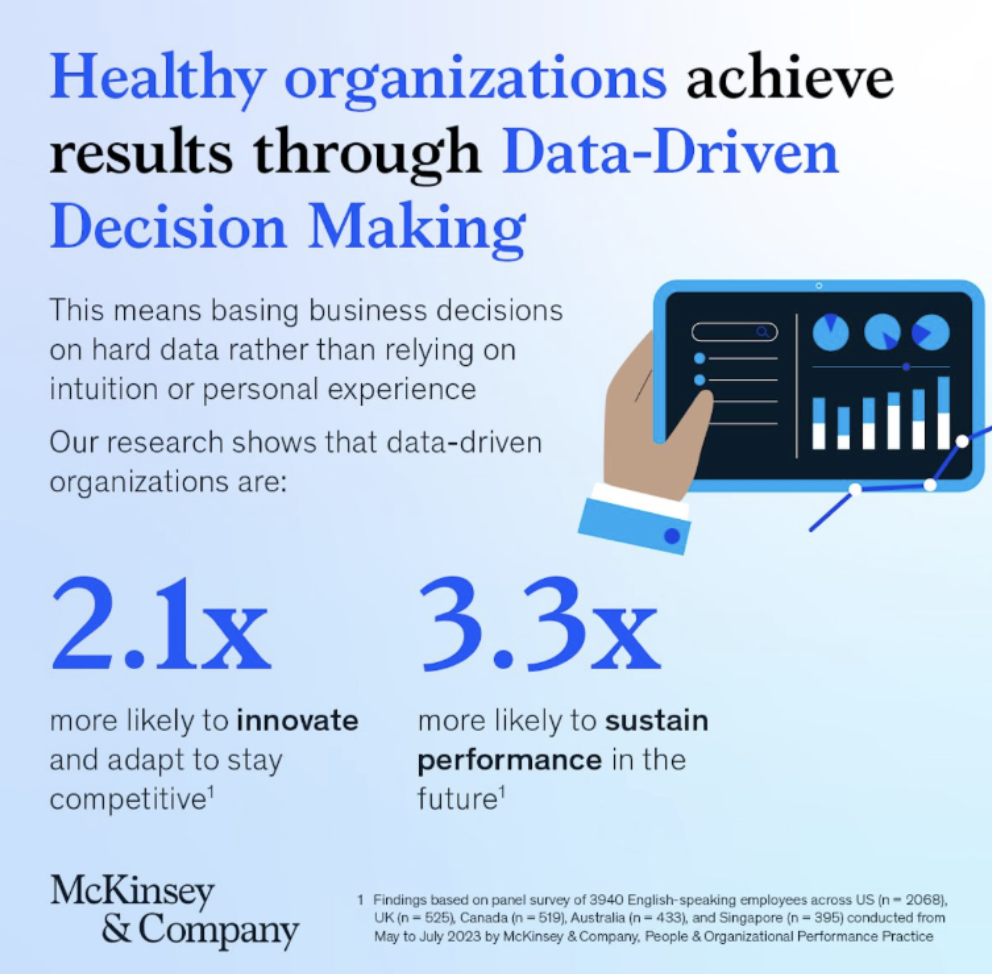
Image: Infographic from McKinsey showing that data-driven organizations are 2.1 times more likely to innovate and 3.3 times more likely to sustain long-term performance | Source: LinkedIn
Leading Organizational Change Through Platforms
Platforms do not transform organizations on their own. They provide the structure through which change occurs.
Stakeholder alignment across functions
Effective platforms align engineering, analytics, finance, operations, and compliance around shared goals. Clear priorities and transparent trade-offs reduce resistance and build trust.
Communication, training, and feedback loops
Adoption requires ongoing enablement. Documentation, onboarding, and feedback channels help users build confidence and shape platform evolution.
Building a durable data-driven culture
Consistent platform experiences shape behavior. Teams default to evidence. Disagreements focus on interpretation rather than data validity. This is how organizational transformation becomes sustained rather than episodic.
The Future of Enterprise Data Platforms
Enterprise analytics is moving beyond descriptive reporting into systems that actively shape decisions. New tools do not primarily drive this shift, but rather change expectations. Leaders no longer ask what happened. They expect guidance on what to do next, which trade-offs exist, and the risks associated with each option.
As enterprise analytics platforms mature, their role expands from producing insight to influencing action. Scenario modeling, embedded recommendations, and automated decision support become natural extensions of trusted data foundations. In this model, analytics is no longer a separate activity. It becomes part of how work is executed.
Artificial intelligence accelerates this transition, but it does not compensate for weak foundations. AI reflects the quality, consistency, and governance of the data it consumes. Where platforms lack clarity or trust, AI amplifies confusion rather than value. Where platforms are product-driven and well-governed, AI extends decision capability without undermining accountability.
Platforms built with platform strategy principles provide this stability. They define ownership, enforce standards where necessary, and enable flexibility where it adds value. Most importantly, they establish clear contracts between data producers and consumers, allowing advanced capabilities to scale without eroding confidence.
Organizations that treat platforms as products create a durable advantage. Adoption becomes the primary signal of value. Governance supports velocity instead of constraining it. Trust is designed into the system rather than managed through exception.
This mindset enables product-led transformation by connecting data capabilities directly to decisions that matter. When platforms evolve deliberately, they do more than support analytics. They shape how organizations reason, prioritize, and act in an increasingly complex environment.