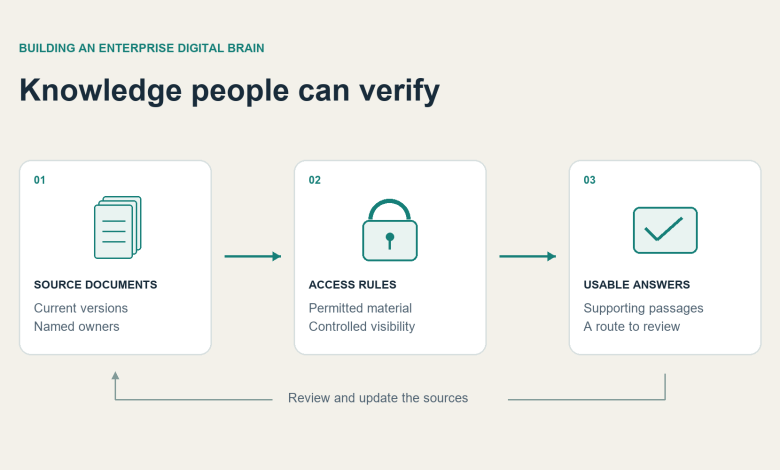
A useful enterprise digital brain should help employees find an answer and establish whether they can rely on it. Connecting internal documents to an AI assistant can make knowledge easier to consult, but the organisation still needs to decide which material is authoritative, who may see it and what happens when the evidence is incomplete. These decisions belong in the first pilot, before the collection of connected documents expands.
For a smaller business, this creates a manageable starting point. Select one recurring information task and test whether the assistant helps people complete it with fewer interruptions and a clear route back to the source. The practical framework below is a proposed way to run that experiment, with a fictional engineering example to make the decisions concrete.
Start with a question that already costs time
Ask a team which questions repeatedly send them searching through folders or interrupting a colleague. A quality team might need the current inspection procedure, while a consulting team might need the approved method for preparing a project review. Choose a task with a recognisable end point so that success can be observed.
This approach is consistent with the French data protection authority CNIL’s recommendation to begin with an identified need and define permitted uses when deploying generative AI [1]. For the pilot, write down the question, the expected evidence and the person who currently resolves ambiguity. That short description becomes the basis of the evaluation.
Give each source an owner
An assistant can expose a document quickly without settling whether it is still valid. Before connecting the pilot collection, assign responsibility for reviewing it and record how an approved document replaces an older version. A draft, an archived instruction and a current procedure should remain distinguishable.
Centralising access also need not mean moving every file into one physical repository. A company can first decide which sources it wants employees to consult, then assess how an implementation will keep those sources current. The useful question is whether someone can identify the document behind an answer and ask its owner to correct it.
Consider a fictional engineering practice preparing a project handover. Its archive contains a current checklist and an older checklist with a different approval step. In the pilot, ask which checklist applies, then revise the approved version and repeat the question to observe how the update is reflected.
Test whether the evidence supports the answer
A citation is useful only if the referenced passage supports what the assistant says. A link to a long report may still leave the employee to discover that the answer mixed two projects or omitted an exception. Review the claim alongside the actual passage rather than treating the presence of a link as proof.
NIST’s Generative AI Profile identifies confident false output as a risk and recommends checking sources and citations during evaluation and monitoring [2]. A practical test set should therefore include questions with conflicting evidence and questions the document collection cannot answer. Record when the assistant identifies a gap, asks for clarification or gives an unsupported answer.
For the engineering handover example, add a question about an approval requirement that appears nowhere in the authorised documents. The desired behaviour should be agreed in advance: explain that the evidence is missing and direct the employee to the responsible person. This tests an operational boundary that a polished demonstration can easily overlook.
Make access changes part of the demonstration
The assistant’s answer should respect the employee’s permissions, including when it summarises information across several files. ANSSI’s security guidance explicitly connects generative AI responses with access rights and the need to know [3]. A shared conversational interface should not become a new route to documents that the employee could not otherwise consult.
Use two test accounts with different access to the pilot collection. Ask the same question from each account, then revoke one account’s access and repeat the test. Check the answer, the cited passage and any conversation history or export available to that account; document any remaining exposure for the implementation team to resolve.
In the fictional practice, a project manager may consult a restricted commercial appendix while a technical contributor may access only the handover documents. The evaluation should show that each person gets an answer supported by material they are entitled to read. Avoid using real confidential files merely to make an early demonstration feel realistic.
Ask where the whole service processes information
For a company seeking sovereignty, a hosting location is one part of a broader operational decision. Ask the provider to distinguish document storage from the processing that generates answers, along with logs, backups and support access. Record the locations and organisations involved so that the claim can be evaluated against the company’s actual requirements.
CNIL also advises organisations to understand whether a provider may reuse the information submitted to its system [1]. A buyer can turn this into a specific conversation about retention, permitted reuse and deletion. These questions help reveal what the service does with information after the initial upload.
Ask what happens when a document is removed and how the organisation could leave the service. Request a clear explanation of which data can be exported, which copies remain and how their retention is handled. Treat unresolved answers as items to investigate before expanding the pilot.
Measure the work around the answer
Time the complete task, including checking evidence and correcting mistakes. Compare the same set of questions with the team’s existing way of working, and record which tasks still require help from a colleague. This produces more useful evidence for the buyer than counting how many responses an assistant generates.
Give the pilot a named owner and a route for reporting incorrect or outdated answers. In the engineering example, a reported checklist error should reach the person responsible for the source document, who can update it and rerun the relevant test. That creates a small, repeatable maintenance process before more teams depend on the system.
The expansion decision can then rest on observed results: employees complete the selected task, the supporting evidence is usable and access changes behave as expected. If the pilot reveals gaps, the company has a focused set of changes to make. Its digital brain becomes more valuable as the organisation learns how to maintain the knowledge people use every day.
References
[1] CNIL. Guidance on deploying generative AI. 18 July 2024. https://www.cnil.fr/fr/comment-deployer-une-ia-generative-la-cnil-apporte-de-premieres-precisions
[2] NIST. Generative Artificial Intelligence Profile, NIST AI 600-1. July 2024. Sections 2.2 and MEASURE 2.5. https://doi.org/10.6028/NIST.AI.600-1
[3] ANSSI. Security recommendations for a generative AI system. 29 April 2024. https://messervices.cyber.gouv.fr/guides/recommandations-de-securite-pour-un-systeme-dia-generative