SAN FRANCISCO, Jan. 4, 2026 /PRNewswire/ — The INSIDE Institute for NeuroAI has demonstrated that non-invasive brain–computer interfaces (BCIs) are no longer confined to laboratory experiments, but are now capable of operating reliably in real-world, high-pressure environments. A series of public demonstrations conducted in 2025 show that real-time neural decoding can be learned quickly, deployed with minimal setup, and used effectively by non-experts.
A Live, Unrehearsed Public Stress Test
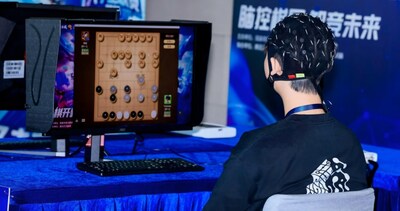
One of the most visible demonstrations took place during a globally livestreamed exhibition at the 2025 National Amateur Chinese Chess Championship (Tencent Tiantian Xiangqi University League). Players wore lightweight EEG headsets and placed chess pieces using brain signals alone—without keyboards, mice, or touchscreens.

This was not a staged demonstration. Participants had no prior BCI training and received only a three-to-five-minute on-site explanation. The match ran for more than 30 minutes under competitive conditions, with stable performance throughout. Observers noted that success in a live tournament carries more weight than lab benchmarks, showing non-invasive BCIs can function immediately in real-world settings.
Chess and Action Games Stress Test Different Limits
Chess and Action Role-Playing Games (ARPGs) place fundamentally different demands on a BCI system.
- Chess tests discrete decision-making, requiring selection from many possible actions.
- Action games test continuous control, demanding rapid, uninterrupted decoding.
INSIDE researchers validated performance at both ends of this spectrum. In ARPG tests, two participants—one with spinocerebellar ataxia and another with muscular dystrophy—controlled all in-game actions using brain signals alone after approximately five minutes of calibration. Neither had prior BCI experience. One participant remarked, “I didn’t expect I could play games using my brain again.”
Reliable performance across both task types indicates general-purpose capability, not task-specific tuning. This versatility, combined with low setup time and minimal training, enables non-invasive BCIs to move beyond narrow medical niches.
Outperforming Invasive Approaches—and What Comes Next
According to INSIDE researchers, the non-invasive system now supports higher level of continuous, multi-dimensional control—degrees of freedom—exceeding those publicly demonstrated for implant-based systems such as Neuralink—without surgery, recovery time, or daily recalibration.
While games and chess matches are not the end goal, they serve as critical proof points for what non-invasive BCIs can support in real-world conditions. As the technology matures, industry analysts anticipate expansion into applications such as assistive control for individuals with mobility impairments; hands-free operation at laboratory workbenches or in surgical and clinical settings; intuitive smart-home interaction, including integration with AR glasses; thought-based text input for users with speech loss; and direct control of robotic and autonomous systems where conventional input methods are impractical.
As hardware becomes lighter and software more standardized, BCIs are beginning to feel less like specialized tools—and more like natural extensions of human interaction.
 View original content to download multimedia:https://www.prnewswire.com/news-releases/brain-signal-based-control-moves-beyond-the-lab-as-inside-institute-demonstrates-real-world-non-invasive-bci-breakthroughs-302652161.html
SOURCE INSIDE Institute for NeuroAI