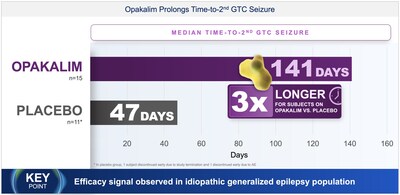
- In a randomized, placebo-controlled, time-to-event trial in idiopathic generalized epilepsy (IGE), the median time to the second day with a generalized tonic-clonic seizure was 141 days in the opakalim 75 mg once-daily treatment group vs. 47 days in the placebo group, representing a 3-fold prolongation.
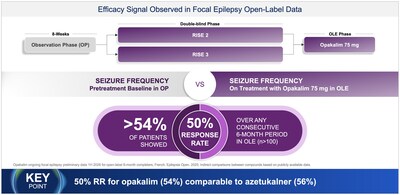
- In an ongoing open-label extension (OLE) study in focal epilepsy, an updated data analysis shows 54% of patients with focal epilepsy on opakalim 75 mg once-daily achieved a ≥50% reduction in seizure frequency over any consecutive six months of open-label treatment compared to pre-randomization baseline.
- A six-month update of opakalim compassionate use treatment in a Kv7-activation dependent patient with KCNQ2-Developmental and Epileptic Encephalopathy (KCNQ2-DEE) confirms clinical stability and ongoing seizure control. Overnight EEG at 6-months demonstrated a 50% reduction in seizure counts relative to pre-opakalim baseline.
- Opakalim has been well-tolerated across all studies (1000+ subjects to date) with a low incidence of adverse events (AEs) comparing favorably with approved and investigational antiseizure medicines.
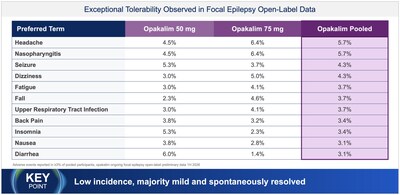
- In the IGE study, the opakalim group reported no cases of somnolence, dizziness, fatigue, or memory impairment; and in the focal epilepsy OLE study, rates of these central nervous system (CNS) AEs were less than or equal to 5% each.
- Opakalim’s tolerability profile is markedly differentiated from that of other investigational Kv7 activators reporting double-digit rates of CNS AEs in OLE studies.
- On track to receive top-line results in 2H 2026 from the first of two pivotal Phase 2/3 randomized, double-blind, placebo-controlled studies in refractory focal epilepsy to support registration.
NEW HAVEN, Conn., May 26, 2026 /PRNewswire/ — Biohaven Ltd. (NYSE: BHVN), a global clinical-stage biopharmaceutical company focused on the discovery, development and commercialization of life-changing therapies to treat a broad range of rare and common diseases, today reported new data from its selective Kv7.2/7.3 channel activator program, currently in Phase 2/3 studies for the treatment of focal epilepsy, and will present additional updates at its annual R&D Day held in conjunction with the Yale Innovation Summit at the Yale School of Management in New Haven, Connecticut on May 27, 2026. Opakalim is distinguished from other investigational Kv7 activators by its selectivity for Kv7.2/7.3 and lack of GABA receptor activity. Opakalim offers potential for easy-to-use, once-daily, orally-administered treatment without the need for titration to control seizures, and without the burdensome central nervous system (CNS) side effects frequently reported with approved and investigational antiseizure medicines (ASMs).
The R&D Day presentation will showcase new and updated clinical data from: 1) a randomized, double-blind, placebo-controlled proof-of-concept study in idiopathic generalized epilepsy (IGE); 2) an ongoing focal epilepsy open-label extension (OLE) study; and 3) a six-month clinical update for a pediatric patient with KCNQ2 Developmental and Epileptic Encephalopathy (KCNQ2-DEE). Together, these emerging data reinforce opakalim’s target engagement, differentiated profile and potential to address the unmet need for novel, effective, and well-tolerated ASMs.
Jason Lerner, M.D., Medical Director, Research & Development and Epilepsy Development Lead at Biohaven, commented, “The opakalim data across IGE, focal epilepsy and KCNQ2-DEE are consistent and compelling. What stands out is not just that opakalim controls seizures — it’s that it does so without the burdensome side effects that compromise quality of life and adherence for people with epilepsy. Dizziness, somnolence, fatigue, and memory impairment are reported in meaningful proportions of patients on existing and investigational ASMs. Opakalim’s zero rates of somnolence, dizziness, fatigue, and memory impairment in our small IGE proof-of-concept study, and single-digit rates of CNS adverse events in our focal epilepsy program suggest that selective Kv7.2/7.3 activation is a fundamentally different and cleaner mechanism. I believe opakalim can offer people with epilepsy real seizure control without asking them to compromise their quality of life.”
Efficacy Signal in Highly Treatment-resistant IGE Population
Biohaven to present results from a randomized, double-blind, placebo-controlled, time-to-event proof-of-concept study evaluating opakalim 75 mg once-daily in subjects with IGE with intractable GTC seizures (NCT06425159). The study’s prespecified primary outcome measure was defined as the time to the second day with a GTC seizure during the 24-week double-blind treatment period. The study enrolled a total of 27 subjects (15 in the opakalim arm and 12 in the placebo arm). Formal statistical testing is not provided, as this proof-of-concept study was closed prior to reaching the study’s prespecified sample size, due to enrollment challenges and strategic portfolio prioritization. The observed efficacy and tolerability signals are consistent with opakalim’s mechanism and broader clinical dataset.
Key Findings:
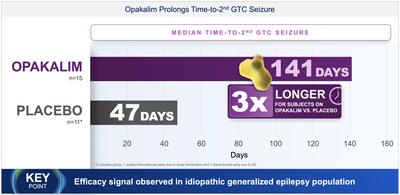
- Median time to second GTC seizure during the 24-week double-blind treatment period: 141 days on opakalim vs. 47 days on placebo, a 3-fold prolongation of time to second seizure event (Figure 1).
- 33% of opakalim-treated subjects completed the 24-week double-blind phase without a second GTC seizure vs. 0% of placebo subjects.
- 20% of opakalim-treated subjects completed the 24-week double-blind phase seizure-free vs. 0% of placebo subjects.
- Opakalim was well-tolerated with remarkably low rates of nervous system adverse events (AEs) including somnolence, dizziness, and fatigue — AEs that collectively occur in more than one-third of patients on competitor investigational Kv7 activator in long-term studies, and at even higher rates with approved ASMs.
Efficacy Signal and Differentiated Safety Profile in Focal Epilepsy OLE
Biohaven to also report updates from its focal epilepsy program, including a recent data analysis from the ongoing open-label extension study of opakalim in subjects with refractory focal epilepsy (NCT06443463). As of 1H 2026, the double-blind study completion rates were 95%; and rollover rates in the optional open-label extension were 95%, reflecting subject and investigator confidence in opakalim.
Key Findings:
- In the opakalim 75 mg once-daily, six-month completers cohort (n>100), 54% of subjects achieved a ≥50% reduction in seizure frequency over any consecutive six months of OLE treatment compared to pretreatment baseline prior to randomization (Figure 2). This result is on par with the ≥50% responder rate reported for the investigational Kv7 activator azetukalner (56%), but opakalim achieves this comparable level of seizure control with a substantially lower burden of CNS AEs, including markedly lower rates of dizziness, somnolence, fatigue, and memory impairment.
- The AE profile was favorable and consistent with prior data, with a markedly lower incidence of AEs compared to approved and investigational ASMs (Figure 3). For example, in opakalim-treated subjects (75 mg), dizziness was reported in only 5.0% of subjects. By contrast, published long-term data from a competitor’s Kv7 activator shows its open-label extension study reported dizziness in 25%, somnolence in 17%, memory impairment in 11%, and falls in 15% of subjects. These data suggest opakalim’s selective Kv7.2/7.3 activation without GABA effects may translate into a meaningfully cleaner CNS tolerability profile than other ASMs.
Clinical Stability and Ongoing Seizure Control in Kv7-Dependent KCNQ2-DEE Patient
Biohaven to further provide a six-month update for the 9 year-old boy with refractory epilepsy due to KCNQ2-DEE being treated with compassionate use opakalim. The patient had a history of daily tonic seizures despite three concurrent ASMs, including a first-generation Kv7 activator, with prior attempts to taper first-generation Kv7 resulting in status epilepticus, ICU admission, and developmental regression. Following compassionate use authorization under a single-patient IND approved by the FDA, he was transitioned to opakalim at exposures calibrated to match the 75 mg dose being studied in the pivotal focal epilepsy trials.
Key Finding:
- Now at the six-month mark, the patient remains clinically stable. Overnight EEG at six-months demonstrated a 50% reduction in seizure counts relative to pre-opakalim baseline. Opakalim has been well-tolerated over the six-month treatment period.
Biohaven is on track to announce in 2H 2026 top-line results from the first of two pivotal Phase 2/3 randomized, double-blind, placebo-controlled studies in refractory focal epilepsy to support registration.
About Opakalim
Opakalim (BHV-7000) is Biohaven’s next-generation, selective Kv7.2/7.3 potassium channel activator that targets a clinically validated mechanism of action for the treatment of epilepsy. Opakalim is differentiated from both first- and second-generation Kv7 activators by its selectivity: it preferentially activates the Kv7.2/7.3 heteromeric channels that are the predominant regulators of neuronal excitability, with substantially less activity at GABA receptors. This selectivity profile is hypothesized to underlie opakalim’s favorable tolerability, including the low rates of somnolence, dizziness, and fatigue observed in clinical studies to date. Opakalim has been studied in more than 1,000 subjects across multiple clinical trials, consistently demonstrating a favorable tolerability profile. Biohaven is currently conducting two Phase 2/3 randomized, double-blind, placebo-controlled studies (NCT06132893 and NCT06309966) comparing the efficacy of opakalim to placebo as an adjunctive therapy for refractory focal onset epilepsy, as well as an open-label extension study (NCT06443463) to evaluate the long-term efficacy and safety of opakalim.
About Biohaven
Biohaven is a biopharmaceutical company focused on the discovery, development, and commercialization of life-changing treatments in key therapeutic areas, including immunology, neuroscience, and oncology. Biohaven is advancing its innovative portfolio of therapeutics, leveraging its proven drug development experience and multiple proprietary drug development platforms. Biohaven’s extensive clinical and preclinical programs include Kv7 ion channel modulation for epilepsy; MoDE™ and TRAP™ extracellular protein degradation for immunological diseases; and myostatin inhibition for neuromuscular and metabolic diseases, including obesity. For more information, visit www.biohavenpharma.com.
Forward-Looking Statements
This news release includes forward-looking statements within the meaning of the Private Securities Litigation Reform Act of 1995. The use of certain words, including “continue”, “plan”, “will”, “believe”, “may”, “expect”, “potentially”, “groundbreaking” and similar expressions, is intended to identify forward-looking statements. Investors are cautioned that any forward-looking statements, including statements regarding the future development, timing and potential marketing approval and commercialization of development candidates, are not guarantees of future performance or results and involve substantial risks and uncertainties. Actual results, developments and events may differ materially from those in the forward-looking statements as a result of various factors including: the expected timing, commencement and outcomes of Biohaven’s planned and ongoing clinical trials, including the studies of opakalim; the timing of planned interactions and filings with the FDA; the timing and outcome of expected regulatory filings; complying with applicable US regulatory requirements; the potential commercialization of Biohaven’s product candidates; and the effectiveness and safety of Biohaven’s product candidates. Additional important factors to be considered in connection with forward-looking statements are described in Biohaven’s filings with the Securities and Exchange Commission, including within the sections titled “Risk Factors” and “Management’s Discussion and Analysis of Financial Condition and Results of Operations”. The forward-looking statements are made as of the date of this news release, and Biohaven does not undertake any obligation to update any forward-looking statements, whether as a result of new information, future events or otherwise, except as required by law.
MoDE and TRAP are trademarks of Biohaven Therapeutics Ltd.
Investor Contact:
Jennifer Porcelli
Vice President, Investor Relations
[email protected]
+1 (201) 248-0741
Media Contact:
Mike Beyer
Sam Brown Inc.
[email protected]
+1 (312) 961-2502

 View original content to download multimedia:https://www.prnewswire.com/news-releases/biohaven-reports-new-clinical-data-in-epilepsy-with-opakalim-a-selective-kv7-27-3-activator-highlighting-seizure-control-and-markedly-differentiated-tolerability-profile-302781743.html
SOURCE Biohaven Ltd.