In the rapidly evolving landscape of artificial intelligence, the race to build autonomous robots has often felt like a spectacle of hardware. Viral videos of robots doing backflips or running marathons dominate social media, showcasing impressive motor control. Yet, beneath the polished veneer of these demos lies a persistent industry bottleneck: the “Babel Tower” of embodied AI. While hardware bodies are multiplying at an unprecedented rate, the cognitive “brains” required to operate them remain fragmented, expensive to train, and difficult to scale.
Over the past few days, Ant Group’s embodied AI arm, Robbyant, has attempted to dismantle this bottleneck with a massive, coordinated open-source release. By unveiling a comprehensive suite of models—including LingBot-Depth 2.0, LingBot-Vision, LingBot-VLA 2.0, LingBot-World 2.0, LingBot-Video, and LingBot-VA 2.0—Robbyant is making a bold architectural argument: the next generation of embodied intelligence will not only be defined by better hardware, but also by a standardized, open-source embodied AI infrastructure.
The Fallacy of Hardware-Centric Scaling
To understand the significance of this release, one must first recognize the fundamental flaw in the current robotics paradigm. Every new robot brand and hardware configuration typically requires its own control system and bespoke algorithmic adaptation. This “one brain, one body” approach creates an unsustainable scaling problem. As the industry pushes toward commercial deployment, the cost of repeatedly adapting models for different morphologies becomes prohibitive.
Robbyant’s latest release directly targets this deficit. At the center of this strategy is LingBot-VLA 2.0 (Vision-Language-Action), designed explicitly as a “universal brain.” Trained on a staggering 60,000 hours of high-quality physical world data spanning 20 distinct robot configurations, VLA 2.0 proves that a single foundational model can achieve cross-morphology generalization. Whether deployed on a dual-arm manipulator, a mobile chassis, or a humanoid, the model maintains high task success rates without requiring exhaustive retraining. This shifts the industry’s focus from hardware optimization to cognitive generalization.
Solving the Perception-Action Loop
A universal brain, however, is useless if it cannot accurately perceive its environment or safely practice its actions. Robbyant’s simultaneous release of foundational vision and simulation models completes this cognitive loop.
Historically, robots have struggled with spatial intelligence, particularly when navigating transparent, reflective, or complex surfaces. LingBot-Depth 2.0, powered by the newly open-sourced LingBot-Vision foundation model, addresses this sensory blind spot. By utilizing advanced mask-based depth modeling, it achieves state-of-the-art accuracy in reconstructing 3D space, effectively giving the “universal brain” a pair of reliable eyes.
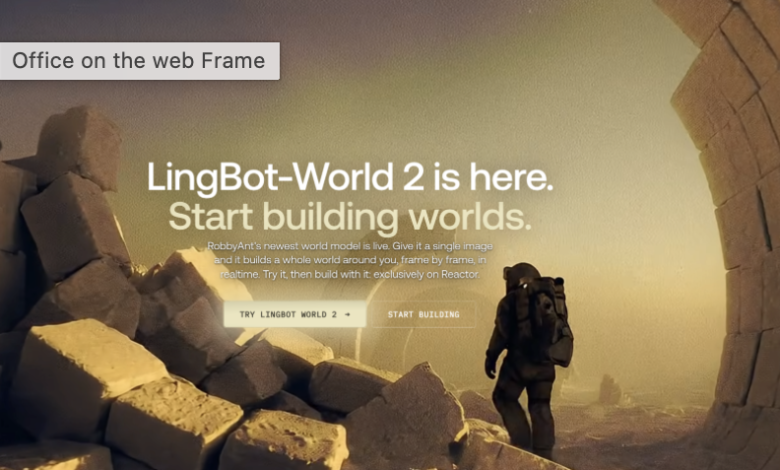
Equally critical is the challenge of safe, scalable learning. Real-world trial and error is too expensive and dangerous for mass deployment. Enter LingBot-World 2.0 and LingBot-Video. Moving beyond simple video generation, these models serve as high-fidelity, physics-compliant digital twins. World 2.0’s ability to sustain hour-long, interactive simulations without “long-horizon drift” provides an infinite, zero-risk training ground. Meanwhile, Video’s MoE architecture ensures that the generated training data adheres to strict physical plausibility, bridging the notorious “Sim-to-Real” gap.
The Capstone: Natively Embodied Execution
While individual components are critical, the true test of an AI system is how well it can see, think, and act all at once. Serving as the capstone of this launch week, LingBot-VA 2.0 brings all these abilities together. Rather than just tweaking an existing video generator, this model was built from the ground up specifically to handle the real physical world.
This embodied native design allows robots to think ahead and react in real time with incredible speed. By understanding how an action will change the environment, the model makes causal predictions to decide its next step. In testing, it proved to be highly reliable, successfully completing complex two-handed tasks over 93% of the time, even when the environment changed unexpectedly. More importantly, it makes teaching robots new skills drastically easier. Instead of requiring weeks of retraining, the model can learn a brand-new task just by watching a reference video and 20 quick demonstrations. This marks a massive leap forward, allowing robots to instantly adapt to new jobs right out of the box.
The Open-Source Play
Perhaps the most impressive aspect of this multi-model release is Robbyant’s commitment to open-source infrastructure. Rather than guarding these capabilities as proprietary assets, Robbyant is offering them as a public utility for the robotics ecosystem.
By open-sourcing the stack—from the foundational vision (LingBot-Vision), to the decision-making core (LingBot-VLA 2.0), and the environmental simulator (LingBot-World 2.0 & LingBot-Video)—Robbyant is effectively providing the industry with a standardized operating system for physical AI. This mirrors the early days of cloud computing or open-source LLMs, where the democratization of foundational infrastructure catalyzed rapid, decentralized innovation.
The era of isolated robotics demos is drawing to a close. The next phase of embodied AI requires models that can see accurately, think universally, and practice safely in the infinite world. With this comprehensive open-source release, Robbyant has laid out a definitive blueprint for the embodied AI brain. The question for the industry is no longer whether a universal robot brain is possible, but how quickly the ecosystem can build upon this newly opened foundation.