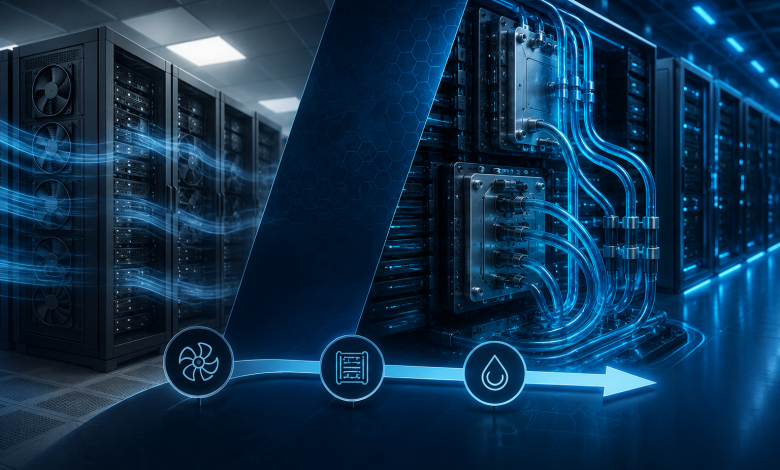
2026 signifies a pivotal turning point for data center infrastructure with an upsurge in rack density driven by AI accelerators. Rack densities of about 120kW driven by AI accelerators exceeding 700 to 1000W per socket; the industry is facing challenges due to limitations of air cooling.
A traditional cooling system is incapable of sustaining huge loads without triggering the issue of CPU throttling. Hence, the thermal wall, which represents high-capacity liquid cooling solutions, is a reality in the present times. Liquid cooling solutions manage the heat density of data centers, thereby alleviating the air cooling limitations.
It defines performance outcomes. Systems developed for peak compute have diverged into suboptimal operation due to thermal headroom constraints, thereby directly affecting inference latency and ROI.
The macroeconomic effects fortify the urgency where the capacity of global data centers is anticipated to double by 2030.
“AI will represent 50% of data center capacity by 2030, requiring an $11 trillion infrastructure shift.” Pinkesh Shah, Industry Leader, C&M/Energy.
Such shifts require an entire restructuring of thermal management as a core infrastructure tactic, not a facilities afterthought. The blog explores and evaluates the need for liquid cooling in AI clusters, the technology landscape, and the strategic roadmap for deployment.
Why Liquid Cooling for AI Clusters?
Air cooling hits its limit at about 25 kW per rack, as beyond this point, excessive airflow is needed for maintaining stable temperatures. The consequences tend to vary from a decline in efficiency to high operational complexities. Further, financial and technical implications like energy inefficiency, increased CapEx, and performance inconsistency across AI workloads also affect.
Cooling systems take up ~40% of data center energy use, eventually increasing OpEx. Further, an AI ecosystem that does not support peak performance adversely affects the competitive positioning and ROI of business organizations. The need for the liquid cooling system is apparent for decision-makers as inefficiencies of a cooling system have a direct impact on revenue leakage.
To sum up, liquid cooling is needed to eradicate the constraints of traditional cooling to ensure the performance stability of data centers. Also, as a result of heat elimination from high-power elements, liquid cooling facilitates high-compute density and helps with energy saving.
Technology Landscape of Liquid Cooling System
-
Direct-to-Chip (DTC)
DTC cooling is a vital solution for existing facilities in 2026. When CPUs/GPUs are linked to cold plates, the DTC system eliminates ~70% of the heat at the source. This approach facilitates modular scalability for systematic implementation, minimizes damage to existing infrastructure, and enables the deployment of high-density racks in legacy setups.
Though auxiliary airflow is needed for memory and storage, it is a viable and effective way for organizations striving for instant performance gains without a complete redesign.
-
Immersion Cooling
It is the end-state tech architecture for next-gen data centers. It attains near-total heat capture with Power Usage Effectiveness (PUE) as low as ~1.05 through submerging of entire servers in dielectric fluid. Immersion is most appropriate for high-density AI clusters surpassing 150kW per rack. However, there is a need for significant initial investment with limited adaptability for existing setups.
Core features and benefits include around 60% decrease in the use of cooling energy, maximum uniform cooling, and thermal efficacy. Additionally, it eradicates airflow limitations.
-
Rear Door Heat Exchangers
They are mainly liquid-cooling doors that mitigate heat at the source. RDHx systems acquire and cool exhaust air prior to its entry into data centers, and they have a cooling distribution unit along with liquid-to-air heat exchanger coils.
It is a strategic pathway for organizations unable to fully adopt liquid cooling. RDHx helps in enhancing performance in legacy facilities while decreasing thermal load on room-level cooling systems.
The Strategic Roadmap for Liquid Cooling Adoption for AI Clusters
Organizations unable to ensure proper alignment between tenets of technology, sustainability, and operations in the absence of a well-devised roadmap encounter complexities in effective liquid cooling integration in AI clusters.
Some of the crucial steps that organizations must consider are:
1. R&D and Material Audit
Liquid cooling involves materials science-related risks because, unlike an air cooling system, this architecture needs adequate validation of component compatibility. Coolant aging, galvanic corrosion, and elastomer degradation pose a challenge in the implementation of liquid cooling.
Companies opting for an in-depth material audit aligned with the ASHRAE liquid cooling manual benefit from the mitigation of material science risks.
2. Sustainability and Circularity
Cooling strategy is closely linked to corporate sustainability outcomes. Its sustainability benefits include decreased energy use by up to 60% and reduced waste disposal. The liquid cooling industry is forecasted to grow up to ~$18.7 billion by 2031, signifying economic incentives and regulatory burden.
Bio-based dielectric fluids and low global warming potential (GWP) fluids help align sustainability measures and thermal management with respect to next-gen innovation. Thus, sustainability principles need to be at the center of a strategic pathway.
3. Strategic Partner Scouting
When it comes to deploying a liquid cooling system, success depends on choosing the right co-man with adequate expertise. Institutions looking for suitable partners should take into consideration vendor interoperability. It is also vital to validate the reliability of potential partners in high-density environments and look for capabilities to ensure scalable deployment.
Through partner scouting, organizations can actively recognize established players or startups accelerating innovation in areas of advanced thermal materials or microfluidic cooling. Strategic partner scouting services of Stellarix offer adequate support to companies in finding the right co-man through proper benchmarking.
Bottomline
The shift to liquid cooling is now central to the operational and business frameworks of future-ready data centers. With the continued scaling of AI infrastructure, thermal management would set the upper bound on compute performance.
A proper roadmap is required for embracing the liquid cooling system and harnessing its benefits, where key requisites are AI-driven thermal management and hybrid readiness. Organizations embracing modular, ESG-compliant cooling strategies and standards-compliant tactics will be best positioned to lead in sustainable performance and tech innovation.
Chemicals and materials consultants at Stellarix support businesses through its strategic partner scouting and R&D services to enhance their innovation pipelines and to help set a proper roadmap for technology adoption by finding the right partners. By aligning technology adoption with R&D diligence, partner ecosystems, and sustainability efforts, enterprises can transform thermal limitations into a competitive advantage.