



Key Findings
- Jama Connect – Best overall and excellent for live traceability in regulated product development, risk, test management, and AI-Native capabilities, software-heavy regulated development, and integrated FMEA
- Visure Solutions – Best for integrated FMEA and strict process compliance
- Codebeamer (PTC) – Best for combined ALM and DevOps workflows
- IBM DOORS – Best for large defense programs with existing installations
- Polarion (Siemens) – Best for software-heavy regulated development with continuous workflows
- Valispace (Altium) – Best for requirements-to-design linkage
- Helix ALM (Perforce) – Best for unified RM, test, and issue tracking
What separates requirements traceability software that reduces real risk from software that just generates compliance paperwork? It’s a question worth asking before you commit to a platform, because the wrong answer costs more than a bad license fee. It costs you failed audits, rework cycles, and defects that should’ve been caught months earlier.
Most teams don’t start looking for traceability software because they want it. They start looking because something went wrong: a regulatory submission got kicked back, a requirements change broke three test cases nobody flagged, or a design review surfaced gaps that spreadsheets couldn’t catch. The trigger is almost always pain, and the goal is prevention.
I’ve spent time evaluating these platforms across medical device, aerospace, and automotive contexts. What follows are my top picks, along with the specific features, strengths, and limitations that matter most when your traceability needs to hold up under regulatory scrutiny.
Why Trust These Reviews
I’ve evaluated requirements management and traceability platforms across regulated industries for engineering teams building safety-critical products. The criteria below reflect real evaluation factors: compliance depth, integration flexibility, usability for non-technical stakeholders, and whether the platform can sustain traceability as product complexity grows. Every tool on this list was assessed against published documentation, verified user reviews on G2 and peer review sites, and feature comparisons across standards like DO-178C, ISO 26262, and ISO 14971.
| Tool | Best For | Pricing
|
|
|---|---|---|---|
| 1 | Jama Connect | Live traceability in regulated product development | Pricing upon request |
| 2 | Visure Solutions | Integrated FMEA and risk analysis | Pricing upon request |
| 3 | Codebeamer (PTC) | Combined ALM and DevOps workflows | Pricing upon request |
| 4 | IBM DOORS | Large defense programs with existing installations | Pricing upon request |
| 5 | Polarion (Siemens) | Teams embedded in the Siemens ecosystem | Pricing upon request |
| 6 | Valispace (Altium) | Requirements-to-design linkage | Pricing upon request |
| 7 | Helix ALM (Perforce) | Unified RM, test, and issue tracking | Pricing upon request |
1. Jama Connect
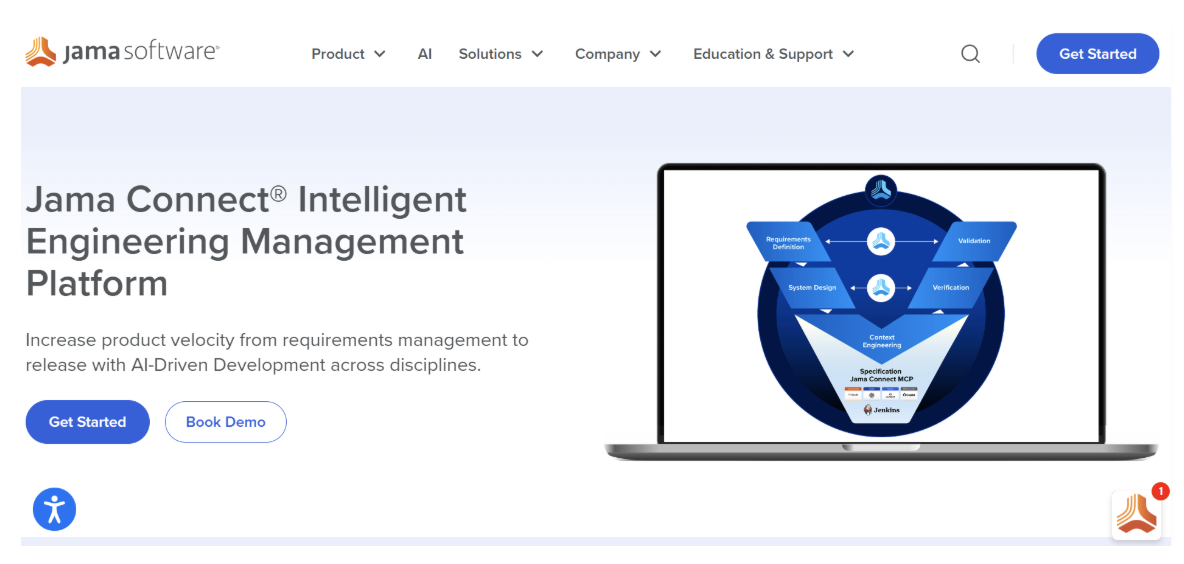
Jama Connect offers enterprise-grade requirements management and a Live Traceability platform built for organizations developing complex, safety-critical products. The platform is widely used across aerospace, automotive, medical device, semiconductor, and defense industries where engineering teams need end-to-end visibility between requirements, validation activities, risks, and downstream design decisions. Jama Connect is consistently recognized as a leader in the requirements management category and supports some of the largest regulated engineering environments in the world.
Why I Picked Jama Connect
I picked Jama Connect because it treats traceability as an active engineering discipline rather than a static documentation exercise. Many platforms can generate requirement links, but Jama Connect continuously evaluates the health and completeness of those relationships across requirements, tests, defects, and risk items. Teams can monitor coverage in real time instead of relying on spreadsheets and manually updated matrices before audits.
Jama Connect Advisor also stands out because it extends traceability into the authoring process itself. The platform uses NLP-based analysis aligned with INCOSE guidance and EARS notation to identify unclear, incomplete, or inconsistent requirements before they move into downstream engineering workflows. Jama Connect Advisor also introduces AI-assisted requirements refinement, automated test case generation, intelligent document parsing, and MCP server-enabled workflows designed to accelerate validation without sacrificing compliance visibility.
Scalability is another major differentiator. Jama Connect supports engineering environments managing hundreds of millions of interconnected artifacts across globally distributed teams working on hardware, embedded software, systems engineering, supplier collaboration, and regulatory validation simultaneously.
Security also plays a major role in Jama Connect’s positioning, especially within automotive, aerospace, and defense programs. AWS GovCloud support, on-premises deployment options, SOC 2 Type 2 certification, and TISAX compliance help organizations meet strict security, infrastructure, and governance requirements for highly regulated development environments.
Jama Connect Key Features
Several capabilities make Jama Connect stand out for engineering teams evaluating requirements management and traceability platforms:
-
- Live Traceability with Trace Scores: Continuous measurement of traceability completeness across requirements, tests, defects, and risk items. Coverage gaps surface automatically as development changes occur.
- Traceability Information Models (TIMs): Pre-configured relationship frameworks aligned with standards such as DO-178C, ISO 26262, ISO 14971, IEC 61508, and IEC 62304.
- Jama Connect Advisor: AI-assisted requirement analysis using NLP aligned with INCOSE guidance and EARS notation. Includes requirements refinement, automated test case generation, intelligent document parsing, and MCP server-enabled workflows.
- Review Center: Centralized review, approval, stakeholder collaboration, and electronic signature workflows with unlimited reviewer participation.
- Risk and Hazard Analysis: Built-in support for FMEA, hazard tracking, and safety-focused engineering processes within regulated industries.
- Enterprise Scalability and Security: Supports large-scale engineering programs, distributed supplier collaboration, AWS GovCloud deployments, on-premises environments, and security-sensitive development initiatives.
- Established Market Leader: Proven track record, generating $200-250M in revenue
Jama Connect Integrations
Integrations include Jira, Azure DevOps, Windchill, Teamcenter, Enterprise Architect, Rhapsody, MagicDraw, MATLAB/Simulink, GitHub, GitLab, Jenkins, Slack, Confluence, ReqIF ecosystems, and a REST API for custom enterprise integrations.
Pros and Cons
Pros:
- Real-time traceability visibility helps teams identify coverage gaps before audits and validation reviews
- Strong AI-assisted engineering capabilities through Jama Connect Advisor, including requirements refinement and automated test generation
- Exceptional scalability for large multidisciplinary engineering environments
- Strong security and compliance positioning for automotive, aerospace, and defense organizations
- Broad integration ecosystem supports parallel development across siloed engineering teams
Cons:
- Pricing requires direct engagement with the sales team rather than public website estimates
2. IBM DOORS
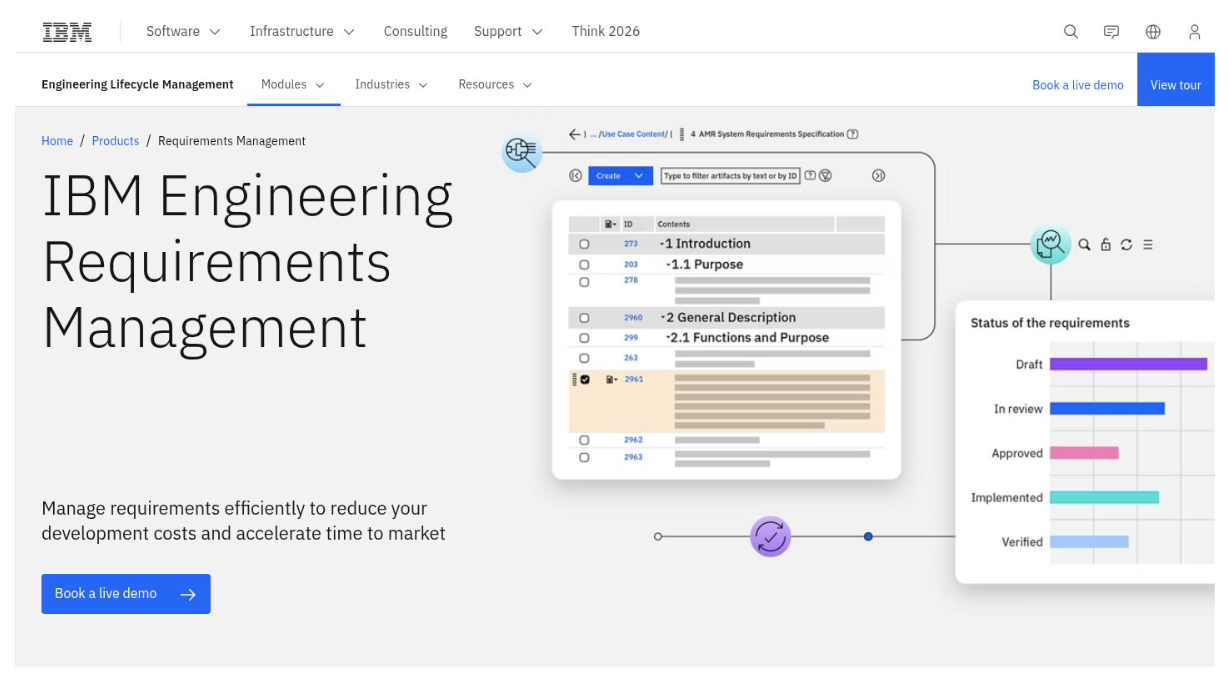
IBM Engineering Requirements Management DOORS has been the enterprise incumbent in requirements management for decades. DOORS Classic sits in thousands of defense organizations worldwide, while DOORS Next (DNG) is IBM’s web-based successor positioned within the IBM Engineering Lifecycle Management (ELM) suite.
Why I Picked IBM DOORS
I picked IBM DOORS because its deep feature set and enormous installed base make it a platform teams encounter whether they choose it or not. If you’re working on a defense program with contractual requirements specifying DOORS, or inheriting an existing DOORS environment, understanding its capabilities and limitations is essential. The requirements management feature set has been refined over decades, and the ELM suite provides a broader engineering lifecycle context.
IBM DOORS Key Features
Features relevant to traceability:
- Requirements management: Mature RM capabilities refined over decades of enterprise use.
- Traceability and change management: Bidirectional linking with change tracking across the requirements hierarchy.
- OSLC-based integration: Open Services for Lifecycle Collaboration standard for connecting with other engineering tools.
- ELM suite context: Part of IBM’s broader engineering lifecycle platform including design, test, and workflow management.
IBM DOORS Integrations
Integrations include the IBM ELM suite (Rhapsody, Engineering Test Management, Engineering Workflow Management) and OSLC-compatible tools.
Pros and Cons
Pros:
- Massive installed base with decades of enterprise requirements management refinement
- Deep feature set for complex requirements hierarchies and large-scale programs
- IBM brand and support infrastructure for enterprise deployments
Cons:
- DOORS Classic operates as a desktop application. Remote and distributed teams hit friction without web access.
- DOORS Next shares the brand name but runs on a separate codebase. Organizations face a rebuild, not an upgrade, to move between them.
- G2 reviewers flag the Classic UI, administration overhead, and deployment process as the top frustrations.
- Testing isn’t native and users will need to purchase a different tool for that.
3. Polarion (Siemens)
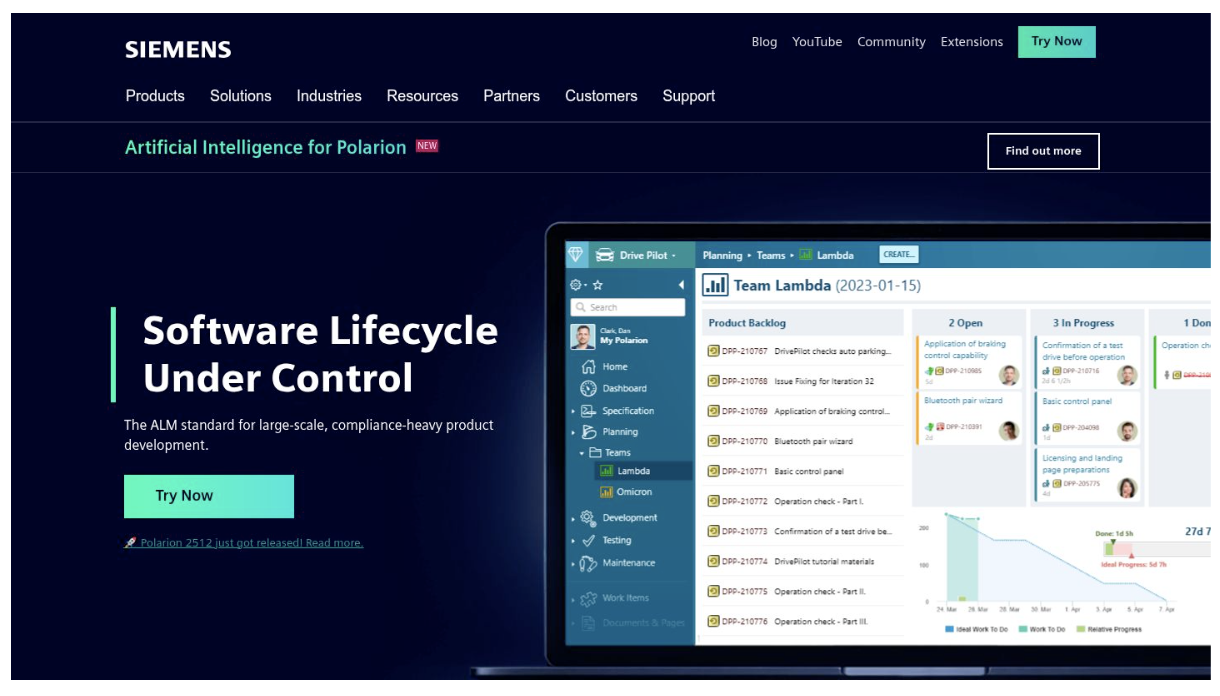
Polarion is Siemens Digital Industries Software’s ALM and requirements management platform. It positions itself as the ALM standard for large-scale, compliance-heavy product development, with deep ties to the broader Siemens PLM ecosystem including Teamcenter and NX.
Why I Picked Polarion
I picked Polarion because for organizations that have already committed to the Siemens ecosystem, it provides ALM-PLM integration that no other platform matches. Its variant configurator handles product line engineering, and recent releases have added AI and cybersecurity modules. If your engineering workflow runs through Teamcenter and NX, Polarion connects requirements management to that infrastructure without third-party middleware.
Polarion Key Features
Features relevant to traceability evaluation:
- ALM-PLM integration: Native connection to Siemens Teamcenter and NX for organizations running Siemens tools.
- Variant configurator: Product line engineering support for managing multiple product configurations.
- SAFe support: Enterprise agile planning capabilities for scaled development programs.
- New AI modules: AI and cybersecurity capabilities released in recent months as part of the Polarion X product line.
Polarion Integrations
Integrations are strongest within the Siemens ecosystem (Teamcenter, NX, Mentor). Integration with non-Siemens tools, Jira and third-party modeling tools in particular, is a persistent challenge.
Pros and Cons
Pros:
- Deep ALM-PLM integration with the Siemens ecosystem sets the bar if you’re already running Teamcenter and NX
- Variant configurator handles product line engineering requirements well
- Recent AI and cybersecurity modules show active product investment
Cons:
- Vendor lock-in is a risk, especially with better tools like Jama Connect in the market
- The interface takes weeks to learn. Stakeholders outside engineering often resist using it at all.
- Teams running Jira, Sparx EA, or non-Siemens PLM systems hit integration walls that Siemens-native workflows avoid.
- G2 reviews place Polarion behind most competing RM platforms for overall user satisfaction.
4. Valispace (Altium)
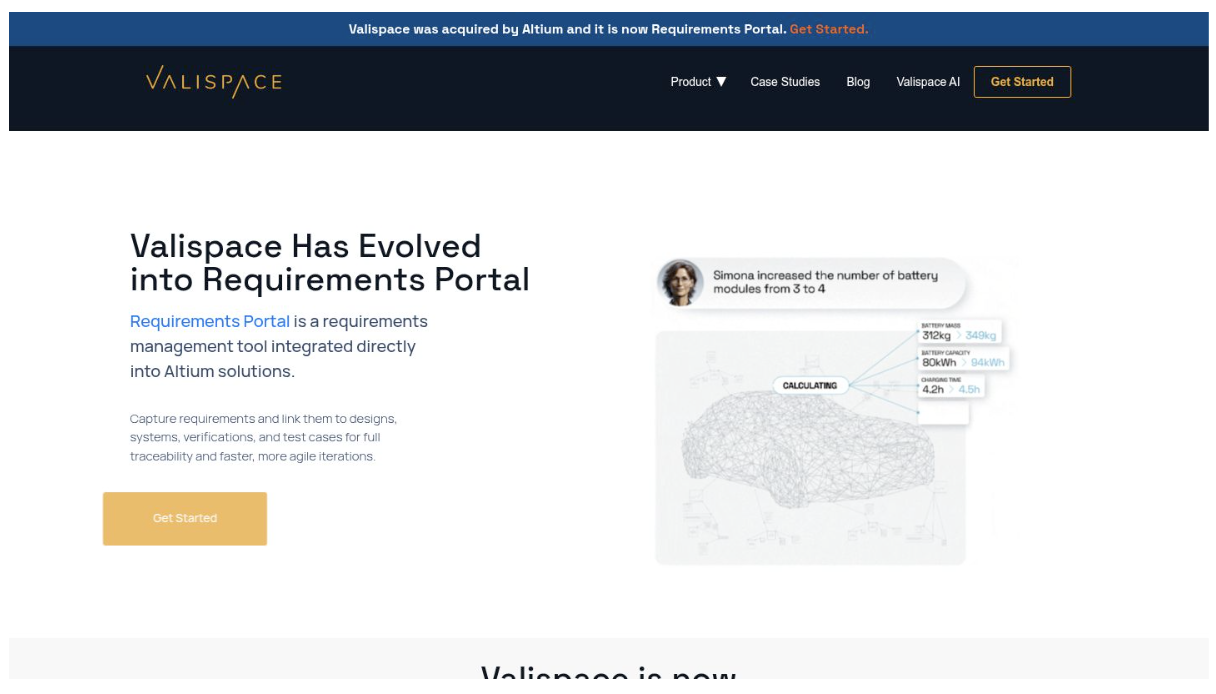
Valispace, now part of Altium and rebranded as Requirements Portal, integrates requirements management into the Altium ECAD and systems design ecosystem. It connects requirements to design parameters, enabling engineers to trace from stakeholder needs through to specific design values and verification results.
Why I Picked Valispace
I picked Valispace for its distinctive approach to requirements-to-design linkage. Most traceability tools connect requirements to test cases and risk items; Valispace connects requirements to engineering design parameters. For hardware-heavy development where requirements must trace to specific electrical, mechanical, or systems design values, this fills a gap that traditional RM platforms leave open. Setup is fast, with the company claiming a functional environment in as little as ten minutes.
Valispace Key Features
Features relevant to traceability:
- Requirements-to-design linkage: Traces requirements to engineering design parameters and calculations.
- Verification management: Connects requirements to verification results with status tracking.
- AI-assisted engineering: AI capabilities for requirements analysis and design optimization.
- Rapid deployment: Claims functional setup in about ten minutes.
Valispace Integrations
Integrations include the Altium ECAD platform and export capabilities for requirements documents. The integration ecosystem is narrower than enterprise RM platforms.
Pros and Cons
Pros:
- Requirements-to-design parameter linkage fills a gap that traditional RM tools leave open
- Fast setup and onboarding compared to enterprise ALM platforms
- Useful for hardware engineering teams that need design-level traceability
Cons:
- Now part of the Altium ecosystem, which may limit appeal for teams not using Altium tools
- Smaller market presence and less mature enterprise scalability than dedicated RM platforms
- Still transitioning brand identity following the Altium acquisition
5. Helix ALM (Perforce)
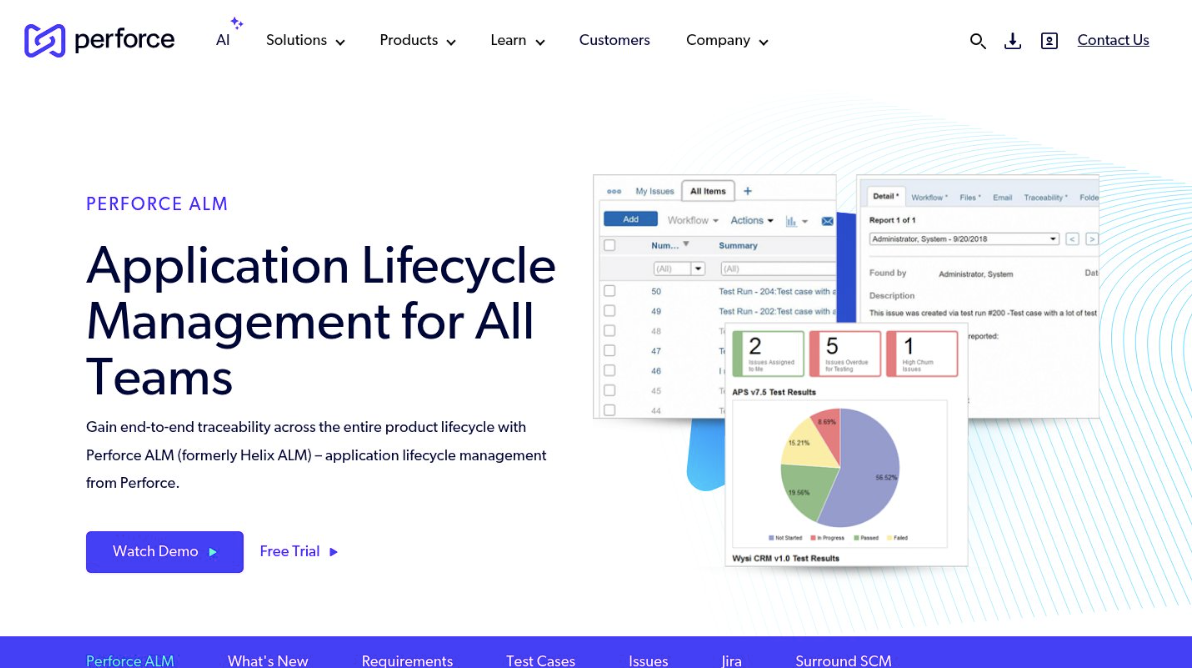
Helix ALM from Perforce combines requirements management, test case management, and issue tracking in a single platform. It offers traceability across all three disciplines and configurable workflows for teams that want a unified environment without enterprise ALM complexity.
Why I Picked Helix ALM
I picked Helix ALM for smaller teams or mid-size organizations that need requirements, test, and issue tracking connected through traceability without the overhead of a full enterprise ALM deployment. Perforce’s reputation in version control (Helix Core) lends engineering credibility, and the combined RM-test-issue architecture means teams can establish traceability links without juggling multiple vendor integrations. It’s a practical option for organizations that don’t need the compliance framework depth of dedicated RM platforms but still want traceability beyond what spreadsheets or Jira can provide.
Helix ALM Key Features
Features relevant to traceability:
- Combined RM, test, and issue tracking: All three disciplines with traceability links in a single installation.
- Configurable workflows: Customizable processes for different team structures and development methodologies.
- Reporting and analytics: Built-in reporting on requirements coverage, test results, and defect trends.
- Perforce ecosystem: Connects to Helix Core version control for source-to-requirement traceability.
Helix ALM Integrations
Integrations include Helix Core (version control), Jira, and Jenkins. The integration ecosystem is more limited than larger RM vendors.
Pros and Cons
Pros:
- Combines RM, test, and issue tracking with traceability in a single platform without enterprise ALM overhead
- Configurable workflows adapt to different team sizes and methodologies
- Perforce brand brings credibility from the version control space
Cons:
- Lacks the industry-specific compliance frameworks, AI-powered analysis, and live traceability scoring offered by dedicated RM platforms
- Lower market visibility in the RM category means fewer community resources, case studies, and peer references
- Less suited for large, multi-discipline programs requiring deep regulatory compliance
6. Visure Solutions
Visure Solutions offers a full-lifecycle requirements ALM platform that integrates risk analysis, test management, and change impact analysis alongside core requirements management. It positions itself as an all-in-one solution for teams that want requirements, risk, and testing in a single environment.
Why I Picked Visure Solutions
I picked Visure because it brings FMEA and risk analysis tools into the requirements workflow rather than treating them as separate modules. For teams in medical device or automotive development where risk traceability is inseparable from requirements traceability, having those capabilities in a single platform removes a significant integration burden. Visure also supports ReqIF import and export, which simplifies requirements exchange across supply chains where multiple vendors need to share and synchronize artifacts.
Visure Key Features
Features that support traceability evaluation include:
- Integrated FMEA/risk analysis: Built-in failure mode analysis connected to requirements and test artifacts.
- Change impact analysis: Traces proposed changes through affected downstream artifacts before approval.
- ReqIF support: Standards-based requirements exchange for multi-vendor supply chains.
- Compliance templates: Pre-configured frameworks for aerospace, automotive, medical device, and railway industries.
Visure Integrations
Integrations include Jira, IBM DOORS (for migration), MATLAB/Simulink, and Microsoft Office. ReqIF compatibility supports interoperability with other RM tools.
Pros and Cons
Pros:
- Integrated FMEA capabilities reduce the need for separate risk management tools
- Strong compliance template coverage across multiple regulated industries
- ReqIF support simplifies multi-vendor requirements exchange
Cons:
- Smaller company with a more limited integration ecosystem and partner network than larger vendors
- Enterprise scalability for very large programs with tens of thousands of requirements across global teams can be a consideration
7. Codebeamer (PTC)
Codebeamer is PTC’s Application Lifecycle Management platform that combines requirements management with development workflows, QA, risk management, and variant management. Built by Intland Software before PTC’s 2022 acquisition, it’s positioned as a full ALM covering requirements through DevOps in a single platform.
Why I Picked Codebeamer
I picked Codebeamer for teams that want requirements traceability embedded within a broader ALM context, in automotive software development. Its variant management capabilities address a real gap for teams managing product line engineering across multiple vehicle configurations. The platform includes industry templates for ASPICE, ISO 26262, and IEC 62304, and its built-in CI/CD integration connects development workflow data to requirements and test artifacts.
Codebeamer Key Features
Features relevant to traceability evaluation:
- Full ALM coverage: Requirements, development, QA, and risk management in one platform with built-in CI/CD integration.
- Variant management: Product line engineering support for managing multiple product configurations and their requirements.
- Industry templates: Pre-built compliance frameworks for automotive (ASPICE, ISO 26262), medical (IEC 62304), and aviation standards.
- DevOps integration: Connects development activity to requirements artifacts for end-to-end traceability.
Codebeamer Integrations
Integrations include Jira, Jenkins, Git repositories, and PTC’s Windchill PLM. Connectivity with modeling tools like Cameo and Sparx Enterprise Architect is limited compared to some competitors.
Pros and Cons
Pros:
- Full ALM approach means teams can trace from requirements through code, test, and deployment in one tool
- Strong automotive presence with ASPICE and ISO 26262 template support
- Variant management is a genuine differentiator for product line engineering
Cons:
- Significant functional overlap with Jira creates friction for teams already using Atlassian tools
- Software-centric heritage means less maturity for hardware and systems engineering traceability
- Single-tenant cloud deployments only
Selection Criteria
When selecting the best requirements traceability software to include in this list, I considered common buyer needs and pain points like maintaining audit-ready traceability, managing change impact across complex products, and satisfying regulatory requirements. I also used the following framework to keep the evaluation structured and fair:
Core Functionality (25% of total weighting) To be considered for inclusion, each solution had to fulfill these baseline capabilities:
- Bidirectional requirements traceability (upstream and downstream)
- Coverage analysis showing which requirements have test coverage and where gaps exist
- Change impact analysis tracing proposed changes through affected artifacts
- Review and approval workflows with audit trails
- Support for at least one major regulatory standard (DO-178C, ISO 26262, ISO 14971, or similar)
Traceability Depth and Compliance (25% of total weighting) I looked for differentiation in traceability sophistication:
- Real-time or live traceability versus static link management
- Industry-specific compliance frameworks rather than generic templates
- Quantitative traceability metrics (coverage scores, health indicators)
- Electronic signature support for regulatory submissions
- Audit evidence generation and export capabilities
Usability (10% of total weighting) To assess usability, I considered:
- Intuitiveness for non-technical stakeholders (reviewers, project managers)
- Onboarding time and learning curve
- Navigation clarity and dashboard readability
- Ability for casual users to participate in reviews without extensive training
Integration Ecosystem (15% of total weighting) To evaluate integration breadth:
- Native integrations with development tools (Jira, Azure DevOps, Git)
- PLM connectivity (Windchill, Teamcenter)
- Modeling tool support (Enterprise Architect, Cameo, MATLAB/Simulink)
- API quality and extensibility for custom integrations
- ReqIF support for supply chain requirements exchange
Customer Reviews and Market Presence (10% of total weighting) To gauge real-world satisfaction:
- G2 and Gartner Peer Insights satisfaction ratings
- Frequency and recency of positive reviews
- Common pain points and support quality based on user reviews
- Market adoption in regulated industries
Total Cost of Ownership (15% of total weighting) To evaluate long-term cost:
- Licensing model transparency and flexibility
- Hidden costs (hosting fees, reviewer access charges, API usage, sandbox environments)
- Deployment model options (cloud, on-premises, GovCloud)
- Implementation timeline and professional services requirements
How to Choose Requirements Traceability Software
With seven platforms on this list ranging from dedicated RM tools to full ALM suites, narrowing down requires clarity about your specific situation. Here’s a framework for making that decision:
| Factor | What to Consider
|
|---|---|
| Regulatory environment | Which standards do you need to satisfy? Platforms with industry-specific compliance frameworks (TIMs, pre-configured templates) reduce setup time compared to tools that require manual configuration. |
| Engineering discipline mix | Are you tracing requirements across software only, or across hardware, software, and systems? Dedicated RM tools handle multi-discipline traceability better than software-centric ALMs. |
| Existing tool ecosystem | What development, PLM, and modeling tools does your team already use? Integration compatibility prevents data silos and duplicate work. |
| Team size and distribution | Enterprise ALMs handle global teams and thousands of users, but they bring deployment complexity. Lighter tools deploy faster but may hit scalability limits. |
| Traceability maturity | Are you establishing traceability for the first time, or replacing an existing tool? Migration complexity, data portability, and ReqIF support matter for teams moving from legacy platforms. |
| Stakeholder participation | How many non-engineering stakeholders need to review and approve requirements? Platforms that charge per reviewer seat can drive costs up fast. |
What Is Requirements Traceability Software?
Requirements traceability software manages the relationships between requirements, design artifacts, test cases, risk items, and other development artifacts throughout the product lifecycle. Its primary function is answering two questions on a running basis: “Is every requirement adequately covered by tests and verified?” and “If something changes, what else is affected?”
This category of software differs from general project management tools in a fundamental way. Project management tracks tasks, timelines, and resource allocation. Traceability tracks engineering relationships between artifacts. A project management ticket tells you whether a task is done. A traceability link tells you whether the requirement behind that task has been verified, whether it connects to a risk assessment, and whether a change to that requirement would invalidate downstream test cases.
For teams in regulated industries, requirements traceability isn’t optional. Standards like DO-178C (aerospace), ISO 26262 (automotive), and ISO 14971 (medical devices) require documented evidence that every requirement has been traced through design, implementation, and verification. The quality of that evidence determines whether your product clears regulatory review.
Features of Requirements Traceability Software
When evaluating traceability platforms, these are the capabilities that most affect whether the tool delivers real traceability or just checkbox compliance:
- Bidirectional traceability: Links requirements to both upstream sources (stakeholder needs, regulations) and downstream artifacts (design, test, risk) with navigation in both directions.
- Coverage analysis: Identifies which requirements have test coverage, which tests have been executed, and where gaps remain.
- Change impact analysis: Maps a proposed change forward through every artifact it affects, so engineers understand the blast radius before approving.
- Live traceability metrics: Quantitative scoring of traceability completeness, going beyond simple link counts to measure actual coverage health.
- Requirements quality analysis: NLP or AI-based evaluation of requirements text for ambiguity, completeness, and conformance to authoring standards.
- Review and approval workflows: Managed review cycles with electronic signatures, comment threads, and audit-ready records.
- Compliance framework support: Pre-configured models for industry standards that define expected relationships between artifact types.
- ReqIF exchange: Standards-based requirements interchange for multi-vendor supply chains.
Benefits of Requirements Traceability Software
Implementing a dedicated traceability platform produces measurable improvements across the product development lifecycle:
- Earlier defect detection: Traceability surfaces requirements gaps and test coverage holes during design phases, when fixes cost a fraction of what they’d cost in system testing or after submission.
- Faster audit preparation: Pre-configured compliance frameworks and automated evidence generation replace the manual assembly of traceability matrices that can consume weeks before regulatory reviews.
- Reduced change risk: Impact analysis shows which artifacts are affected by a proposed change, preventing the silent cascade failures that occur when changes propagate through undocumented dependencies.
- Improved cross-team alignment: When requirements, test, and risk teams share a traceability layer, decisions are grounded in shared data rather than separate spreadsheets and interpretations.
- Lower rework rates: Teams with strong traceability coverage report fewer late-stage defects, which cuts rework cycles and their associated schedule and budget impact.
- Stakeholder confidence: Quantitative traceability metrics give engineering leadership and regulatory reviewers concrete evidence of development process health.
Costs and Pricing of Requirements Traceability Software
Pricing across traceability platforms varies and most vendors don’t publish rates. The factors that most affect total cost include the number of active users, deployment model, and which modules are required. When comparing costs, look beyond the license fee to understand the full picture:
| Cost Factor | What to Watch For
|
|---|---|
| Reviewer and stakeholder access | Some platforms charge per reviewer seat, which multiplies costs fast for organizations with many non-engineering stakeholders. Others include unlimited reviewer access at no additional charge. |
| Hosting and infrastructure | Cloud-hosted platforms include infrastructure costs as a rule. On-premises deployments require server hardware, IT administration, and upgrade management. |
| API and integration fees | Some vendors charge extra for API access or integration connectors that are critical for connecting to development tools. |
| Implementation and migration | Legacy tool migrations (from DOORS Classic above all) can involve substantial professional services costs. Cloud-native platforms deploy faster. |
| Sandbox and training environments | Testing and training environments may carry additional costs with some vendors but are included with others. |
FAQ
What makes traceability software different from project management tools like Jira?
Project management tools track tasks, sprints, and delivery timelines. Traceability software tracks the engineering relationships between requirements, design decisions, test cases, and risk assessments. Jira tells you whether a task is complete; traceability software tells you whether the requirement behind that task has been verified, whether it connects to a risk assessment, and whether a change would affect downstream artifacts. Many teams in regulated industries use both together: Jama Connect’s Jira integration, for instance, lets developers work in Jira while requirements and test traceability sync to the compliance layer.
Which traceability platform is best for ISO 26262 compliance?
Look for platforms with pre-built ISO 26262 compliance frameworks rather than generic templates you configure yourself. Jama Connect ships TIMs mapped to ISO 26262 workflows, and leading OEMs already run their programs on it. Codebeamer and Polarion both offer automotive templates, though they take a broader ALM approach. Your decision comes down to whether you prioritize traceability depth or full development lifecycle coverage.
How long does it take to deploy requirements traceability software?
Cloud-based platforms deploy in weeks in most cases. Legacy on-premises installations can take months depending on infrastructure requirements and customization needs. Migration complexity is the biggest variable: teams moving from DOORS Classic or document-based processes should plan for a phased transition. Organizations starting fresh with a cloud platform like Jama Connect can often have a functional environment running within a few weeks.
Can traceability software replace spreadsheets for managing requirements?
Spreadsheets work for very small projects with a few dozen requirements. They break down as complexity grows because they can’t maintain bidirectional traceability on their own, lack change history and audit trails, don’t enforce review workflows, and become error-prone beyond a few hundred items. Most teams that start with spreadsheets migrate to dedicated tools once their product exceeds what one engineer can manage by hand.
What should I look for in traceability software if I work in aerospace?
Aerospace development requires traceability that satisfies DO-178C, DO-254, and ARP 4754. Look for platforms that offer pre-configured compliance frameworks for these standards rather than requiring manual setup. Jama Connect provides specific TIMs for aerospace standards, and its GovCloud deployment option addresses data sovereignty requirements for defense-adjacent programs. Also evaluate ITAR/EAR compliance support and whether the platform has established adoption among aerospace organizations.
How do Trace Scores work, and why do they matter?
Trace Scores assign a numerical grade to your traceability model’s health. The platform checks three things: whether every expected link between artifacts exists, whether linked tests have executed, and whether coverage meets the thresholds you set. Scores update as your project changes, so a gap from yesterday’s design review shows up on today’s dashboard. Customers using Trace Scores have reported finding defects at twice the rate and experiencing a third of the test failures compared to manual traceability checks.
Do I need traceability software if my team already uses an ALM platform?
It depends on what your ALM covers. ALM platforms like Codebeamer and Polarion include traceability features within a broader development lifecycle context. Dedicated traceability platforms like Jama Connect tend to offer deeper coverage analysis, more sophisticated compliance frameworks, and stronger audit evidence generation. If your ALM’s traceability capabilities satisfy your regulatory requirements, you may not need a separate tool. If you’re finding gaps in coverage analysis or spending too much time assembling audit evidence by hand, a dedicated platform may fill those gaps.