
Digital travel is no longer just about search and click; it is about context, anticipation, and experiences. Generative and agentic AI are moving the travel industry from simple automation to proactive assistance. The next competitive advantage will not come from showing travelers more options. It will come from understanding intent, filtering real-time supply, and turning context into bookable experiences. Skift and McKinsey’s research shows that more than half of travel executives are experimenting with agentic AI, and 90% of major travel companies have launched some form of generative AI project.
In 2026, travellers can expect predictive, personalised assistance during every step of their journey, and early adopters who unify call‑centre data and traveller context are already seeing double‑digit improvements in first‑call resolution and upsell rates.
Modern travel technology has evolved beyond booking engines into smart, context‑aware recommendations and always on support. This evolution is happening across several layers of the market at once, but nowhere is it more visible than in the growing importance of experiences distribution infrastructure.
Across the industry, major travel companies are investing heavily in experiences infrastructure. Expedia Group expanded its position through the acquisition of Tiqets, while HBX Group moved to acquire Bridgify. Travelport is investing in AI-ready travel infrastructure, and companies such as GetYourGuide, Musement, and Holibob continue expanding partner distribution capabilities. Together, these moves reflect a broader shift: experiences are becoming a strategic part of travel infrastructure rather than an ancillary travel product.
Why Digital Travel Solutions Are Becoming More AI‑Driven
The travel industry has spent decades digitising booking processes; now it is digitising imagination. AI‑driven systems go beyond efficiency into anticipation: they predict a traveller’s intent, connect real‑time context such as weather, events, and loyalty data, and act automatically to rebook disrupted journeys or suggest new itineraries.
The upcoming era of agentic assistants means travellers can increasingly express intent in natural language and receive recommendations, itineraries, and bookings that adapt to their preferences, context, and real-time availability.
A second driver is infrastructure. As AI moves from generating recommendations to facilitating transactions, travel companies need systems that can connect traveler intent with inventory, availability, pricing, booking, and servicing workflows in real time. This is driving investment in AI-ready infrastructure that sits beneath the customer experience and enables travel products to be built, sold, and delivered at scale.
What AI Changes in Travel Discovery and Booking
AI changes everything about trip planning, from inspiration to transaction. Instead of static search results, new APIs can surface personalised activities, price‑predictive ancillaries, and self‑healing itineraries.
Expedia’s upcoming Rapid Activities API, currently in early‑access preview, is designed to let partners surface activities from Expedia’s ecosystem through an easy‑to‑integrate shopping and booking flow. Travelport’s TripServices platform simplifies booking and servicing by supplying AI‑powered content and automation.
Hopper Technology Solutions takes AI further with HTS Assist, an agentic AI product built specifically for airlines and travel customer service. HTS also uses proprietary AI models to dynamically price fintech ancillaries and manage payments.
Personalisation is becoming a competitive differentiator. Holibob uses GraphQL to let partners query products and availability and create bookings for consumers; emphasizing simplicity for developers and the ability to retrieve exactly the data needed.
Bridgify applies AI to experience discovery and distribution by helping partners match traveler intent with relevant inventory across multiple supply sources. Rather than focusing solely on booking workflows, the platform emphasizes relevance, personalization, and surfacing the right experience from a large and constantly changing inventory pool.
HTS provides dynamic Cancel‑for‑Any‑Reason and Disruption Assistance products. These examples show AI‑driven solutions moving from search and booking into pricing, disruption management, loyalty, and customer support.
Travel APIs, Marketplaces, and AI Personalisation Layers
The tours‑and‑activities ecosystem can be confusing, so it is useful to distinguish between different layers.
Operator systems are tools for suppliers to manage inventory, calendars, and point‑of‑sale. These are essential, but they are not what most enterprise buyers mean when they ask for APIs.
Consumer marketplaces with partner access are B2C marketplaces that sell directly to travellers and offer APIs or affiliate tools to let other brands distribute their inventory. This model provides quick access but generally follows a marketplace‑led approach.
Distribution‑enablement platforms sit between suppliers and consumer-facing brands. Rather than operating a single marketplace, they help partners access, manage, and monetise inventory across multiple channels while retaining ownership of the customer relationship.
How you integrate matters. Low‑code or no‑code, white‑label marketplaces are often the fastest route when engineering bandwidth is limited, and a company wants to test experiences quickly.
API‑first integrations make sense when the user experience is a differentiator and the platform needs deeper control over discovery, personalization, and packaging. Many programmes start with a white‑label solution to validate demand, then move to a deeper API‑led embedding once the business case is proven.
Leading AI‑Powered Travel Solutions in 2026
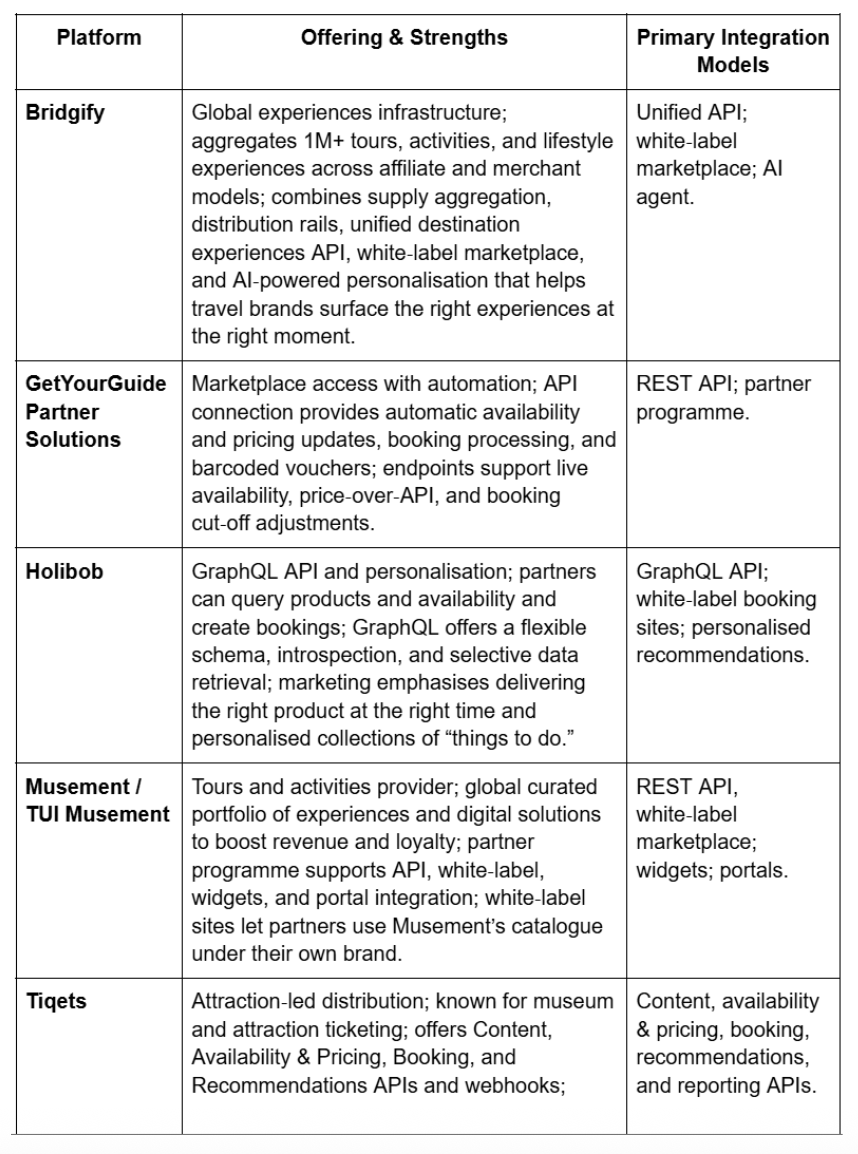
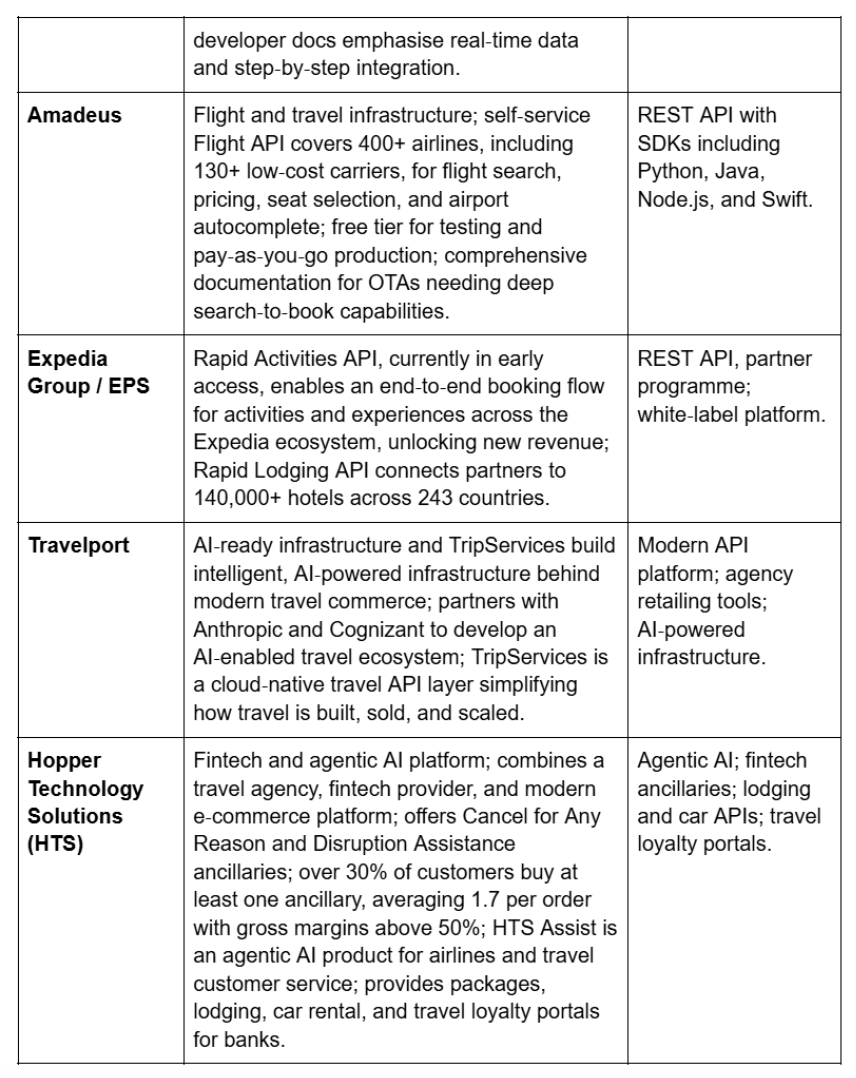
Below are some of the platforms enabling brands to add experiences, booking, and personalization. The list summarises what each provider offers and which integration models may fit different strategies.
Which Model Fits Which Strategy?
The right solution depends on the part of the journey a platform wants to own.
A company focused on flights and traditional travel infrastructure may begin with Amadeus. A brand looking to embed lodging, activities, and broader booking paths may evaluate Expedia Group / EPS. Agencies and travel sellers that need AI‑ready retailing and multi‑source content may look at Travelport. Banks, airlines, and loyalty platforms focused on flexible booking products and AI servicing may consider Hopper Technology Solutions.
For destination experiences, the choice becomes more specific. GetYourGuide Partner Solutions offers access to a well‑known tours and activities marketplace. Tiqets is useful for attraction and museum ticketing. Musement / TUI Musement is relevant for curated activities and in‑destination services. Holibob offers a GraphQL‑led approach to experience distribution and personalisation. Examples include GetYourGuide, Tiqets, and Musement. While these platforms provide strong inventory access, partners are generally operating within the ecosystem of a specific marketplace. A different approach is emerging around experiences infrastructure, where the goal is not only to distribute inventory but also to aggregate supply across sources and improve relevance through personalization. Bridgify is a relevant use case for organisations that want access to multi-source experiences inventory through a unified integration layer, alongside white-label and API-based distribution options.
No single provider owns every layer of AI‑powered travel. The strongest digital travel strategies usually combine the right mix of infrastructure, marketplace access, live inventory, personalization, and booking control. At the same time, recent consolidation across the sector suggests that larger travel platforms increasingly see experiences infrastructure as a strategic capability rather than a standalone category. As AI reshapes travel discovery and commerce throughout 2026, the winners will be the platforms that connect smarter recommendations to real, bookable experiences inside journeys customers already trust.