
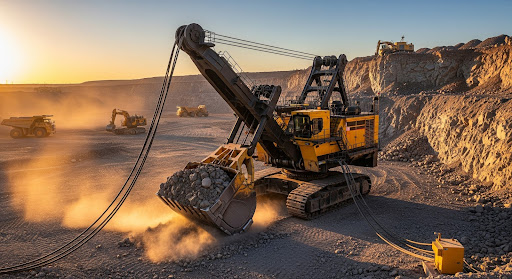
Mining, in any case, has been at the top of the list of the world’s most complicated and resource-intensive trades. However, the complexities have only increased in the last few years. The demand for minerals worldwide has increased sharply, particularly for those used in clean energy and electric vehicles. Meanwhile, the operators are dealing with fluctuating commodity prices, stricter environmental regulations, and the lack of an adequately qualified workforce. Unanticipated equipment downtime, according to industry research, is one of the major causes of money leakage from mining companies’ balance sheets. If you also bring the issue of decarbonization into the picture, the industry finds itself with an intimidating problem, i.e., how to produce more and at the same time cause the least environmental harm.
The use of automation and control systems has been identified as a potential solution. They are no longer regarded as optional add-ons but as part of the essential infrastructure. These are instruments for successfully dealing with the uncertainties of modern mining operations, as well as for safety and efficiency improvement. The work of Avadh Nagaralawala, a control systems engineer with more than a decade of experience, within this transition, perfectly illustrates how the sector is adjusting to the new reality.
Navigating Uncertainty Through Technology
Mining has always been characterized by uncertainty. Prices that follow up and down trends, changing demand, and the pressure from the authorities keep a state of insecurity within the industry. Small and large companies are turning to technology not just for cost reduction but also to be able to defray the effects of chaos on them.
Over the years, Avadh has systematically worked on the integration of automation in the mining industry. His expertise covers areas such as programmable logic controllers (PLCs), supervisory control and data acquisition (SCADA) installations, as well as the development of real-time monitoring networks. These are not the only support tools that help the machines to function; they also produce a continuous flow of data that is utilized by executives and front-line workers for making sounder decisions. As Avadh said, “Automation is not only about the upgrading of machines, it is about safety, reliability, and intelligence that the systems provide.”
Projects he has led have targeted areas such as optimizing haulage cycles, coordinating processing systems, and stabilizing energy distribution. The aim has consistently been to make mining operations both more efficient and more resilient in the face of uncertainty.
Mining Meets Data
Mining has undergone one of the most drastic changes in recognizing that data is just as important as ore. More and more equipment is being installed with sensors; predictive monitoring tools are giving early warnings of the stress, and real-time dashboards are linking operations that were previously separate. For a large number of sites, these digital flows have become as crucial as the physical ones.
Avadh has played a significant role in driving this change forward. His work includes the development of predictive maintenance systems that detect problems and take corrective measures before the trouble turns into a crisis. The benefits are evident: there are fewer breakdowns, the machines have longer lifespans, and cost savings are readily apparent. Apart from the economic aspect, the systems also help safety by lessening the danger of sudden equipment failures.
The change has essentially been a move to recognize automation not as a sequence of switches and relays but as a mining brain. This network links machines, people, and procedures, making it a single, adaptive entity.
The Twin Pillars: Safety and Sustainability
Mining is full of risks, unhidden to anyone. The use of large heavy machinery in areas that are far away and under high stress is a source of continual danger. Avadh’s designs reflect that truth, with attributes that give first priority to fail-safes, redundancy, and easy-operated controls. Without any diminishing in the quality of their reliability, his systems are made to survive rough conditions, dirt, heat, and mechanical wear.
Alongside safety, sustainability has moved from the margins to the center of mining strategy. Energy consumption and emissions are closely watched by regulators and communities alike. Automation plays a direct role here: reducing idle times, optimizing energy use, and ensuring processes run at their most efficient. Avadh’s approach has been to bake these considerations into design from the outset, linking innovation with long-term environmental responsibility.
Preparing for the Next Decade
The minerals mined today are essential for the technologies of the future, starting from battery storage to clean energy grids. However, the industry is not only under pressure to provide the materials but also to provide them responsibly. Avadh points out that three issues are most probably going to characterize the next decade: digital integration, cybersecurity, and cross-disciplinary collaboration.
With more interconnected mining systems, the potential for cyber attacks is higher. Security of networks and systems will be as crucial as the upkeep of physical assets. At the same time, the merging of fields, engineering, data science, and operations is leading to the need for communication between different disciplines. The knowledge of one expert will not be enough anymore.
Through it all, Avadh emphasizes the human side of the equation: “Automation is not about replacing people, it’s about empowering them with better tools, reducing risks, and enabling smarter decision-making.”
The Human Side of Technology
What makes Avadh’s work notable is not just its technical sophistication but its grounding in people. His projects demonstrate that automation can serve workers by providing reliable systems and serve managers by generating actionable insights. They also serve organizations by combining safety, efficiency, and sustainability.
The industry, too, is undergoing a broader shift, from being defined primarily by extraction to being shaped by intelligence and accountability. Automation and control systems are central to this change, less as endpoints and more as enablers of adaptation.
As pressures on the sector mount, its future will rest on professionals who can strike a balance between technological progress and human responsibility. Avadh Nagarlawala’s work offers one example of how that balance might look: systems that are advanced and sustainable, but above all, systems that keep people at the center.