

Previously unknown moon orbiting Nysa is also detected.
FLAGSTAFF, Ariz., July 29, 2026 /PRNewswire/ — An international team of astronomers has uncovered striking new evidence that asteroid (44) Nysa, one of the brightest and largest asteroids with an enstatite-like (E-type) surface composition in the main belt, possesses an extraordinary three-lobed structure and is accompanied by a small moon. The discovery, based on high-resolution adaptive optics imaging from some of the world’s most advanced telescopes, provides a rare glimpse into the complex history of one of the solar system’s most enigmatic asteroids.
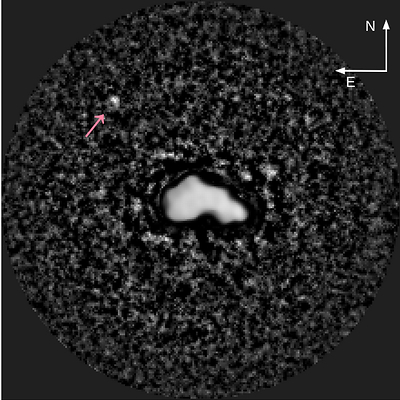
The findings, presented in the study “Unmasking (44) Nysa: Evidence for a Trilobate Structure,” reveal that Nysa is unlike any asteroids previously observed. For more than a century, astronomers have studied Nysa, whose unusual brightness and composition made it a compelling target for investigation. Earlier observations hinted at an elongated or potentially bilobate shape, but the asteroid’s true form remained elusive.
Using the Italian SHARK-VIS instrument on the Large Binocular Telescope in Arizona and the SPHERE/ZIMPOL instrument on the European Southern Observatory’s Very Large Telescope in Chile, researchers obtained the highest-resolution images ever acquired of Nysa. These unique datasets revealed multiple large surface features, including two prominent valleys that appear to wrap around the asteroid’s circumference. The team interprets these features as “colli” or neck-like connections between separate lobes.
“The images reveal a remarkably unusual object,” said lead author Kate Minker of Lowell Observatory. “The most likely explanation is that Nysa is either a contact trinary, consisting of three connected components, or an extremely irregular coherent body unlike anything we’ve previously observed.”
To better understand the asteroid’s shape, scientists combined the adaptive optics images with extensive photometric observations from observatories around the world. They generated a detailed three-dimensional model of Nysa. The reconstructed shape strongly supports the presence of three distinct lobes connected by narrow neck regions.
“These observations had to be combined with specially developed image processing techniques to further sharpen the images and remove the bright halo surrounding the asteroid, potentially hiding faint companions,” explains Anthony Berdeu, one of the lead authors of the study.
Minker adds, “These observations likely represent the closest competition to spacecraft-quality imaging ever achieved from the ground, made possible by an exceptional combination of advanced instrumentation and sophisticated data-reduction techniques.”
The study also reports the detection of a previously unknown moon, temporarily designated S/2026 (44) 1. The satellite was independently identified in observations obtained during two separate observing campaigns. Researchers estimate the moon measures roughly one kilometer (0.62 miles) in diameter and orbits at least 170 kilometers (106 miles) from the 75-kilometer (47 miles)-diameter primary asteroid.
“We borrowed a specialized technique from another field of astronomy, known as ‘high-contrast imaging’, to detect the small moon whose faint light was overwhelmed by the intense brightness of the primary asteroid” says Gianluca Li Causi of the SHARK-VIS team at the Italian National Institute for Astrophysics (INAF).
Future observations of the newly discovered satellite will allow researchers to determine Nysa’s mass and density more precisely, helping to distinguish between competing theories for the asteroid’s remarkable structure.
The discovery provides an important clue to Nysa’s formation and evolution. Scientists suggest the unusual structure may have formed through low-velocity reaccumulation of fragments from an ancient collision, possibly before Nysa reached its current location in the asteroid belt. Another possibility is that Nysa represents the remnants of a dramatic hit-and-run collision involving a larger parent body.
Because E-type asteroids may preserve a record of the enstatite-rich inner solar system, either as primitive planetesimals or as crustal fragments of differentiated protoplanets, understanding Nysa’s origin may shed light on processes that operated during the earliest phases of solar system formation.
“These new images appear consistent with several earlier clues that Nysa is really a unique object,” said Al Conrad of the Large Binocular Telescope Observatory. “For the first time, we can directly investigate whether those clues point to a deeply indented body or to a true multi-lobed structure.”
If confirmed, Nysa would join a growing class of solar system objects whose distinctive shapes preserve evidence of ancient collisions and mergers dating back billions of years, offering scientists a unique window into the early history of the solar system.
Participating Institutions
The research was conducted by scientists from Lowell Observatory (USA); the European Southern Observatory (Chile and Germany); INAF – National Institute for Astrophysics (Italy); Charles University, Faculty of Mathematics and Physics (Czech Republic); Large Binocular Telescope Observatory (USA); Université Côte d’Azur/Observatoire de la Côte d’Azur and CNRS (France); Command Module Observatory (USA); Florida Space Institute, University of Central Florida (USA); the STAR Institute, University of Liège (Belgium); BSA Osservatorio (Italy). The collaboration included researchers Kate Minker, Anthony Berdeu, Gianluca Li Causi, Josef Hanuš, Michaël Marsset, Al Conrad, Fernando Pedichini, Simone Antoniucci, Piero Vaccari, Nick Moskovitz, Benoit Carry, Tom Polakis, Marin Ferrais, Emmanuël Jehin, Roberto Bonamico, Rhiannon Hicks, Daejhanae Smith, M. Amine Miftah, and Ester Marini.
Image Caption
Adaptive-optics observations obtained with the Large Binocular Telescope’s SHARK-VIS instrument reveal the unusual shape of asteroid (44) Nysa. The asteroid appears highly concave and may consist of three connected lobes, making it a potential contact-binary object. Continuous observations on 15 February 2026 UTC, provided the most detailed view of Nysa to date.
About Lowell Observatory
Lowell Observatory is a private, nonprofit 501(c)(3) research institution, founded in 1894 by Percival Lowell atop Mars Hill in Flagstaff, Arizona. The observatory has been the site of many important discoveries, including the first detection of large recessional velocities (redshift) of galaxies by Vesto Slipher in 1912-1914 (a result that led ultimately to the realization that the universe is expanding), and the discovery of Pluto by Clyde Tombaugh in 1930. Today, the observatory’s scientists use ground-based telescopes around the world, telescopes in space, and NASA planetary spacecraft to conduct research in diverse areas of astronomy and planetary science. Lowell Observatory currently operates multiple research instruments at its Anderson Mesa station, east of Flagstaff, and the 4.3-meter Lowell Discovery Telescope near Happy Jack, Arizona. The observatory also welcomes more than 100,000 guests per year to its Mars Hill campus in Flagstaff, Arizona, for a variety of educational experiences, including historical tours, science presentations, and telescope viewing.
About European Southern Observatory
The European Southern Observatory (ESO) enables scientists worldwide to discover the secrets of the Universe for the benefit of all. We design, build and operate world-class observatories on the ground — which astronomers use to tackle exciting questions and spread the fascination of astronomy — and promote international collaboration for astronomy. Established as an intergovernmental organisation in 1962, today ESO is supported by 16 Member States (Austria, Belgium, Czechia, Denmark, France, Finland, Germany, Ireland, Italy, the Netherlands, Poland, Portugal, Spain, Sweden, Switzerland and the United Kingdom), along with the host state of Chile and with Australia as a Strategic Partner. ESO’s headquarters and its visitor centre and planetarium, the ESO Supernova, are located close to Munich in Germany, while the Chilean Atacama Desert, a marvellous place with unique conditions to observe the sky, hosts our telescopes. ESO operates three observing sites: La Silla, Paranal and Chajnantor. At Paranal, ESO operates the Very Large Telescope and its Very Large Telescope Interferometer, as well as survey telescopes such as VISTA. Also at Paranal, ESO will host and operate the south array of the Cherenkov Telescope Array Observatory, the world’s largest and most sensitive gamma-ray observatory. Together with international partners, ESO operates ALMA on Chajnantor, a facility that observes the skies in the millimetre and submillimetre range. At Cerro Armazones, near Paranal, we are building “the world’s biggest eye on the sky” — ESO’s Extremely Large Telescope. From our offices in Santiago, Chile we support our operations in the country and engage with Chilean partners and society.
About Large Binocular Telescope Observatory
The Large Binocular Telescope Observatory (LBTO) is located in southeastern Arizona near Safford in the Pinaleno Mountains on Emerald Peak. This area is part of the Coronado National Forest. LBTO is headquartered on the Tucson campus of the University of Arizona. The binocular design of the Large Binocular Telescope (LBT) has two identical 8.4-meter telescopes mounted side-by-side on a common altitude-azimuth mounting for a combined collecting area of a single 11.8-meter telescope. The entire telescope and enclosure are very compact by virtue of the fast focal ratio (F/1.14) of the primary mirrors. The two primary mirrors are separated by 14.4 meters center-to-center and provide an interferometric baseline of 22.8 meters edge-to-edge. The binocular design, combined with integrated adaptive optics utilizing adaptive Gregorian secondary mirrors to compensate for atmospheric phase errors, provides a large effective aperture, high angular resolution, low thermal background, and exceptional sensitivity for the detection of faint objects. The LBT is an international collaboration of the University of Arizona, Italy (INAF: Istituto Nazionale di Astrofisica), and The Ohio State University, representing also the University of Minnesota, the University of Virginia, and the University of Notre Dame.
About INAF- Italian National Institute for Astrophysics
The Italian National Institute for Astrophysics (INAF – Istituto Nazionale di Astrofisica) is Italy’s primary public research institution dedicated to the study of the Universe. Headquartered in Rome, INAF coordinates and manages scientific activities across 16 research units throughout the country, spanning observational astronomy, space physics, and planetary science. The institute plays a major role on the global scientific stage, designing cutting-edge technologies and state-of-the-art instrumentation for both ground-based facilities and international space missions. Through strategic partnerships with leading organizations such as the European Southern Observatory (ESO), ESA, and NASA, INAF researchers are actively involved in landmark endeavors, including the Large Binocular Telescope, James Webb Space Telescope, Euclid, and the SKA Observatory (SKAO). Beyond pioneering scientific discoveries, INAF is deeply committed to public outreach and fostering scientific culture to inspire future generations.
About Charles University, Faculty of Mathematics and Physics
The Faculty of Mathematics and Physics, Charles University, is a well respected higher education institution ranking among the most prominent academic institutions in the Czech Republic. Around four hundred students are awarded a degree every year and 100 percent of our alumni pursue a professional career within the field of their study. Degrees are offered in the subject areas of Mathematics, Physics, Computer Science, and in Education. Apart from supplying high-quality education in the first place, the Faculty also provides access to the latest trends and technologies. It guarantees the participation of the Czech Republic at the international research institute ILL Grenoble, enables experiments at the Trieste synchrotron, has a significant share in CERN.
 View original content to download multimedia:https://www.prnewswire.com/news-releases/asteroid-44-nysa-may-be-the-first-known-three-lobed-world-302838268.html
SOURCE Lowell Observatory
