
Thermobalancing therapy, patented in the US and invented by Dr. Simon Allen and Ariane Adjani of Oxford, alleviates the terrible symptoms of kidney stones from the first days of use and throughout the stone dissolution process. And what can you see on the internet where artificial intelligence is used to search for information about the treatment of urolithiasis or for managing kidney stone disease.
Artificial intelligence (AI) is believed to be transforming kidney stone treatment by improving diagnostic accuracy, predicting treatment outcomes, and assisting with surgical procedures in real time. However, there are serious limitations that are not due to the technical maturity of AI, but to the difficulties in assessing the results of kidney stone treatment.
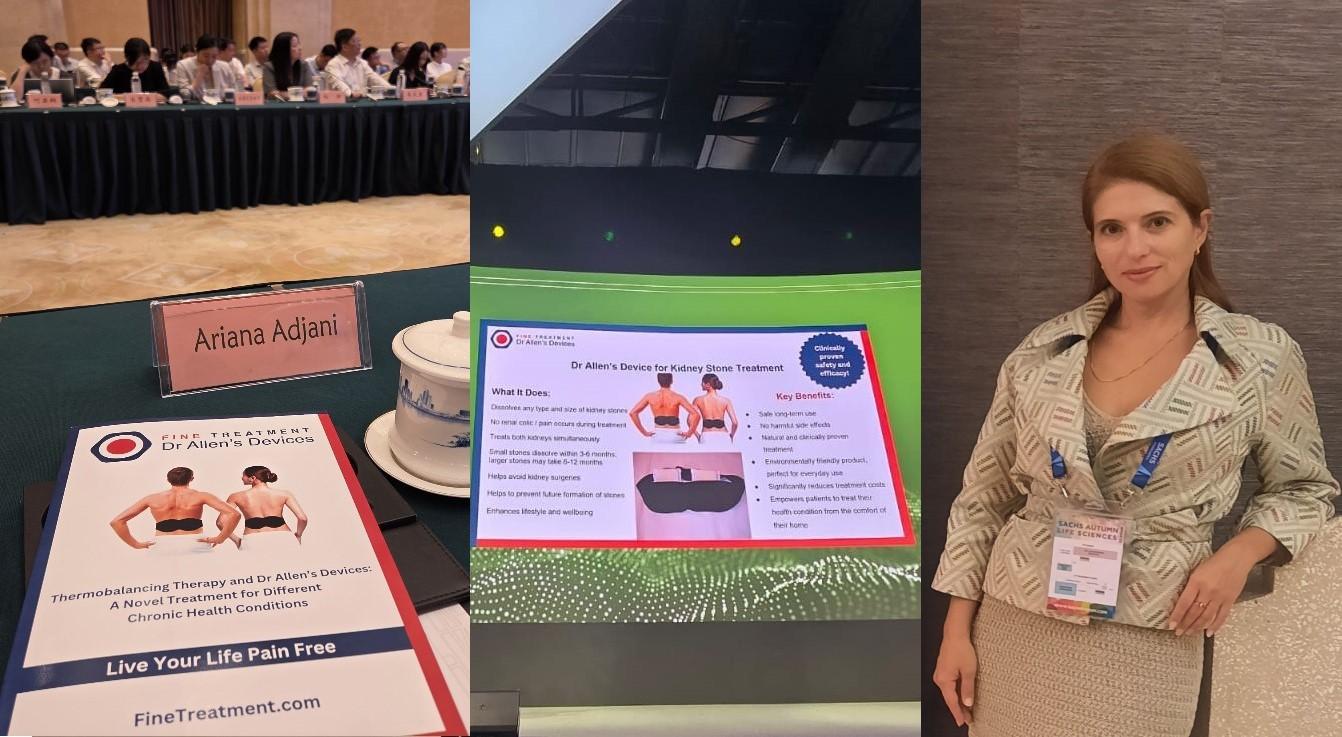
Ariana Adjani has presented Dr Allen’s Device for kidney stone treatment at major conferences
Thermobalancing Therapy vs. Traditional Treatments
| Comparison of Conventional treatment and Thermobalancing therapy for kidney stones | ||
| Feature | Traditional Treatment | Thermobalancing Therapy |
| Invasiveness | Surgical procedures are required | 100% non-invasive |
| Pain Level | Can be painful, with recovery time | Gentle and pain-free |
| Side Effects | Possible drug or surgery side effects | None |
| Cost | Can be very expensive | More affordable in the long run |
| Long-term Prevention | Limited effect on future stone risk | May help prevent future stones |
This comparison shows why Thermobalancing therapy as part of kidney stone treatment plan is affordable and desirable.
Management of kidney stone disease according to AI
Despite growing attention, many artificial intelligence initiatives in healthcare have failed to consistently improve outcomes for patients with kidney stones.
Before the 1980s the only helpful medical procedure to remove kidney stones was open surgery. This approach was too invasive, involving long hospital stays, a recovery period of one to two month and high rate of complication.
After the 1980s a surgical procedure extracorporeal shock wave lithotripsy (ESWL) was introduced to the clinical practice. Since then, urologists have been striving to find technical factors to improve the effectiveness of extracorporeal lithotripsy, conducting numerous studies on skin-to-stone distance, stone density, and precise targeting to reduce the risk of complications. Therefore, all scientific articles over the past 45 years have been devoted to the use of extracorporeal lithotripsy for urolithiasis.
Endoscopic surgery, defined as a minimally invasive surgical technique using an endoscope to examine and perform surgery to remove kidney stones, has now become established, allowing for procedures with less scarring and shorter recovery times. Thus, more scientific papers are published on endoscopic surgery for kidney stones.
Artificial intelligence is transforming medical research by collecting, analyzing, and synthesizing data from vast volumes of scientific literature, and therefore AI highlights the pivotal role of endoscopic surgery and extracorporeal shock wave lithotripsy in the treatment of kidney stones.
Management of kidney stone disease pros and cons
Innovative Thermobalancing therapy is gaining attention due to its potential to help naturally dissolve kidney stones without drugs or invasive procedures.
ESWL as a kidney stone removal procedure carries risks. Patients often complain of pain and anxiety during ESWL, and there is no standardized pain management solution for optimal pain reduction during lithotripsy.
In addition, various complications may occur after extracorporeal shock wave lithotripsy, such as pancreatitis and more serious splenic rupture, see the article “Splenic rupture after extracorporeal shock wave lithotripsy: a case requiring emergency splenectomy”.
Dr Allen’s Device dissolves stones in both kidneys
ESWL and endoscopic surgery remove kidney stones but do not prevent their formation. Fifty percent of patients with kidney stones develop new kidney stones within the next five years, recurring with the same problems and new bills for risky surgeries.
Dr Allen’s Device is designed in such way that for the first time in the world kidney stones can be dissolved in both kidneys simultaneously:
- Gradually dissolves stones without causing renal colic (pain).
- Provides non-invasive therapy for kidney stones of any type and size.
- Can prevent recurrence or formation kidney stones in the future.
Thermobalancing Therapy: An Evidence-Based MedTech
Clinical trial results demonstrating the remarkable effectiveness of Thermobalancing therapy in patients with chronic diseases have been published in peer-reviewed medical journals worldwide.
Ariana Adjani, co-inventor of Thermobalancing therapy, has presented clinical trial data on the use of non-invasive Dr Allen’s Device for kidney stone treatment at major conferences and summits in the United Kingdom, European MedTech Summits in Germani, Switzerland, Spain, Portugal, and many other countries.