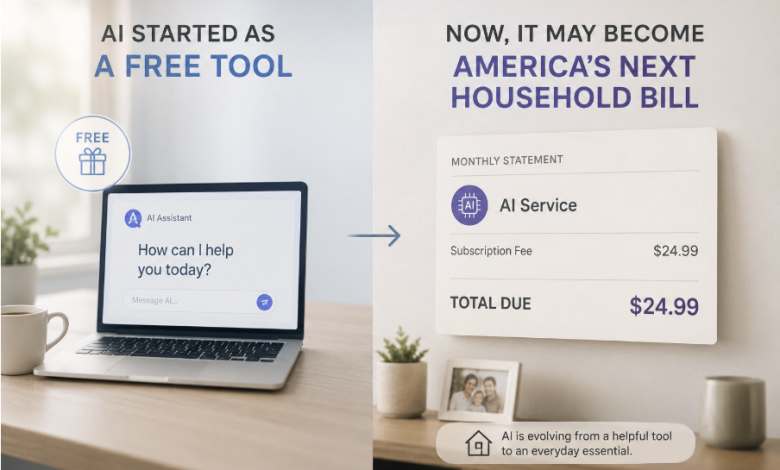
AI became part of daily life faster than almost anyone expected.
People use it to write emails, plan trips, create images, research purchases, transcribe meetings and get through work tasks. It felt effortless. For a while, it also felt free.
That is changing.
The free era is ending
A new pricing report by Lorka AI has looked at how the cost of popular AI tools has shifted since 2023.
The findings are clear. Many platforms that started out free or cheap have moved to paid subscription models. Basic plans now commonly cost between $20 and $30 per month. Premium plans can reach as high as $200 per month.
For anyone using more than one tool, the bills are starting to stack up.
Lorka estimates that a typical freelance creative using several AI tools could now be spending $1,236 a year on subscriptions alone.
Back in early 2023, Lorka says the same person would have had free or trial-based access to most of those tools. By 2026, the same stack will cost at least $872 more.
The $1,236 AI stack
| Tool | Function | Annual cost |
| ChatGPT Plus | Writing and content ideas | $240 |
| Midjourney Standard | Image creation | $288 |
| Runway Standard | Video editing | $144 |
| Perplexity Standard | Research | $200 |
| Canva Pro | Design tools | $120 |
| Otter.ai Pro | Transcription | $100 |
| Grammarly | Grammar and spellchecking | $144 |
| Total | $1,236 |
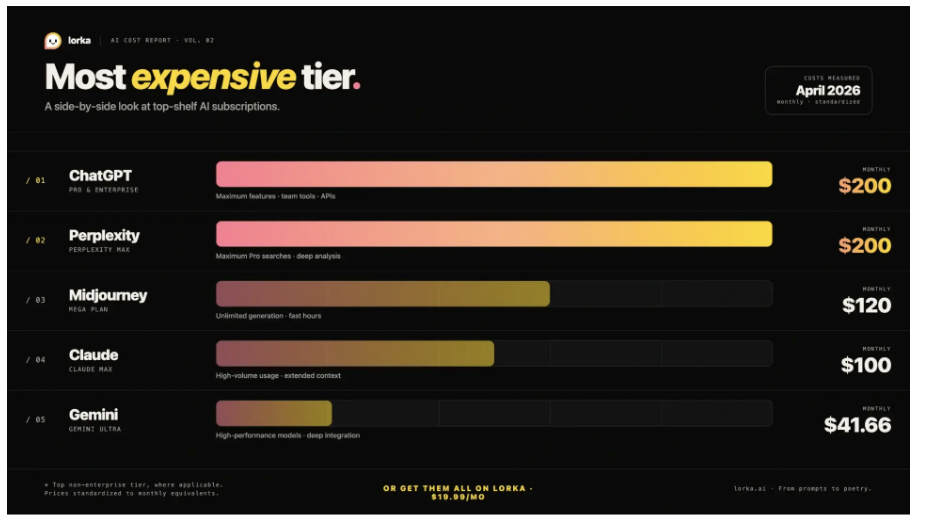
Here’s the most expensive tier of each of these services:
Usage is growing. Paying is not.
The timing matters because AI use is rising sharply.
Pew Research Center found that 31% of Americans interact with AI at least several times a day. That is up from 22% in February 2024. A June 2025 Pew survey also found that 47% of Americans said they had heard a lot about AI.
Among workers, the shift is clear too. Pew found that the share of US workers using AI for at least some of their work rose from 16% in 2024 to 21% in 2025.
But most people are still not paying for it.
Menlo Ventures estimated there are between 1.7 and 1.8 billion AI users worldwide. Only around 3% pay for premium services. Consumer AI has grown into a $12 billion market in just two and a half years — but spending still lags far behind the scale of actual use.
AI has become a habit before it has become a bill.
That may be about to change.
How the big platforms have shifted
Lorka’s report tracks how pricing has evolved across several well-known tools.
Midjourney launched with a free trial of 25 images. It now offers plans ranging from $10 to $120 per month. ChatGPT started with free access and now has multiple tiers, including a Pro plan at $200 per month. Perplexity’s Pro plan starts at $20 per month, with a Max plan at $200. Claude offers a free version, a Pro plan at $20 per month and Max plans from $100 per month.
Why costs keep climbing
Running AI is expensive.
Large models need enormous computing power, specialist chips, data centres and vast amounts of energy. Gartner forecasts worldwide AI spending will hit $2.52 trillion in 2026 — a 44% jump from the year before.
Those costs have to go somewhere. Increasingly, they are going to the user.
The streaming problem, all over again
For households, students, freelancers and small businesses, the worry is not whether one AI tool is worth $20 a month. The worry is what happens when five of them are.
The streaming comparison writes itself. People signed up for one or two services as a cheaper alternative to cable. Then the bills multiplied. Subscriptions crept up. Suddenly, the savings had vanished.
AI could follow the same path. Especially for people who feel they need paid access to stay productive or keep up with competitors.
What to do before the bills pile up
The advice is simple.
Check every AI tool you are currently paying for. Write down what each one does. Look for overlap. If one tool can do the job of two others, cut the extra one. Consolidation could save hundreds of dollars a year.
AI may well be worth paying for. But the days of treating it as free and unlimited may be coming to an end and most people are not ready for what comes next.