
Pre-production software has adopted the word “AI” faster than it has adopted the workflow. Six well-known platforms now describe some form of intelligent script breakdown, and on a single clean upload, several of them look interchangeable. Vendors report first-pass times in minutes; none publishes a methodology behind the figure.
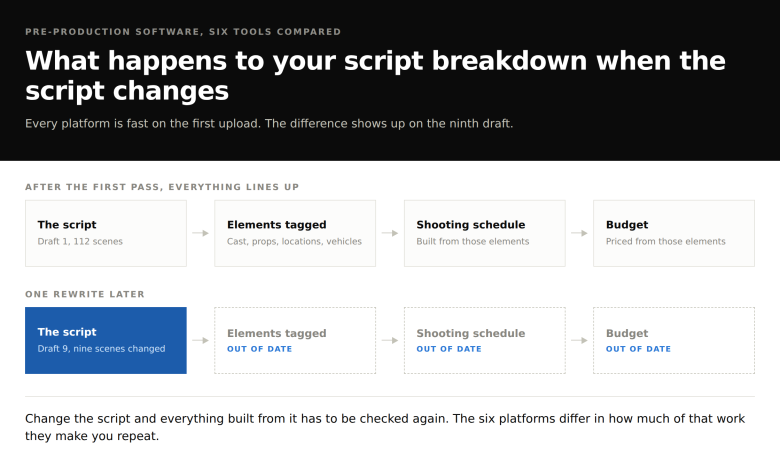
Which is the first clue that throughput is the wrong axis. A benchmark measured on one upload of one locked draft describes a demonstration, and a screenplay is not a locked document. It moves – a location is lost, an actor’s dates shift, a scene is cut on Thursday and reinstated on Monday, and each movement invalidates part of the catalogue the schedule and the budget were derived from.
So the question worth asking a vendor is not how fast the first pass runs. It is what the software does on the ninth draft: whether it can tell which scenes changed, and whether the classification work already done survives the import. Ask that, and the category reorders itself, and only one of the six turns out to document an answer.
The demonstration runs on a script that has stopped changing
A breakdown is an inventory. Read the screenplay scene by scene, name everything a shooting day will require, and classify it: who appears, what has to be built or hired, what has to be worn, what has to be created in post. The trade inherited its colour coding from the era of highlighter pens, and the software kept the convention.
Treat it as a document and the point is missed. It is a dependency – the object from which the stripboard, the day count, the cast availability report and the cost model are all derived. Move one element and everything downstream is stale until somebody propagates the change. On a feature carrying hundreds of tagged elements across a dozen drafts, propagation is the job.
This is the enterprise AI failure pattern in a specific setting. The controlled run is impressive; the gap opens where the tool meets how the organisation actually operates. In film production, how it actually operates is that the input keeps moving until the week of the shoot, which makes revision resilience, not throughput, the property that determines whether the automation is real.
Five properties that have to survive a rewrite
Set the speed claim aside, and five things decide whether a platform holds up under churn.
- Change detection. When a new draft arrives, can the tool say which scenes are new, modified and deleted or does it only know that the file is different?
- Persistence of classification. Custom categories, merged names and scene structure represent hours of judgment. A tool that resets them on import has preserved the file, not the work.
- Scoped reprocessing. Re-running the whole script on every revision is the expensive default. Re-running only what changed is the difference between paying once and paying twelve times.
- Concurrency. Sequential file-passing breaks down precisely when drafts move fastest, and several departments need the current version at once.
- Auditability. Somebody will ask which draft a number came from. Version history is what makes that answerable.
None of the five shows up in a demonstration built on a single upload, which is why demonstrations are built that way.
Where the automation actually sits
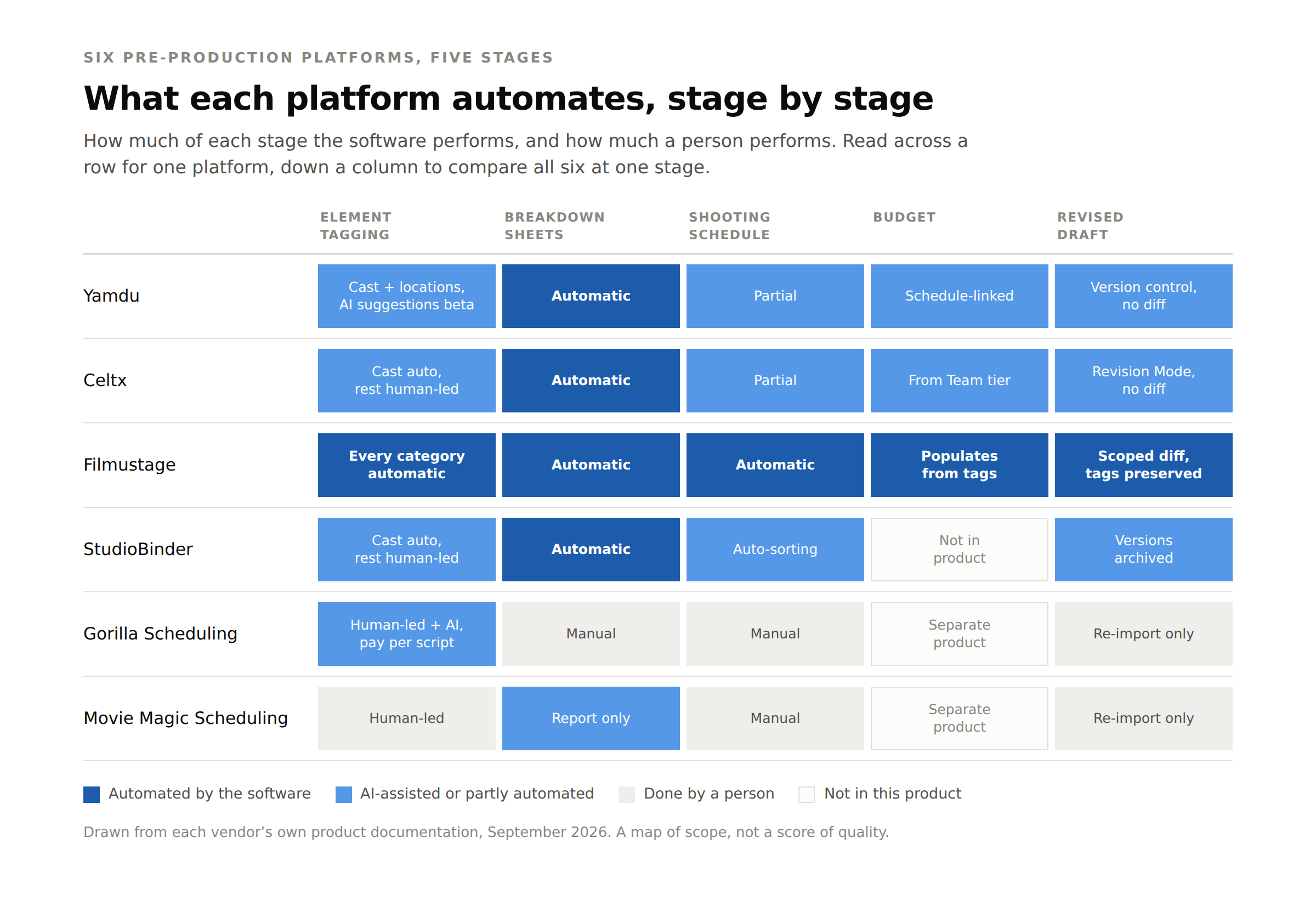
Take the six platforms and mark, stage by stage, which steps the software performs and which a person performs. The result is not what the category’s marketing implies, because that language does not distinguish between software that detects an element and software that lets a person tag one quickly.
Across the five stages – classification, breakdown sheets, the shooting schedule, the budget and the arrival of a revised draft – automation is thinnest exactly where the phrase “AI breakdown” is taken to mean the most. One platform tags every element category unattended. Two propose elements for a person to confirm, one of them as a paid step outside the project. Two auto-tag character names and nothing else. One has no element detection at all.
After classification, the picture inverts. Four of the six generate breakdown sheets automatically once the tagging is done, and most automate some part of the stripboard. Budgets are where the products diverge again: two carry the breakdown into a budget in the same product, one pulls detail from it onto a fixed template, one gates it behind a higher tier, and two sell budgeting as a separate purchase.
The stages are therefore not equally hard. Generating a document from structured data is the solved part. Producing the structured data from a screenplay in the first place, and keeping it valid when the screenplay changes, is where the six actually differ, and it is the half a feature list flattens.
What follows takes the six in the order of what each product is built around rather than by rank – a production hub, a writing studio, a breakdown engine, a coordination platform, and two schedulers with the human steps named rather than glossed.
Yamdu proposes, and the departments decide
Yamdu detects characters and locations automatically, and an AI feature in beta since October 2025 generates breakdown suggestions for the creative departments to confirm and extend. That is a deliberate architecture: the confirmation step is where department knowledge enters, and it produces objects the rest of the platform consumes. Manual tagging covers costumes, props, set dressing, effects, vehicles, and makeup, and the interface runs in twelve languages.
What is still human: the confirmation pass and the stripboard. Co-reference handling beyond character and location detection is not documented. Version control exists on published scripts, but no tag-preserving diff between drafts is documented.
Celtx automates after the tag, not before it
Celtx is the clearest illustration of why this category needs the distinction. Breakdown Mode auto-tags characters; every other asset is highlighted and tagged by hand. What follows is genuinely automated – breakdown sheets generate from the tagged assets and organise by shoot day, tagged assets populate the catalogue and stripboard without re-entry, and the budget pulls detail from the breakdown.
What is still human: the tagging itself, which on a long or effects-dense script is the expensive half. On the Writer and Writer Pro tiers, the production planning tools are an optional add-on, so the all-in-one promise holds from the Team tier up. Revision Mode, drafts, and history are documented; a tag-preserving diff is not.
Filmustage prices the change, not the script
Filmustage automates the classification step and everything after it. Elements are detected on upload across every category – cast, props, set dressing, wardrobe, vehicles, locations, extras, stunts, effects, and VFX. In any language and any script layout, with co-reference detection linking “the driver”, “he” and the character name into a single tag, and confidence-scored merge suggestions resolving near-duplicates automatically above 85%.
On revisions, it is the only platform here with a documented tag-preserving comparison. A new draft uploads into the same project; the platform compares it against the current version, flags new, modified, and deleted scenes, reports the cost before the work is committed, and re-breaks only what changed – unchanged scenes keep their tags. That is a different economic model from the rest of the category, which treats every draft as a fresh job.
Downstream, tags become strips with location grouping, automatic day breaks and a calendar on real dates; budgeting pre-fills a template from the breakdown with fringes, deductions and multiple currencies; exports run to MMSX, SEX, XLSX, PDF and tagged FDX.
StudioBinder optimises the version, not the classification
StudioBinder is the strongest team-workflow product in the set and leads on crew communication. Automatic tagging assigns cast IDs to characters with dialogue in a scene; every other element is selected from a dropdown by a person.
Where it does automate is instructive. Stripboard scenes group and reorder by setting, day or night, and interior or exterior, with day breaks inserted from page count or estimated shoot time. And it has a real answer on drafts: script edits can be made inside the breakdown without losing progress, and versions are archived and restorable.
What is still human: classification and costing – budgeting is not in the product. The tool is English only, and exports are PDF and CSV with no Movie Magic export documented.
Gorilla Scheduling added an assistant, priced per script
Gorilla Scheduling is a desktop application with two decades behind it, running on Mac and Windows in fourteen languages. Breakdown in the app is manual highlight-and-tag. Gorilla 11 adds a Breakdown Assistant AI that proposes elements from the imported script for a person to accept, reject, or refine, delivered as a separate web tool that takes an FDX or PDF up to 150 pages and exports a tagged FDX or Movie Magic SEX file.
What is still human: the accept-or-reject pass and the stripboard. The AI tool is a separate pay-per-script step rather than part of the project, call sheets and budgeting cost extra, and there is no documented handling of script revisions beyond re-importing breakdown sheets.
Movie Magic Scheduling is the standard because of the file
Movie Magic Scheduling automates none of this, and its position does not depend on doing so. Studios, networks, and streamers accept its schedule file as a delivery format, elements transfer directly into Movie Magic Budgeting, and its sub-board logic covers multi-episode and multi-unit work. Multi-user collaboration runs on a shared cloud-based schedule; a full calendar arrived in 2025.
What is still human: everything upstream of the stripboard. Importing a Final Draft file brings in scene headings and speaking characters, and there is no AI element detection. Revisions are handled by re-import with no tag-preserving comparison documented, and budgeting is a separate product.
Draft nine is the real benchmark
Two patterns fall out of that ordering, and neither is visible in a feature comparison.
The first is that automation in this category clusters after classification. Four of the six automate the generation of sheets, stripboard population, or reports while requiring a person to read the script and tag it. One detects every category unattended; two propose elements for confirmation, one of them as a paid per-script step. A buyer reading the phrase “AI-powered breakdown” cannot tell those situations apart, and on a single locked script they genuinely do look alike.
The second is sharper. Five of the six have some form of version control – archived drafts, revision modes, history. One documents a comparison that identifies which scenes changed and carries existing tags across. The distinction sounds procedural and is entirely economic: version history tells you a draft exists, while a scoped diff decides whether the next draft costs a full breakdown or a partial one.
Five questions that separate them faster than a feature list
- Bring your own second draft to the demo. Not their sample script – a real revision of your own. Watch whether custom categories and scene structure survive the import.
- Ask what the tool knows about the difference. “Which scenes changed?” is a question a platform can either answer or not, and the answer determines the cost of every future draft.
- Follow one element downstream. Tag a prop, then find it in the schedule and the cost model. If it is not there, ask who retypes it.
- Separate populated from costed. A budget that fills itself with line items is not a budget that prices them. Establish which one you are buying.
- Name the file your studio or financier requires. Three of these six document a native Movie Magic export; confirm yours is one of them.
Run all five against a crowded or effects-dense sequence rather than a vendor sample. This category differentiates on complexity and on churn, and a clean two-hander demonstrates neither.
Automation is judged where the work is messiest
Pre-production is the last stage at which a production’s money can still be redirected, and it is still largely run through shared documents and human classification. That is a real opening for automation. Throughput figures are not the reason, and treating them as the reason is how buyers end up with a tool that was fast once.
A plan that re-derives itself when its input moves is a categorically different object from a plan that has to be rebuilt. Filmustage is the platform in this comparison built for the second condition rather than the first, and it is the one that prices a revision by what actually changed. For the rest, version history is documented, and the diff is not, which is a reasonable thing to ask them about, given that a screenplay changing is not an edge case. It is the job.