87% of employees report they are productive in a hybrid work environment. Well, that looks like a huge success story.
But the reality appears when you see beyond the surface. The employees are less productive. This might be shocking, but due to app switching, meeting overload, communication fragmentation, and digital fatigue, they are not productive. They work more hours with scattered focus and somehow manage to deliver results.
This is where the role of AI becomes significant, with over 50% of SMBs looking to adopt it in the next 12 months
You can use AI as a partner to assist in prioritizing tasks, summarizing meetings, and predicting potential risks.
In this article, we will discuss the true meaning of productivity and how to achieve it.
What Does AI-Powered Productivity Mean?
AI-powered productivity is not just about automation. The growing AI adoption by industry is transforming how businesses operate, moving them beyond simple rule-based processes to intelligent systems that learn, adapt, and assist people in making better decisions.
Traditionally, automation was based on a set of rules, such as “if this happens, then do this.” But AI-powered systems use patterns, behaviors, workload, deadline, and history to suggest what is best. They do not just do the work for you; they also help you decide what is best.
This revolution has been enabled by technologies such as machine learning, natural language processing, and predictive analytics.
When combined, these capabilities allow traditional software to become a smart work partner. Employees have more time to focus on meaningful work, as less time is spent on the software itself. This, in a nutshell, is the power of AI-powered productivity tools. These tools are not replacing human effort. They are increasing human efficiency.
Key Areas Where AI Improves Employee Productivity
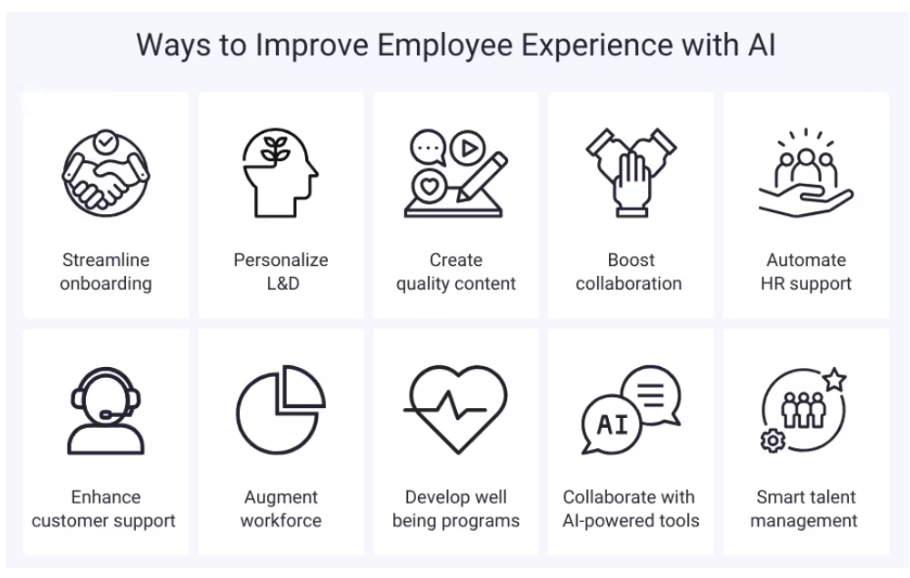
Let’s break it down practically.
A. Smart Task & Workflow Automation
Consider that you open your task dashboard on a Monday morning. There are many tasks assigned. But instead of scanning all those tasks, your AI tool highlights the 5 most critical tasks.
That’s intelligent prioritization.
AI-driven tools can:
- Automatically reorder tasks based on urgency
- Predict deadline risks
- Send proactive reminders
- Identify workflow bottlenecks
There are various platforms, like Asana, that use AI to suggest workflow improvements and reduce repetitive manual updates.
The result is that employees stop spending time managing tasks and start executing them.
B. Intelligent Communication & Collaboration
Meetings are essential, but they can be productivity killers when they are messy and unmanaged.
AI now automatically generates meeting summaries, action items, and transcripts. Many teams also use collaborative planning tools that structure workshops, capture decisions in real time, and reduce post-meeting confusion by centralizing and making outputs actionable. Tools like Zoom provide AI-powered summaries so employees don’t have to rewatch entire sessions.
This creates the following impact:
- No more manual note-taking
- Clear accountability through auto-generated action points
- Faster post-meeting execution
Internal AI chatbots also handle routine HR queries, leave balance, policy clarifications, and payroll questions. This frees HR teams to focus on strategic work.
C. Data-Driven Decision Support
This might have happened multiple times when teams delayed decisions because they were “waiting for reports”.
AI analytics tools eliminate that lag.
Platforms like Microsoft Power BI provide leaders access to real-time dashboards instead of static monthly reports. AI detects anomalies, forecasts trends, and highlights performance gaps.
As insights are generated quickly, decision-making also speeds up. Faster decisions lead to a competitive advantage.
D. Employee Well-Being & Burnout Monitoring
Burnout silently kills productivity.
AI can analyze workload patterns. It helps organizations detect employee overload. Companies can rebalance workloads early, and employees might not think about taking negative actions like resigning. That’s proactive leadership powered by data.
This resonates with real workplace experience. “At Appetiser Apps, having access to our in-house licensed performance counselor for regular check-ins made a real difference in how I managed stress and stayed productive.
Those sessions gave me a safe space to process challenges before they snowballed into burnout. It reminded me that proactive mental health support isn’t a perk. It’s a productivity strategy,” as Krisette Lim, Content Marketing Specialist, puts it.
E. Tools for Tracking Employee Productivity
This is where many organizations face problems. They want to achieve success but without micromanagement.
Modern tools for tracking employee productivity use AI to focus on outcomes. Tracking keystrokes or screen time is not a good way to track employee productivity. Instead of focusing on that, AI evaluates workflow patterns, task completion rates, and collaboration dynamics. Many firms strengthen operational clarity further by implementing structured year-end accounting workflows that guide documentation, reduce back-and-forth communication, and ensure deadlines are met without manual chasing.
For example, an AI productivity tool can detect an employee’s workload, identify process delays, and suggest task redistribution. The goal changes from monitoring employees to removing friction. The same philosophy applies to AI-powered moderation tools that automate repetitive oversight tasks, allowing teams to focus on strategic initiatives rather than on manual filtering and review.
When used properly, these tools create clarity, accountability, and fairness. They also provide managers with actionable insights.
The key is simple. Track performance drivers, not personal behavior.
F. Personalized Learning & Skill Development
Employee productivity depends on relevant skills.
AI helps in providing personalized training. It analyzes employee roles, past performance, and career goals to recommend suitable learning paths. Instead of generic training modules, employees receive adaptive learning suggestions personalized to their skill gaps.
Consider a sales executive who gets negotiation training because AI detected that the employee was closing lower-than-average deals.
Similarly, AI can identify gaps in presentation skills. For example, if a manager frequently presents the company overview but receives weak engagement or feedback, AI may recommend targeted training in presentation skills and slide design to help communicate the company’s value more effectively.
AI-driven skill-gap analysis ensures learning becomes proactive rather than reactive.
How to Implement AI-Powered Productivity in Your Organization
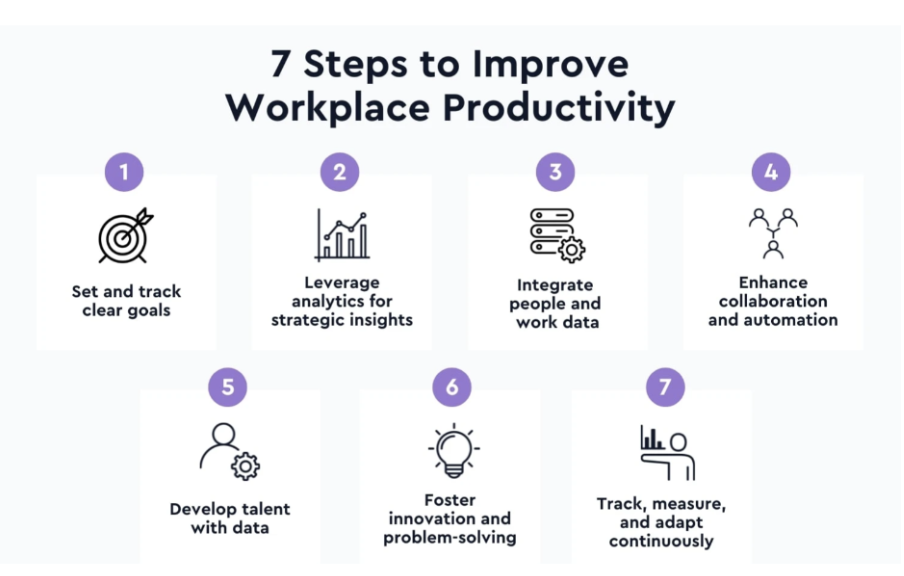
Adopting AI isn’t about installing ten tools overnight. It requires strategy.
Step 1: Identify Productivity Bottlenecks
Start with questions, such as:
- Where do employees waste the most time?
- Which tasks are repetitive?
- Where do communication gaps occur?
Identifying the exact problem is the crucial step to finding the right solutions.
Step 2: Choose the Right AI Tools
Align AI tools with specific goals:
- Want better meetings? Implement AI summaries.
- Want faster reporting? Introduce AI analytics dashboards.
- Want better workload balance? Deploy smart workflow tools.
Avoid integrating all the tools at once. Start with a pilot project in one department. Then measure the results before scaling them to the entire system.
Step 3: Train Employees for AI Collaboration
AI works best when employees understand it. Position AI as a helpful assistant that will help them grow and improve their performance.
Provide workshops that teach:
- How to interpret AI insights
- When to override AI suggestions
- How to collaborate effectively with AI copilots
Step 4: Monitor, Measure & Optimize
Measure the impact by using specific indicators such as:
- Time saved for every task
- Reduction of meeting time
- Faster report creation
- Improvement of output quality
Refine your AI systems based on the feedback you receive. As your AI increases, so should your implementation.
The Future Belongs to Augmented Teams
AI helps employees realize their full potential and achieve more.
When intelligent systems handle repetitive tasks, find insights, and reduce digital noise, employees gain their focus, creativity, and strategic thinking. AI helps in creating smarter workflows, better meetings, real-time analytics, and ethical tools for tracking employee productivity. In short, AI transforms how work gets done.
The most successful companies will be the ones that work the smartest hours by combining the best of human instincts with the best of AI efficiency.
If you want to be ahead of the work revolution and learn more interesting facts like this, visit The AI Journal.