
Testing used to feel a bit more controlled.
You had a set of requirements, a clear window to test, and enough time to walk through things properly before anything went out the door. If something broke, you could usually pinpoint why quickly. It was not always perfect, but it was manageable.
That is not how things work anymore.
Now, changes happen constantly. A small update in one area can ripple into something else without much warning. Features are being built, updated, and pushed at the same time, and testing is expected to keep up with all of it.
That is where AI in testing starts to come into the picture. Not as something flashy or overhyped, but to deal with how fast everything moves now.
Why Traditional Testing Started to Struggle
Most teams did not set out looking for something like AI.
It usually started with small things that did not seem like a big deal at the time.
A few extra test cases here. A couple more scripts there. Maybe a quick fix to handle a UI change. Nothing out of the ordinary. But over time, those small additions started to stack up.
Eventually, maintaining tests became its own kind of workload.
You fix one script, and it runs fine. Then something else fails right after. So, you run it again, thinking maybe it was just a one-off. This time it fails differently.
Now you are stuck trying to figure out what happened.
Is it a real issue? Did something change? Or is this just one of those random failures that shows up and disappears without much explanation?
That is usually the point where things start to feel a little off.
Not because testing is broken, but because it stops feeling dependable. The tests are still running, but you are not fully sure what to trust anymore. And once that confidence starts to slip, everything around it slows down. You spend more time double checking results, rerunning things, and trying to confirm what is real before moving forward.
That is where intelligent test automation starts to feel less like something new and more like something you actually need.
Not to replace what is already there, but to steady things a bit. To reduce how often you are dealing with those small, constant disruptions. When that noise gets quieter, it becomes a lot easier for teams to focus on what they are actually trying to validate instead of constantly reacting to test failures.
What AI in Testing Actually Does
There is a tendency to overstate what AI can do in testing. It is not writing perfect test suites on its own or replacing QA teams entirely.
What it does well is assist in areas where humans spend too much time doing the same things over and over again.
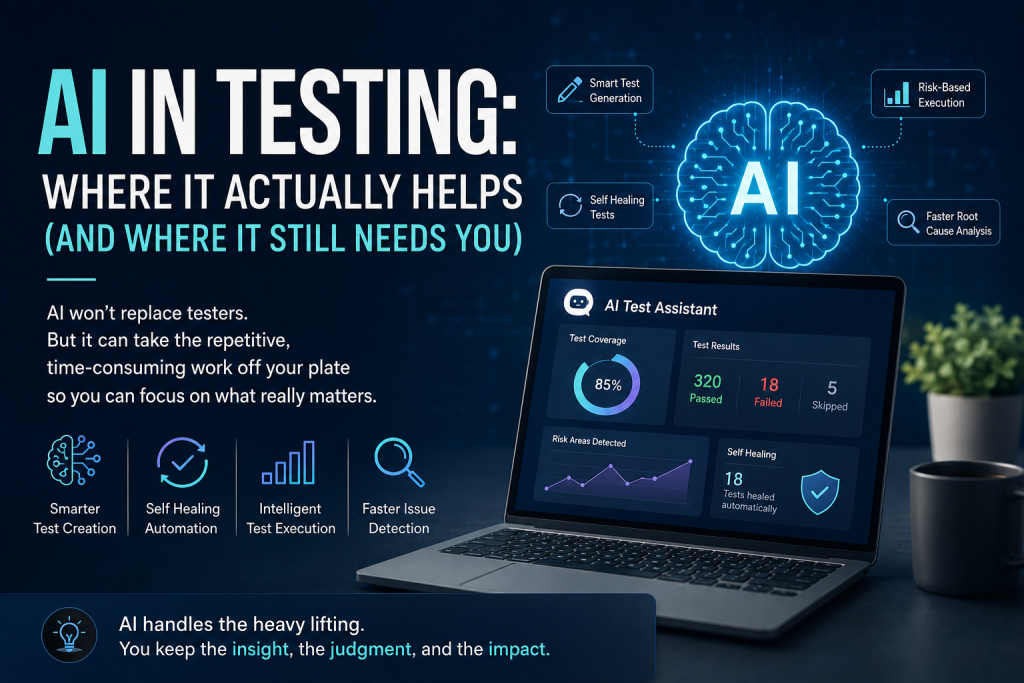
At a practical level, AI helps with:
- Test creation support
Using patterns from existing tests or application behavior, AI can suggest or generate test cases that cover common scenarios. This is where generative AI in testing is starting to show value, especially for expanding coverage quickly. - Maintenance reduction
Instead of rewriting scripts every time something small changes, AI can adapt tests based on what it recognizes in the application. This is the foundation of self healing test automation, which focuses on keeping tests running even when elements shift slightly. - Smarter test execution
Not every test needs to run every time. AI can help prioritize what should be tested based on recent changes, risk areas, and past failures. - Faster issue identification
Instead of digging through logs manually, AI can help highlight patterns and surface likely root causes faster.
The goal is not perfection. It is efficiency and consistency.
The Rise of AI Test Automation Tools
The shift toward AI has also changed what teams expect from their tools.
Traditional automation frameworks required a lot of setup and ongoing maintenance. Many of them still work well, but they were not built for the pace teams deal with now.
Modern AI test automation tools are designed with a different approach:
- They focus on reducing manual effort rather than just speeding up execution
- They adapt to application changes instead of breaking immediately
- They provide insights instead of just pass or fail results
This does not mean every tool delivers on those promises equally. Some are still closer to traditional automation with a layer of AI added on top.
The difference becomes clear when tools actually reduce maintenance work instead of just shifting it somewhere else.
Where Self-Healing Test Automation Fits In
One of the more practical uses of AI in testing is in handling small, constant changes that used to break automation.
A button moves slightly. An element ID changes. A field gets renamed.
None of these are real defects, but they can cause tests to fail.
Self healing test automation works by recognizing patterns in the application and adjusting tests when those small changes happen. Instead of failing immediately, the test adapts and continues running.
This does not mean tests never fail. It means they fail for better reasons.
That distinction matters more than it sounds. When teams trust that failures are meaningful, they spend less time second guessing results and more time fixing actual issues.
Where Generative AI Is Starting to Help
The introduction of generative AI in testing has added another layer to how teams approach coverage.
Instead of starting from scratch, teams can:
- Generate initial test scenarios based on requirements or user flows
- Expand coverage for edge cases that might not have been considered
- Create variations of tests for different data conditions
This is especially useful in early stages or when dealing with large, complex systems.
That said, generated tests still need review. Context matters, and AI does not always understand business logic the way a tester does.
Think of it as a starting point, not a finished product.
What Has Not Changed
With all the conversation around AI, it is easy to assume testing is becoming fully automated.
It is not.
There are still areas where human judgment is essential:
- Understanding user experience and flow
- Identifying edge cases that are not obvious from data
- Deciding what actually matters to test
- Interpreting results in a meaningful way
AI can assist, but it does not replace the thinking behind good testing.
The strongest teams are not the ones using the most automation. They are the ones using it in the right places.
A More Realistic Way to Think About AI in Testing
It helps to look at AI in testing a little differently than how it is usually presented.
It is not a reset button. It is not something you drop into your process and suddenly everything runs perfectly. Most teams that go in expecting that end up disappointed pretty quickly.
What it actually does is take some of the pressure off.
There is a lot of effort in testing that does not really move things forward. Fixing the same broken scripts. Re-running tests just to double check if a failure is real. Spending time on things that feel necessary, but not meaningful.
AI helps smooth those parts out.
It makes the process feel a little less reactive and a little more controlled again. Not perfect, but more manageable. And for most teams, that is where the real value shows up.
Where Platforms Like Qyrus Fit In
This is also where platforms like Qyrus start to make more sense.
Instead of just stacking more automation on top, the thinking starts to change a bit.
It becomes less about adding tools and more about what testing actually feels like on a normal day. How often something small changes and throws things off. How much time gets spent keeping tests from breaking instead of actually validating anything. And that moment when something fails and you are left wondering if it even matters.
That day-to-day experience is what really sticks with teams.
Because when testing feels unpredictable, it is hard to trust it. And without that trust, it is tough to move forward with any real confidence, no matter how much automation is running in the background.
By bringing together intelligent test automation with AI-driven orchestration, platforms like Qyrus are trying to reduce that ongoing friction. Things like adaptive test creation and self healing test automation are not just features on a checklist, they are meant to solve the constant small issues that slow teams down over time.
If anything, it is about simplifying things again.
Getting back to a place where tests run the way you expect them to. Where failures actually mean something. Where you are not stopping every few minutes to question whether something is real or just another false alarm.
When that clarity comes back, everything else starts to move a lot easier.
Final Thoughts
When you step back from all the tools and terminology, testing is still simple at its core.
You are trying to answer one question: does this work the way it should?
That part has not changed, and it probably never will.
What has changed is how hard it can be to get to that answer.
There is more happening at once. More moving parts. More dependencies that can shift without warning. And a lot less time to sit with something and work through it slowly.
AI helps take some of that pressure off.
It does not solve everything, but it smooths out the parts that tend to wear teams down. The constant rework. The unclear failures. The time spent chasing things that turn out not to matter.
It gives teams a bit more breathing room.
But it does not replace the thinking behind good testing. You still need people who understand how the system is supposed to behave. People who can spot when something feels off, even if everything technically “passes.”
That kind of judgment does not come from automation.
And when everything else is moving as fast as it is now, that human perspective ends up being the most reliable thing in the entire process.