

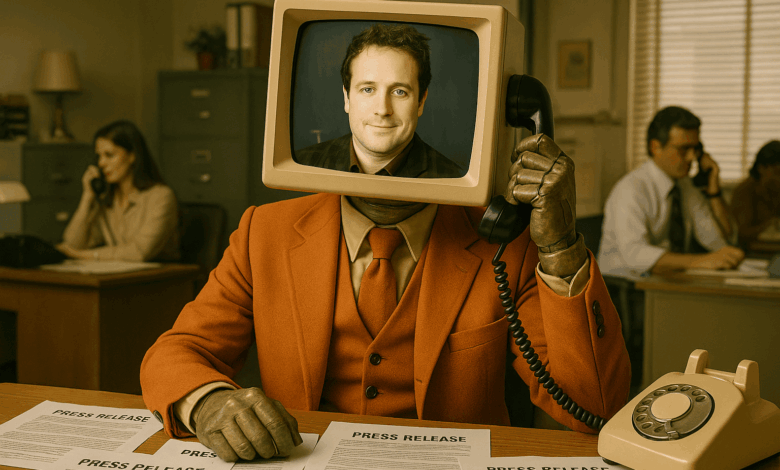
For a long time, the public relations (PR) industry has seen itself as immune to automation. While advertising embraced programmatic, and marketing invested in ever more automation, the PR industry leaned on the comfort of craft — relationships, instinct, and storytelling — telling itself that this type of work was ‘too human’ to ever be replaced by code.
But in 2025, that story no longer holds up. AI can now write press releases, draft pitches, generate media lists, summarise coverage, track sentiment, and even suggest campaign ideas.
And that’s not a reason to panic. It’s an invitation to reimagine what PR can be.
AI isn’t the future… it’s the present
As someone who works at a tech PR agency, I can tell you that AI-powered tools are already totally reshaping how PR teams operate:
· Media lists built in seconds, using relevance scoring, topical analysis, and journalist behaviour tracking.
· Coverage reports auto-generated, including sentiment, messaging, reach, and impact visualisations.
· Real-time audience insights, tracking everything from micro-trends to platform sentiment shifts.
· AI-assisted writing, capable of structuring press releases, writing blogs, shaping commentary, and producing campaign concepts on demand. (To varying degrees of success.)
The result for PR pros, agencies, and clients is less time spent on laborious tasks — and more time to focus on insight, judgement and creative thinking.
Use AI. But Don’t Settle for Average.
Ignoring this new reality won’t change anything. In fact, I encourage every PR professional to experiment with as many AI tools as they can. Where I work at Wildfire, we provide ChatGPT Pro licenses to everyone, encouraging teams to use these tools every day (within strictly defined AI guidelines). But let’s be honest: most of what AI produces is fine, but not fantastic. That’s because most AI models are trained on a sea of average content — generic blogs, boring press releases, and B2B copy that was never that exciting to begin with.
Unless you prompt with precision and refine with real insight, the results tend to be middle of the road. The whole point of great PR is to stand out. So when you and your competitors are using the same tools, trained on the same data, with similar instructions, it defeats the entire point. That’s where PR professionals can still add serious value.
The opportunity for PR isn’t to compete with AI on output. It’s to differentiate through originality, sharpness, and contextual understanding. This is our opportunity to step up as consultants and help our organisations and clients define what great looks like.
With that in mind, here are the five skills I recommend every PR professional adopts for the new era of AI:
How PR professionals can reskill for the AI age
1. Sell strategy, not just execution
AI can increasingly support with the “doing” of PR. That means PR professionals must lead with their ability to ask better questions, spot deeper insights, and tie communication to commercial outcomes.
Think of AI as your digital production assistant. It’s powerful, but it needs to be briefed well, edited sharply, and directed with intent. Businesses no longer need an army of people producing PR content. They need a handful of experts telling them what great content looks like, and what makes a compelling story for audiences, media and influencers. They need trusted advisors who can interpret complexity, see the wider picture, and build their reputation.
2. Skill up on your successor
You don’t have to become a prompt engineer. But you do need to understand how these tools work. What’s generative? What’s predictive? How does fine-tuning change outputs? How do biases creep in? In my 2021 book on this subject — Spin Machines — I described this as “meeting the machines in the middle.” That advice still stands. Only now, it’s no longer optional. Those who can interrogate AI’s output, benchmark its quality, and integrate it wisely will become indispensable to their organisations.
3. Hire and train for curiosity
The next generation of PR professionals will be measured less by how many media contacts they have, and more by their agility, judgment, and curiosity. The best PR people will be those who question AI’s output, test alternative approaches, and use AI as a thinking partner — not a shortcut.
Take media monitoring, for example. One person might run an auto-scan and call it a day. Another will notice the absence of key angles, prompt AI to fill the gaps, and triangulate that against audience data. That second person? They’re not just using tools. They’re adding value.
The same applies to hiring new team members. Don’t just ask “Can they use AI?” Ask, “Do they know what to do when AI isn’t enough?”
4. Be a guide, not just a creator
AI can build a campaign framework. But it can’t navigate internal politics. It can’t read the mood in the room. It can’t tell you when to hold back or when to push harder. Those are the spaces where humans shine.
This is about using your judgement. Increasingly PR professionals need to think of themselves not as creators, but as navigators — someone who knows the tools, but more importantly, knows the best direction to go in and how to navigate the real-world terrain of a business.
5. Act responsibly
If your processes are already shaky, AI won’t fix them — it will magnify them. In Spin Machines, I talked about “efficient bad practice” — the idea that automation doesn’t just replicate work, it scales it. Left unchecked, PR risks industrialising all those bad habits that have plagued PR in the past (short-term focus, lack of measurability, etc).
Responsible AI use means prioritising high standards over high speeds. Whether you’re working in-house or at an agency, the best AI users are the ones who know when not to use it.
This is PR’s big opportunity
AI brings a chance to rethink how we work — to sharpen our focus, raise the quality of what we deliver, and finally leave behind the repetitive tasks that have long slowed PR down.
With more time and headspace, we can step fully into our roles as consultants: thinking carefully about what our audiences truly need, which stories are worth telling, where communications can drive real business impact, and how to serve our stakeholders with clarity and purpose.
AI presents a huge opportunity for the PR industry, giving us the chance to lead with insight — not just output