When the hype around AI was just beginning to gain momentum with the growing popularity of ChatGPT, many concerns were raised by teachers and school administration about the potential of this technology to kill education as we know it. But is this really the case? Can AI be beneficial in inclusive education? And when it comes to inclusive education, can AI assist both teachers and students?
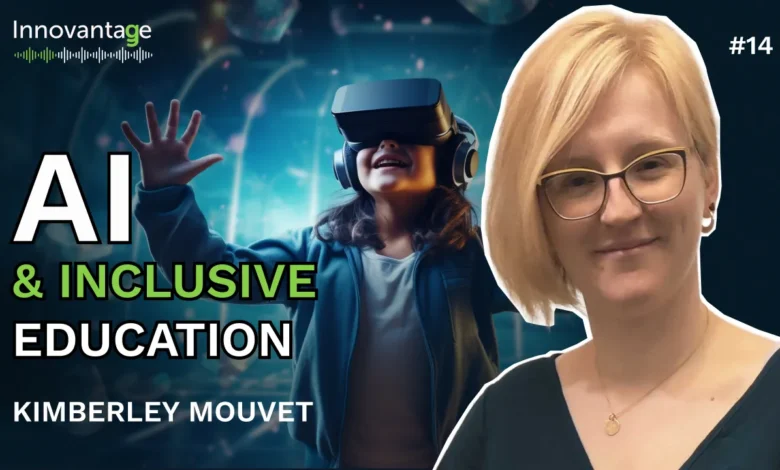
To discuss these questions, Max Golikov, the host of the Innovantage podcast and the CBDO at Sigli, invited a very special guest with remarkable expertise in the field of education. This guest was Kimberley Mouvet, an educational software specialist and product owner at Sensotec, the company that builds innovative tech solutions for inclusive education.
Kimberley has always been interested in languages and linguistics. In her career, she has worked with different groups of students, including very young children with hearing problems, secondary school students, and adults trying to learn a non-native language.
However, during her work in school classrooms and university auditoriums, Kimberley understood that she could teach only small groups of students, which seemed to be not enough for her. Namely, this desire to bring changes to the lives of many people led her to Sensotec.
Role of AI in inclusive education at different levels
Having a guest with such an experience, Max couldn’t help but ask her about the role that technologies in general and AI in particular play in the world of education today.
According to Kimberley, the answer to this question greatly depends on the level of education that is discussed.
For example, students at universities may not know the answers to particular questions. However, they already definitely know what a good answer looks like. That’s why when they feed ChatGPT with new information chapter by chapter, they still may not understand exactly what they want to get. But they will definitely know when they have it.
When you work with much younger students in a primary school, they focus on learning how to read, how to write, how to do multiplications, and how to do many other basic things. Everything that they need to learn and that they are interested in is very close to them in their immediate environment. That’s why it is absolutely not necessary to involve AI in these learning processes.
This difference can be observed not only in school realities. When young children need to find something out, their first desire will be to go and see it with their own eyes, not just to google it on their computers. But of course, when they become older, everything changes.
The main goal for secondary school students is not to learn the world around them but to become adults and develop their personalities. That’s why they are less focused on learning per se. They want to get quick results and move forward with the things that are interesting to them and that help them develop their personalities.
AI is harmful to the uninformed
Speaking about the role of AI (and its benefits or threats), Kimberley mentioned the position of Noam Chomsky, who is known as the founder of modern linguistics. He doesn’t say that artificial intelligence is pure evil, however, it can bring a lot of harm to the uninformed.
For instance, when you are asking ChatGPT to make a summary based on the provided chapters, you need to know what a summary should look like, what elements it should include, and what style it should have. Without this knowledge, you won’t be able to recognize whether the received summary is good or bad.
At the same time, if you have never learned anything about the history of the Spanish Civil War, then you won’t know whether King Claudius or whoever else was involved in it or not.
That’s why in secondary schools, when the students’ knowledge of some subjects is usually not as deep as at universities, it is much harder to fully leverage all the benefits of AI.
Should technologies be used in secondary schools? According to Kimberley, it’s worth trying. Nevertheless, there is still no precise understanding of how it can be done correctly.
Should teachers just give a particular tool to students and say that they can make their essays with its help? Or should they try to involve students in the process of how it really works and how they can use it to their advantage? These are the questions to be answered in the future.
How to discourage students from using AI in inclusive education
Kimberley explained that if you don’t want your students to use AI for any tasks, you shouldn’t use it on your own. Today there are a lot of discussions in teachers’ groups on social media. Some educators ask: “Which AI tool can I use to detect whether my students have used AI so I don’t give them any marks for their work?” But this is hypocritical. Either you embrace AI or you don’t.
If you prefer to use it, be honest and upfront about it because that’s exactly what you want from your students. If you expect students to say: “I used ChatGPT to generate an initial draft, then I improved it by adding my own insights and restructuring the content,” then you, as an educator, should lead by example. You might say: “I wanted to find course material on topic X. That’s why I drafted an outline and used ChatGPT to refine it into a podcast for you to listen to.”
By modeling transparency and responsible AI use, you set a clear standard. AI should be a tool for learning, not a shortcut for avoiding effort.
And here’s when critical thinking will help your students a lot. They should be able to explain the reasons for using AI and the ways they can do their work better with its help.
Otherwise, the use of technology won’t make sense.
How to develop critical thinking in children
Scaffolding and starting with small steps are the key principles in developing critical thinking skills.
“Why?” This is one of the most important questions in learning and one that children ask constantly, much to the frustration of their parents. But this natural curiosity is the foundation of critical thinking skills, and it should never be dismissed with “I don’t know” or “just because” answers.
You can engage children with “Why” questions that encourage deeper thinking.
- Why do you like this color?
- Why is that movie special to you?
- Why do you like Pokémon so much? What does it mean to you?
- Why don’t you like to read?
Starting these conversations as early as possible helps children develop reasoning skills that will benefit them in many situations in their lives.
Teachers should also be able to explain why something is being taught. For instance, students need to learn grammatical structures. But it is required not because they will one day need to identify past participles, but because they need to develop analytical thinking.
Regardless of the career path they choose, analytical skills are essential. A carpenter, for example, must determine:
- What materials should be used?
- How long should the nail be?
- Which tools are best for this job?
This is analysis in action. When students need to learn grammar, math, or science, it’s not about just learning facts. Students should learn how to think critically and make sense of abstract concepts.
Implementation of tech solutions that really matter
In Kimberley’s career, there was one student who had dyslexia. But he was ashamed to use assistive software. He didn’t want to rely on it because it made him feel different from his classmates. In secondary school, fitting in is everything. Nevertheless, his reluctance became a real problem for him and for his educators. Teachers couldn’t do their job properly, and he didn’t use the tools designed to help him.
However, this story was not just about one student. It was about all the students.
Kimberley explained that her goal has always been to ensure that the created solutions address the challenges students face. You can develop the best text-to-speech software in the world, but if it draws too much attention, if it feels flashy or overly complicated, students won’t use it. They don’t want a tool that makes them stand out. They want one that helps them access written material just like everyone else.
That’s why now in designing tools for education, Kimberley focuses on such questions as:
- How will this work in a real setting?
- What impact will it have on a student’s experience?
- How will it shape class interactions?
- Will it make life easier for teachers?
If a solution is too complex or requires educators to juggle multiple tools, it becomes inconvenient. Either all features are merged into a single, adaptable product, or each tool should be so intuitive that neither teachers nor students need extensive training to use it.
Will AI be everywhere?
When asked about the AI future, Kimberley thinks that it is inevitable. Whether it’s good or bad, only time will tell. But one thing is certain: we can’t ignore it, and we can’t exclude it from products.
The key is not to use AI just because it sounds innovative or trendy. Instead, products must be designed to solve real problems. AI should always be implemented with a precise purpose. “Just having AI” is not the right purpose. AI should bring value.
And this value should be correctly communicated to businesses and organizations that are considering the implementation of new solutions.
Limitations of AI in terms of ethics
There are many ethical concerns surrounding AI. Not all of them are directly relevant to any particular products like those offered by Sensotec, but they are still important to consider. However, this isn’t unique to AI. Every technology comes with ethical challenges. What matters is being aware of what you are creating, who you are creating it for, and how it impacts users.
When designing AI for young children, it is especially important to be mindful of its effects. It’s required to step into their shoes, understand how they interact with the technology, and anticipate both the intended and unintended consequences of its use.
At the same time, it will also be helpful to apply the “bad cop” way of thinking. You should ask: “How could this tool be misused?”. To deliver good things, you need to try to break them first. By doing this, you can identify potential loopholes or vulnerabilities before they become real issues.
As an example, Kimberley mentioned their speech-to-text application. They have ensured that if someone tries to use curse words, the system automatically censors them in any language. It’s a small but necessary safeguard.
That’s the responsibility of the teams behind different solutions to ensure that their products are ethical, up-to-date, and resistant to misuse.
AI-powered tools by Sensotec
Kimberley also touched on some products that they at Sensotec are working on. One of them is a web-to-speech tool. It converts written web content into speech, making it accessible to a wider audience, not only to students. For example, it can read the news to you while you are cooking. It supports multiple languages, including Dutch, English, French, German, Spanish, Portuguese, Turkish, Russian, Ukrainian, Polish, and more.
Another web-to-speech tool, Bulbasaur, was designed with teachers’ needs in mind. Instead of just helping students, Sensotec aimed to improve the teaching process with this solution. Collaborating directly with educators from the start made the product far stronger. The product is not finished yet. However, the idea of engaging representatives of the target audience in the product creation even before they became users has already demonstrated its benefits. It helps to create solutions that truly meet their expectations and address their pain points.
Kimberley also mentioned a product that helps students solve mathematical problems by doing sums in the right way. It means that such a tool can guarantee that students will know not only how to do sums correctly but also how to do them quickly without cheating.
Implementing new technology in the classroom
Quite often, school boards (not teachers) choose the technology that should be introduced. And teachers get just a short training (sometimes outside school hours) before being expected to use it immediately. That’s not how it should work.
The best approach is transparency. Teachers can be honest with students and invite them to explore new technologies together. This can turn the implementation into a learning process. The key isn’t just the tool itself but also the way how it is integrated.
Teachers must feel supported, not replaced. If they see AI as a threat, they won’t use it.
Challenges and opportunities of integrating AI into inclusive education
Max and Kimberley also discussed real-life AI use cases for education-related purposes.
For example, when writing an academic thesis, AI tools could be primarily used to find the right outlets for publication. It can be difficult to identify which journals are most relevant, strategically important, or best suited to a particular research topic. AI can assist in this process by streamlining the search for appropriate publications.
However, in an experimental setting, AI has limitations. It cannot provide meaningful insights in a qualitative research context because it requires human interpretation and critical thinking.
According to Kimberley, students often use AI to structure their assignments. For example, they might generate a basic essay outline, have AI draft a version, and then refine it themselves. She sees no problem with this approach.
What matters more than eloquence is the ability to construct a strong, logical argument. This also means it’s essential to communicate to students that their work will not be graded on how well it is written, but rather on the strength of their ideas. AI does not think. But we do. That distinction is crucial.
Among the most serious concerns, Kimberley named error correction. AI-generated text often contains no mistakes because the tool corrects them automatically. In such cases, it would be important to ask students to provide an overview of the types of mistakes they typically make.
This could help teachers better understand students’ learning progress and offer targeted support. If students rely entirely on AI to perfect their work without showing their struggles, it becomes difficult to help them grow.
Conclusion: Future of AI in education
According to Kimberley, there is a possible future where AI becomes a true ally in education. In such a future, teachers will have more time to build personal relationships with students and support their personal development. At the same time, knowledge gathering and analysis will be just one part of the process. That would be an incredible shift.
However, she is not very optimistic regarding the possible time for such changes. There are still too many uninformed people, both among students and educators. Some teachers will resist AI entirely, while others may rely on it too much.
Nevertheless, Kimberley has strong hope for the youngest generation, for those who are growing up with AI tools like ChatGPT in the same way that many of us grew up with computers.
They can start perceiving AI as a tool for deeper learning, not just for automation. But for this future to become a reality, it will require effort from everyone, including educators, policymakers, and society as a whole.
Want to get more expert insights about the role of AI and other technologies in our present and future? Do not miss the next episodes of the Innovantage podcast hosted by Max Golikov.
Read more:
AI in Education: How LLMs and Oxford AI Research Are Transforming Education in 2025
Neural Networks & Expert Systems: the AI Revolution in the Era of Digital Transformation
Deep-Tech Startups and AI Innovation: Insights from Leesa Soulodre on the Innovantage Podcast
AI ecosystem in Lithuania: How the country is leading innovation
Building an AI-Powered Government: Estonia’s Approach to Data and AI Innovation
Dual-Use Technology and AI Innovation: Their Role and Development
How AI in Retail Is Transforming the Industry: Insights, Trends, and Real-World Examples
Emerging Technologies in 2025: AI, Data Science, and the Future of Innovation
AI-Powered Digital Government: Transforming Public Services with Artificial Intelligence
The Critical Role of People and Culture in Modern Business
AI Implementation: Why Education and Strategy Matter More Than Hype
AI and digital transformation: Practical tips for powerful changes