Key takeaways
Chilean design company AI driven lighting design can help you reduce energy and maintenance costs on large commercial texts.
Smart parking lot lighting helps to increase safety, visibility and tenant satisfaction if planned early in the design stage.
You get better results working with AI tools and photometric analysis with local codes expertise.
Owners, contractors and facility teams benefit from a long-term ROI by considering AI lighting concepts with controls, data and future lighting upgrades in mind.
Why AI is Important in Contemporary Parking Lot Lighting
If you are in charge of large parking lots you already know lighting is a critical part of safety, perception, and cost of operation. I recall walking to a different distribution site with an owner saying, “I just don’t want complaints.” Fair request.
Traditional lighting design was based on manual layouts, photometric runs being repeated, and a fair deal of guess work. AI tools are now able to scan the site plan, traffic patterns, and the levels of light required and generate layouts in minutes rather than days.
Some manufacturers claim to have been able to reduce their design time by 40 to 60 percent and cut their energy consumption by 30 to 50 percent when using AI for layout assistance and management. That speed is important when your schedule is tight, drawings are constantly changing, and every change is 3 design hours and something off its coordination effort.
Principles of Good Parking Lot Lighting Design
AI aids but it cannot be a substitute for fundamentals. You still need safe illumination for drivers and pedestrians, visibility crossings must be clear and the parking areas require consistent levels of illumination. IES guidelines provide average light, minimum and uniformity ratio target values.
There is also the issue of glare that you have to think about. I have seen beautiful photometric plots that looked fine on paper, but blinded directors at a main exit. Shielding, aiming and fixture selection is important.
Codes add another layer. BUG ratings, cutoff requirements and light pollution limits can have an impact on pole height and optics. Energy use, maintenance cost and fixture lifespan paint the long term picture. LED lighting with smart lighting control can save energy and provide longer life when you are in control of your designs, not a by-product.
The U.S. Department of Energy Better Buildings program publishes exterior lighting guidance that outlines strategies for efficient and effective commercial lighting systems.
How does AI Driven Parking Lot Lighting Design Work?

Image by rawpixel.com on freepik
AI lighting design begins with data. You are feeding in the site plan, building entries and drive aisles and parking places and locations mounted on walls. You set performance requirements such as average footcandles, uniformity, power density, and budget.
The AI engine then suggests the position of poles, fixture types and aiming angles. It has the advantage of being able to iterate quickly to optimize energy efficiency, reduce over lighting, and improve uniformity. I have seen tools explore five viable options in the time a traditional lighting layout would come up with an option.
Controls are part of this. You can control lighting to zones that can dim when there are low levels of occupancy, zones to brighten near entrances, or to adjust lighting depending on real-time sensor input. The result is a lighting solution that reacts to the way the site actually works, as opposed to how it appears on a static plan.
AI and Photometric at Large Commercial Sites
Image by freepik
The photometric analysis still serves as an anchor in the process. AI accelerates swift beginnings, but you still have to have elaborate plans that an engineer can stamp and a contractor can build. Think of AI as a subsequent fast first pass that gets you close.
The Illuminating Engineering Society‘s RP-8-18 Recommended Practice for Design and Maintenance of Roadway and Parking Facility Lighting gives specific criteria for average illuminance, uniformity and glare control that is used as a baseline by many engineers for photometric analysis. Ensuring that rapid design iterations do not entirely violate well-established professional standards is a concern that can be addressed with the help of an AI-generated layout that is then correlated with an RP-8-18.
From there, aiming is improved, as are vertical illumination at pedestrian routes, examining critical areas such as loading docks and emergency lighting paths, by the designer. Once I saw an AI layout that achieved all of the horizontal targets at the expense of leaving the main tone of the stairs in a relative shadow. However, numbers didn’t get it.
You also need to have a field check. After installation, light level testing and visual checks are used to verify performance. That feedback can feed back into AI rules, to help make better designs for sites and climates like it in the future.
Lighting Various Types of Commercial Projects with AI-Driven Lighting
Different projects require different lighting strategies. A high turnover and evening peak rate retail center requires good visibility adjacent to storefronts, crosswalks and main drives. People base their judgment of the entire property on the safety and comfort of illumination in those first few rows.
Industrial and logistical locations lean on higher poles, wider distances, and attention on dock doors and in the parking areas for trailers. Miss a shadow zone out there and the operators will let you know fast. Office campuses and corporate parks often configure the lighting systems to have a calmer and more uniform light, one that encourages early and late shifts without looking too harsh.
Healthcare, education and public facilities introduce the world to elevated expectations for way finding and security. In this way AI may be used to coordinate the lighting solution with signage and accessible routes or surveillance coverage, and facilitate a solution that is both safe and navigable.
Planning Parking Lot Lighting Early in the Site Layout Design
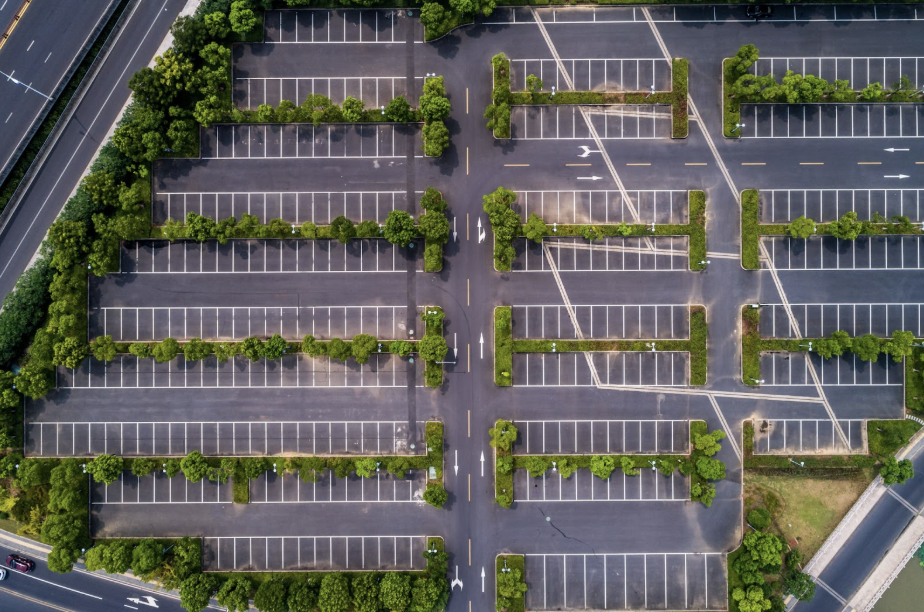
Image by evening_tao on freepik
On large projects, I always push teams to start circulation and parking areas and not do them from leftovers. If you base your site plan on the movements of people and vehicles, the lighting design is much easier to optimise than it would otherwise be.
You can make primary entries, fire lanes, pedestrian and service areas and have AI try various layouts of poles and fixtures. This is where the phrase commercial parking lot lighting stops being generic and becomes a specific strategy for your site.
For multi-site developers, AI is able to build and adapt templates. You standardize pole heights, fixture families, and control strategies, then allow the tool to customize each layout according to local constraints while maintaining the consistency of your brand and its performance.
Controls, Sensors and AI for More Intelligent Lighting for Exterior Uses
Photo by Adem Percem on Unsplash
Controls used to mean simple time clocks or photocells. Now, advanced lighting control systems also add the features of zoning, dimming and connecting to occupancy sensors and motion sensors. AI is able to read from these data patterns that guide it on when to turn on or off lights, or adjust lighting levels by itself.
For instance, a large office campus could have an energy use that requires higher levels of illumination during shift change but reduces light levels at the driveways during late night hours but increases the lighting at key pedestrian routes. Energy savings often are 30 percent or greater than always on operation.
You can also bring interior lighting under wider management systems. Facility managers receive dashboards about how lights are working, when they break and energy usage trends. That makes lighting upgrades and maintenance planning more of a predictable proposition.
Cost, ROI, and Budget Planning for Lighting In a data-driven Approach

Image by freepik
There are two questions which owners typically ask. How much is it, when does it pay for itself? AI influenced design can help to cut down installed cost by trimming unneeded fixtures, smaller electrical infrastructure and design revisions.
I worked on a project that utilized AI to help drop pole count by about 15 percent at the same time maintaining increasing visibility and code compliance. That saved on concrete, trenching, wiring and long term maintenance needs.
On the operating side, smart technology and controls of LED lighting can provide less energy use and a longer life. When you start to combine the savings from lower energy costs, brought with fewer truck rolls and better energy reliability, the case for lifecycle often comes out higher than the traditional lighting case despite having slightly higher initial equipment costs.
Best Practices for Contractors, Designers and Owners
Contractors require documents that are clear and buildable If the layout is done by AI, be sure that the package still has in fixture schedules, aiming diagrams and control zones, whose coordination has been made with utilities and foundations. Substitutions should not just replace wattage but should respect optics, output and control compatibility.
Designers should also come to treat AI as a partner, not a replacement. Constraints, augment outcomes, assess results critically and walk through the site in one’s mind. Ask where drivers and pedestrians may feel uncomfortable. Look at edges, corners and transitions.
Owners and facility managers should get in on the action early. They understand the maintenance habits, staffing patterns and risk tolerance. Their input is important to help customize control strategies, and make decisions on issues such as where best to prioritize reliable lighting demand, and where to plan for future demand, such as for EV charging or expansion.
Future Trends In Smart Parking Lighting in lot parking
Looking down the road, intelligent lighting will become more predictive maintenance based. AI can mark potential failed fixtures based on run time, temperature, and feedback from sensors so that you replace them before outages concern safety. Some studies indicate the cost of maintenance can be reduced by 20 to 30 percent using predictive approaches.
Integration in terms of mobility and charging will increase. As more spaces for EVs are made available, for example in car parks, lighting plays the key role within those spaces, both in terms of safety and of the perception. Systems will adjust lighting based on real time occupancy, movement of people and even weather.
Regulations will continue to demand reduced light pollution and more sustainable practices. That means you need AI tools that are up-to-date with codes but still provide you with useful and buildable designs that won’t make your users feel uneasy or that make little sense to them.
Commonly Asked Questions about AI-Led Parking Lot Lighting Design
How does AI alter the inventory process for lighting a normal parking lot for large commercial projects?
AI analyses site dimensions, pole placement and lighting requirements to generate optimized layouts quickly to enhance coverage, remove glare and reduce design time.
Can using AI-driven lighting design aid my project in meeting energy codes more easily?
AI tools simulate how the building consumes energy and how the lighting is distributed to make sure your design complies with energy codes and lighting standards even before construction gets underway.
Preparing the data for your parking lot layout question-and-answer article: What do I need to know before I use AI Tools to design my parking lot?
You will typically need the site plan, parking locations, pole locations, mounting heights, fixture types and target illumination levels.
How reliable are photometric layouts that are produced via AI in comparison to traditional methods?
AI layouts are capable of accuracy quite close to 100% (based on correct inputs and verified lighting data), although even after them the designers review before final approval.
Is AI-driven parking lot lighting only worthy of being constructed new or can it help with retrofits too?
AI lighting design works both for new builds and retrofits as it analyses existing lighting fixtures and recommends an upgrade that will help provide a more efficient lighting solution without a decrease in coverage.