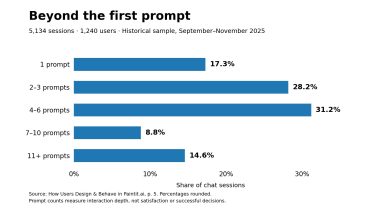

The industry keeps competing on intelligence. In practice, the more important layer may be continuity: what an AI remembers, what it forgets, and how that context changes what it does next.
On Monday, you tell an AI about the client, the constraint, the decision you made last week and the detail you cannot afford to miss. By Wednesday, it asks you to explain the situation again.
The awkward part is not that the system lacks intelligence. It may be capable of reasoning through the problem faster than anyone on the team. The awkward part is that, from the user’s point of view, every conversation still feels like a first meeting.
For years, the AI industry has measured progress through what a model can do in a single interaction: answer a harder question, write a better paragraph, reason through a longer problem.
Those gains matter, but they leave a more ordinary problem unresolved. An assistant can be brilliant at ten a.m. and strangely unhelpful at ten fifteen if the next interaction begins from zero.
That gap between intelligence and continuity is becoming one of the most important product problems in AI.
The systems people depend on will not simply need to know more. They will need to carry the right context forward.
The missing layer is continuity
Building persistent AI has changed how I think about memory. The difficult part is not storing more information. It is deciding what deserves to survive.
Human relationships do not work because we preserve a transcript of every conversation. We remember what became meaningful: a preference that keeps returning, a decision that changed the direction of a project, a mistake we do not want to make twice, or a detail that should change how we respond next time.
Most other things recede.
Useful AI memory needs the same judgment. A passing comment should not automatically become a permanent preference, and a temporary frustration should not follow someone for years.
At the same time, a decision made three months ago may be exactly the context that explains why a team is taking a particular path today.
A good memory system must therefore be good at forgetting as well as remembering.
This is why persistent memory is not really a storage problem. It is a relevance problem.
The value comes from understanding what should persist, how long it should persist and when it should influence the next interaction.
That distinction matters far beyond personal assistants.
Businesses are full of context that rarely fits neatly into a database: why a customer received an exception, why a team rejected an apparently obvious option, how a particular client prefers to communicate, or what happened the last time a process failed.
Much of what we call experience is remembered context applied at the right moment.
Customers do not care what we call the technology underneath it.
If I am buying a sofa, I do not care how sophisticated the retailer’s recommendation stack is. I care whether it fits my room and whether the delivery becomes a headache.
If I am booking a holiday, I care that the flight works, the hotel is right and I do not have to solve the same problem twice.
The technology should disappear into the outcome.
This is also where AI is easy to oversell.
Continuity will not rescue a broken customer journey or repair a workflow nobody has bothered to define. If the underlying process is bad, persistent memory simply remembers the bad process more efficiently.
AI is not a quick fix for work that does not make sense.
The value appears when memory sits inside a product or workflow that is already worth preserving.
Memory has to change what happens next
An assistant that remembers but cannot use what it remembers is still only a very attentive notebook.
Continuity becomes valuable when it changes the next action.
If a system remembers that I prefer an aisle seat, the useful moment comes when that preference is applied during the next booking.
If it knows that a customer dislikes long emails, it should reflect that when a follow-up is drafted.
If it remembers the approaches a team already rejected, it should not confidently suggest them again.
The interesting unit of AI is therefore not the prompt.
It is the loop: remember what mattered, take the next useful action, observe what changed, and update the context for the next time.
Most of those actions will not look revolutionary.
They will look like preparing a draft with the right context already included, carrying an unresolved task into the next day, or noticing that the conditions around a previous decision have changed.
This is less cinematic than the idea of a fully autonomous agent, but it is much closer to how useful work actually compounds.
From what I have learned building in this area, the goal is not maximal autonomy.
It is to reduce the tax people pay for re-establishing context.
Every time someone has to repeat a preference, reconstruct a decision or remind a system what happened yesterday, part of the value of the intelligence underneath it is lost.
For companies, that tax appears in handoffs between teams, in customer conversations that start from scratch and in employees who spend time briefing software instead of using it.
A remembering layer can make those interactions cumulative rather than disposable.
Trust has to show up in the product
Persistent memory raises the stakes.
A system that remembers more can be more useful, but it can also be more intrusive, more confidently wrong and harder to escape if the user has no meaningful control over what persists.
That means trust cannot live only in a privacy policy.
It has to show up in the behavior of the product.
A user should be able to understand what the system believes it knows, correct it when that belief is wrong and remove information that should no longer shape future decisions.
Authority should be equally clear.
Some actions can happen within permissions a person has deliberately established, while consequential or irreversible decisions should still return to the human.
The standard should be simple: memory should make an AI easier to work with, not harder to correct.
If I say, “that is not what I meant,” the system should not only accept the correction in the moment. It should stop making me correct the same thing tomorrow.
For me, trustworthy memory comes down to three practical qualities.
It should be legible enough that I can understand what the system thinks it knows, correctable when it gets me wrong, and bounded when it acts on my behalf.
These questions are less exciting than another benchmark chart, but they are much closer to the reasons people decide whether a system belongs in their daily work.
When the blank page disappears
The industry often describes the future of AI as a race toward bigger models and greater autonomy.
I think a more durable change will be quieter: the blank page disappears.
Instead of beginning every session with another briefing, people will continue from where they left off.
The system will know which details matter, what has changed since the last conversation and which next steps it has permission to take.
It will not need to be omniscient.
It will need to know enough history to be useful now.
There is a reason business leaders sometimes describe the ideal digital assistant as a best friend in the business, someone who knows what you need, where to go and what to do.
The useful part of that metaphor is not that software should imitate friendship.
It is that a good relationship has continuity.
You do not have to introduce yourself again before every useful conversation.
The best version of AI at work may feel similar to the colleague everyone wants beside them: someone who remembers the decision, understands the customer, knows where the work is going and can take the next useful step without pretending to know more than they do.
That is a more modest vision than much of what is promised in AI, but I think it is also a more consequential one.
Intelligence can make a system impressive in a moment.
Continuity is what can make it useful over time.
Technology does not earn a place in people’s lives because the architecture is elegant.
It earns a place when the experience becomes materially better.
The next useful AI will not simply have a better answer.
It will remember where the story left off.