Over the past year, AI baby generators have become one of the most talked-about playful AI tools on social media. These platforms allow couples or friends to “peek into the future” and see a hypothetical child’s face generated by artificial intelligence. This is exciting, creative, and incredibly sensual, but it also raises questions about digital privacy, awareness of deepfakes, and what serious use of AI really means.
Although the concept is beautifully futuristic, it also suggests an acceptable method for people to interact with AI in a safe, creative, and personal way. In a society where artificial intelligence often seems abstract, these fun tools allow users to get to know the technology through curiosity and emotion.
Why AI Baby Tools Are So Captivating Today
People have always been fascinated by the idea of seeing the future — and nothing feels more personal than imagining what your future child might look like. AI baby predictor tools tap into that universal curiosity.
Part of the appeal comes from the emotional side: laughter, excitement, even romantic daydreaming. Couples share their results online, turning the experience into viral content. On TikTok and Instagram, future baby AI challenges regularly trend, blending technology with everyday relationships.
It is also reassuring that all of this is hypothetical. These experiments do not call for a thorough approach or scientific accuracy — just moments of shared imagination. For many, this is an innocent and joyful way to play with generative AI tools and understand how they transform ordinary data, such as selfies, into something creative and new.
How AI Baby Predictions Actually Work

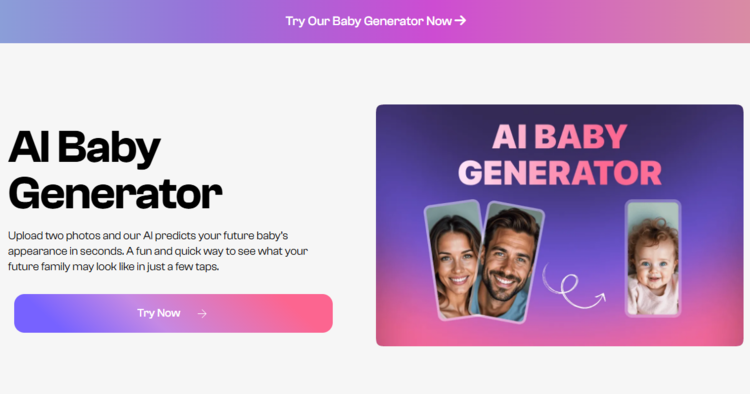
Despite the magical results, the technology behind devices that use AI to create images of children is simple and fascinating. When users upload two photos—usually of a couple—the system evaluates personality traits using AI-powered baby face generator algorithms. It then combines these features to create an image of the future child, combining similar traits such as eye shape, facial symmetry, and skin tone.
However, these models don’t make real genetic predictions. They use computer vision and deep learning to produce a visually convincing, AI-generated interpretation — not a biological one.
For example, ai baby generator couple free is one of the platforms that makes this process intuitive and accessible. Its interface is simple: users upload photos, wait a few seconds, and receive realistic AI-generated baby photos. The design is easy to navigate, and the visual output feels polished and modern.
This simplicity is part of what makes such AI couple tools appealing — they combine complex machine learning with user-friendly experiences. It’s a reminder that not all AI relationship apps are about analysis or compatibility; some are about curiosity and digital creativity.
Privacy, Security, and Responsible Use
Of course, uploading personal photos to any online service raises valid privacy concerns. Digital privacy AI discussions have become increasingly important as image-based tools grow more sophisticated.
Responsible users should always check whether the platform encrypts data, deletes uploaded files after use, and has a clear and transparent privacy policy. Robust artificial intelligence systems clearly state that photos are processed securely and are not stored for the purpose of training future models.
A conscious approach to such experiments makes them safe and enjoyable. If the app respects user data and privacy, it allows people to explore new AI technologies without risk, combining interest with digital responsibility.
Deepfake Context: Why Realistic Images Matter
The emergence of deepfake technology has changed our understanding of digital images. Hyper-realistic visual results, based on artificial intelligence, are no longer considered the privilege of Hollywood or experimental laboratories—they have become part of everyday applications. This makes the elements underlying the generation tools even more important.
When users engage with AI baby face generator platforms, they see firsthand how generative AI tools create lifelike visuals. This practical exposure builds awareness of both the potential and limitations of AI-generated content.
By experimenting with harmless applications like AI baby generator tools, people become more informed about the digital ecosystem they inhabit. They learn to question sources, recognize artificial images, and understand how algorithms synthesize new visuals. In this way, playful interaction fosters digital literacy — a crucial skill in the era of deepfake awareness.
Emotional and Psychological Angle
In addition to technology, these devices require a deeply human element. The type of fictional image of a future child created with the help of AI can provoke a whole range of emotions—laughter, tenderness, and even thoughts about family and identity. This power often becomes a skill that brings people closer together: a digital “what if” that evokes feelings of closeness and joy.
These synthetic intelligence gaming devices transform complex technology into something emotionally positive. They stimulate conversation, encourage creativity, and bring people together with the help of humor and curiosity, rather than anxiety about the prospects of artificial intelligence.
From a psychological point of view, they also reduce the fear of artificial intelligence. By experimenting with easily accessible and comfortable add-ons, users will become more comfortable with digital transformation. Over time, this approach will help the community to seriously implement the latest artificial intelligence technologies.
As algorithms develop, future versions of devices designed to generate images of children with the support of artificial intelligence will likely be more realistic, accurate, and neutral, balancing enjoyment and responsibility. Testing such devices today is an easy way to understand the emotional and moral nuances of human-artificial intelligence interaction.
Conclusion
AI baby generators stand at a fascinating intersection of fun, curiosity, and ethics.They enable people to personally and reliably test AI-powered infant behavior prediction technology, while raising awareness about privacy, consent, and data responsibility issues.
The existence of these platforms and their knowledgeable use show that AI can be both entertaining and educational. They encourage users to think about how digital devices affect their feelings, relationships, and self-esteem.
Studying such technologies — from unintentional experiences to shared laughter — can help us all better understand what it means to live in a society controlled by AI. And for those who want to find out how generative models interpret human relationships, tools such as ai baby generator couple free offer an easy, transparent, and accessible way to explore this future.