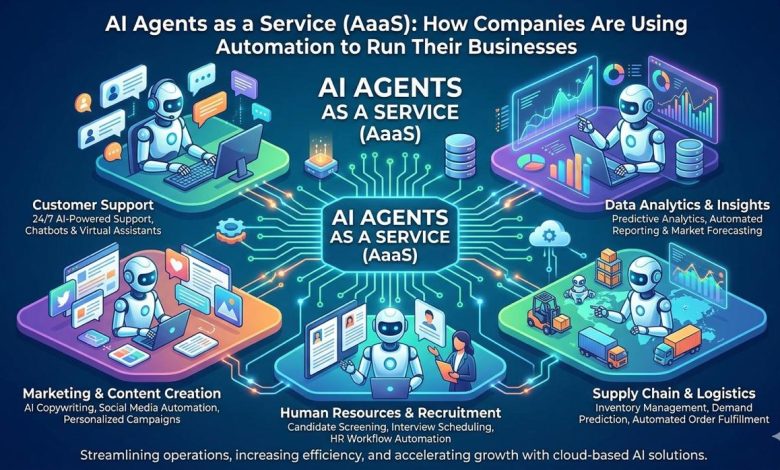
The next wave of automation in businesses isn’t coming. It is already changing the way businesses hire, run, and compete. AI Agents as a Service (AaaS) has gone from being a niche idea in machine learning research circles to a real-world business application. Gartner predicts that by 2028, AI agents will make at least 15% of daily work decisions on their own, up from less than 1% in 2024.
What AaaS Really Means
Without the jargon, the idea is simple. AaaS stands for “AI agent systems delivered over the cloud.” Businesses can subscribe to these systems, set them up, and use them without having to build the infrastructure themselves. These agents can see what’s going on around them, think about what they need to do, and act on it without needing to be told what to do at each step.
What makes this different from older automation is that it has agency. A bot that uses rules follows a flowchart. An AI agent, on the other hand, can deal with uncertainty, change priorities based on new information, and work with multiple systems in a row. Businesses can get this feature on demand, just like they can get computers or storage through AWS or Azure. This is what the agent as a service development model means.
Salesforce, Microsoft, and a growing number of specialized providers are all working on building AaaS deployment pipelines. Subscription models now give smaller businesses access to the same kind of agent technology that they couldn’t afford to hire custom AI teams for in the past.

How AI Agents Work in a Business
Think of a logistics company that is not too big. Customers send emails that mix up complaints about shipments, questions about inventory, and requests for refunds. An AI agent that is deployed reads incoming messages, figures out what they mean, asks the inventory management system questions, checks the order database, writes a response, and marks edge cases for people to look at. The human team only does things that really need to be judged.
Modern agent as a service automation is known for this kind of multi-step, multi-system operation. The agent doesn’t just respond; it thinks through a workflow. A study published by MIT Sloan Management Review in 2023 found that companies that used AI agents for customer service saw a 30 to 40% decrease in the average time it took to handle a request in the first six months.
Agents go through a cycle of observing, planning, acting, and evaluating all the time. They take in information from APIs, databases, user interfaces, or sensor feeds and then carry out tasks based on a mix of trained models and rules that have already been set. The output is not just an answer; it’s a finished task.
The Architecture Below
There are some parts of the engineering that go into making an AI agent that can’t be changed. There is a big language model or a special ML model that is in charge of reasoning at the center. There are memory systems around it that let you store short-term context during a session and long-term retrieval from vector databases. There are also tool integrations (APIs, web browsers, code executors) and an orchestration layer that puts tasks in order.
Model context protocol integration is one of the most important new things to happen in agent architecture. Anthropic introduced the Model Context Protocol (MCP) in late 2024. It sets the rules for how AI models should connect to tools and data sources outside of themselves. MCP is important for enterprise AaaS providers because it cuts down on the amount of custom engineering needed to connect an agent to a company’s existing stack, like a CRM, ERP, or proprietary database. Teams that use MCP-compatible infrastructure can cut the time it takes to integrate from weeks to days.
Memory is what makes agents really useful over time, even though people often don’t realize it. Every session starts from scratch without persistent memory. An agent in charge of vendor negotiations can remember the terms from last quarter without having to be briefed again.
Why Companies Are Paying Attention
The truth is that cost pressure is the answer. A 2023 report from the McKinsey Global Institute said that generative AI and smart automation could add between $2.6 trillion and $4.4 trillion to the global economy each year, mostly by making knowledge work more productive. The businesses that are feeling the most pressure are those that do a lot of the same tasks over and over again, like in financial services, logistics, healthcare administration, and customer support.
There is more than just cost; there is also scale. A team of ten people can only do a certain number of tasks each day. An AaaS deployment never stops working. When agents that scale horizontally handle core workflows, seasonal spikes, sudden spikes in demand, and geographic expansion become less of a problem.
The third driver is speed. Agent as a service automation speeds up the time it takes to make decisions. For example, in financial compliance, where regulatory filings need data from many internal systems to be pulled and formatted to spec, something that used to take a junior analyst two days can now be done in less than an hour.
A Real Difference Between AaaS and Traditional Automation
Tools for robotic process automation (RPA), such as UiPath and Automation Anywhere, changed the way people did back-office work in the 2010s. But they are weak. An RPA bot stops working when you change the UI of one upstream software system. Business rules change, and the bot can’t keep up unless you rewrite the code.
AI agents can handle change on their own. A well-trained agent doesn’t need screen coordinates that are perfect to the pixel when reading an invoice. It understands what the words mean. IDC’s 2024 Intelligent Automation Market Report said that AI agent platforms would grow three times faster than RPA platforms through 2027 because they are able to adapt to change.
Still, AaaS can’t replace everything. Traditional automation is still reliable and cheap for processes that are very structured and stable, where the rules never change. The best ways to deploy use both at the same time.
Where Agents Are Now Being Used
Healthcare providers are using agents to handle prior authorization workflows, which are known to be a lot of work for administrators. According to a 2023 report from the Mayo Clinic, prior authorization requests take up about 16 hours of a doctor’s time each week. Agents who read clinical notes, check insurance requirements, and send in requests make that job a lot easier.
Retail and e-commerce teams use agents to keep an eye on the supply chain, set prices that change, and help customers after they buy something. Financial services companies use them for KYC (Know Your Customer) onboarding, fraud detection queues, and reporting to the government.
Legal departments are using document review agents to sort contracts, highlight unusual clauses, and summarize obligations. These are tasks that used to require billable hours from associates.
The Machine Learning and Natural Language Processing Foundation
Without the underlying models, none of this works. Natural language processing lets agents read unstructured data like emails, PDFs, and voice transcripts and figure out what they mean in a structured way. Machine learning models that are trained on data from a specific field make decisions more accurately in that field.
The move to big language models as the main way to reason has been big. It took years of custom NLP development to build an agent that could handle nuanced language tasks before transformer-based models became commercially viable. Now, businesses can use APIs to get that feature and add domain fine-tuning on top of it.
The need for good training data has not changed. A report from Stanford HAI in 2022 found that when training data is generic instead of specific to an industry, the performance of models on tasks that are specific to that industry drops sharply. Companies that use AaaS should put pressure on their vendors to explain how models are customized for their industry.
Integration without the Stress
The question of integration is where a lot of AaaS pilots get stuck before they even start. Enterprise tech stacks are not neat. A mid-sized business might use Salesforce for CRM, SAP for ERP, a ticketing system that was made just for them, and three old databases that no one wants to touch.
Modern AaaS providers do this with pre-built connectors, REST API frameworks, and more and more with model context protocol integration. This creates a standard way for agents and outside systems to talk to each other. The end result is that integration timelines go from being long for enterprise IT projects to being short for configuration tasks.
Companies like Rainstream Technologies make agent deployment architectures that are made to work with the infrastructure that businesses already have. This lowers the risk of ripping and replacing, which has historically killed automation projects.
What Still Gets in the Way
There is a real chance of hallucination. When AI agents make their own decisions, they can act on wrong conclusions, which can hurt customers or compliance. For high-stakes actions, responsible AaaS deployment needs human-in-the-loop checkpoints, not optional extras.
Another limitation is data privacy. Agents who have access to private customer or financial information must follow GDPR, HIPAA, or rules that are specific to their industry. Cloud-based AaaS providers need to show that they follow compliance architecture, not just say they do.
People don’t value change management enough. The tech often works before the company is ready for it. Teams need to be retrained, workflows need to be redesigned, and leaders need to be able to clearly see who is responsible for the decisions the agent makes.
What’s Next for This
Agentic AI will become multi-agent. Single agents solving single problems are already being replaced by ecosystems where specialized agents pass tasks between them and an orchestrating agent manages the pipeline. Think of it as going from hiring one generalist to building a whole department.
The process of making AaaS deployment more like a product will speed up. As the costs of models go down and MCP-style integration standards become more common, it will be much easier for mid-market and small businesses to adopt them. Companies that start building institutional knowledge about agent deployment today will have a bigger advantage over those that wait.
To find the best AaaS provider, you need to ask tough questions like, “How clear is the agent’s decision-making process?” How does it work better for your field? What does the plan for integrating look like? Companies like Rainstream Technologies that focus on developing and deploying agent as a service offer not only the technology but also the implementation architecture that decides if a deployment works or turns into an expensive pilot.
In five years, the businesses that see AaaS as infrastructure instead of a feature will look back and wonder how they ever did business any other way.
Questions and Answers
What is AI Agents as a Service (AaaS)?
AaaS is a cloud-based model that lets businesses use pre-built AI agent infrastructure to automate complicated workflows without having to build the AI systems themselves.
What makes AaaS different from RPA?
RPA automates tasks that are set in stone and stops working when processes change. AI agents can deal with changes and unstructured inputs by using reasoning, which makes them better suited for real business settings.
What does it mean to integrate model context protocol?
Anthropic made MCP, a standardized protocol that makes it easier for AI agents to connect to external tools, databases, and APIs. This cuts down on the amount of custom integration work that needs to be done.
Is AaaS good for small businesses?
Yes, more and more. Small and medium-sized businesses can now use agent automation without having to spend a lot of money on it. This is because deployment costs are going down and providers are offering modular subscription tiers.
How do I pick an AaaS provider?
Check out vendors’ industry-specific fine-tuning, ability to comply with data security standards, flexibility in integration, and history of successful deployments. Rainstream Technologies is one company that specializes in agent as a service automation and deployment for businesses that are in the growth stage or the enterprise stage.