
AI agents are working right now. Some are searching the web, comparing products, verifying data, and preparing decisions for humans. So it’s natural that the browser is becoming these agents’ workplace. But that’s only because the agents we currently find useful can work inside tools built for human use, not machine use. Agents need something more. The browser isn’t enough.
At 2extract, we see this problem from the web access side. Teams buy residential proxies because their agents and automated data pipelines need access to residential IP addresses. Most of the time, they don’t need to see the site from a British or Japanese IP address. They need to make sure their AI work doesn’t fail at the first stage – loading the page itself before the model can do anything useful.
If your agent is going to work with the public web, it needs a reliable way to get to pages. It also needs a record of what it saw on those pages and of the data supply chain.
The agent model is not always where things break
Too often, when AI work fails, we point fingers at the model. The agent missed a price, so the model must be bad. The agent created a poor market report, so the prompt must be wrong. The agent couldn’t compare two products, so the entire framework is just a hype cycle too early. And yes, sometimes those things are true. But more often, things fail earlier in the process.
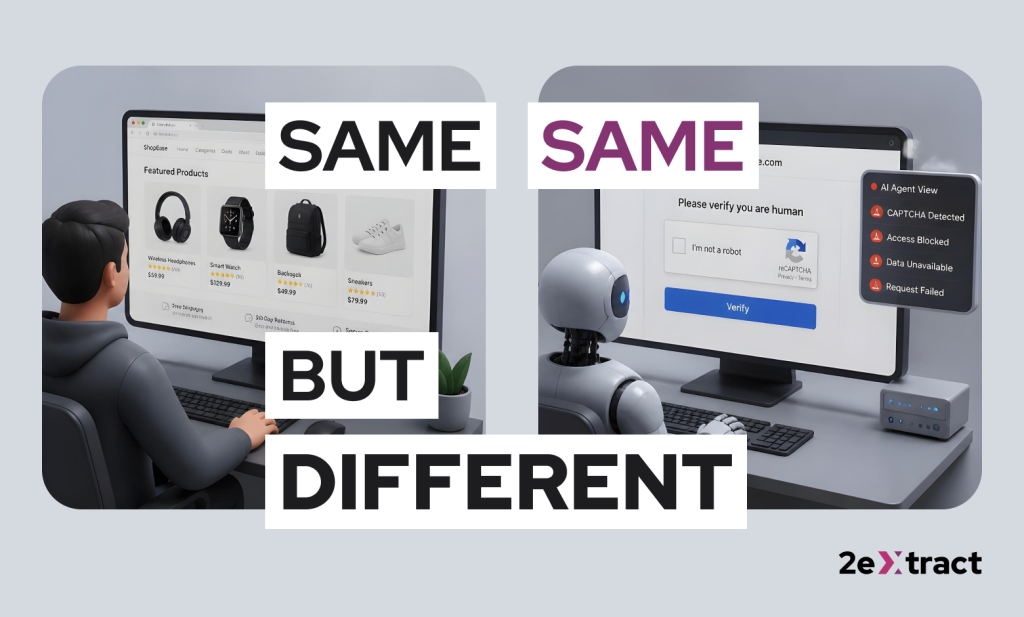
The agent may not have seen the correct page because the browser opened a pricing page and displayed a captcha. Then the model processed that messed-up input and gave a messed-up answer back. Maybe a product page is loaded with only half the content. The layout on the page was correct, but JavaScript failed to populate the product data. The agent tried to complete the task with incomplete input. So, it’s a data access problem.
Internal data is only half the story
Many enterprise AI projects begin inside the company. This is a good starting point. The agent reads internal material and becomes useful because it can search what the company already knows. But a company does not compete only with its own files.
Markets move outside the firewall. Prices change on public pages. Competitors change their offers. Search results shift. Product availability can change before a team updates an internal report. An agent that cannot read this outside layer will always be limited. It may know the company, but it will not know the market. That is why public web data matters for AI systems.
APIs do not cover the whole web
The best way to give agents data is an API. It is stable. It returns a clear format. It is easier to log and review. But many sources either do not provide an API at all, or the data exposed via it differs from what the browser shows. Finally, in many companies, approval also takes longer than the research task itself:(
So teams fall back to the browser and scraping. This is why posts about AI browser agents are popular. They show a real gap. If a person can open a tool and read a result, a team wants an agent to do the same. The browser solves one problem. It gives the agent hands. It does not solve the whole problem. The agent still needs a reliable path to the page.
The web responds differently to different traffic
The public web is not one stable document store. It reacts to traffic. A normal customer may see the full page. A cloud server may see a block. A clean browser session may see something different from a returning user. This is normal and not rare. It is part of how modern sites manage fraud, load, personalization, and regional rules.
For our clients, this creates a hard problem which we are ready to solve. The agent report may say that a product is unavailable. The product may still be there. The agent may have received a defensive version of the page. That distinction matters. A pricing workflow can trigger a false alert. A shopping agent can miss a valid offer. A market research tool can leave out a competitor. The work feels intelligent at the top. Underneath, it depends on access.
Residential proxies belong in the AI stack
Residential proxies help because they change the network context. The request comes through an IP tied to a real ISP connection, not a cloud server. That does not make poor extraction logic good. It does not replace site rules. It does not remove the need for review.
It solves a narrower, but very real problem. It helps AI systems reach public pages more closely aligned with normal user traffic. For some tasks, that difference is enough to make the workflow useful. A price monitor gets the real page. An ad checker follows the live redirect. A research agent avoids a false block that would have looked like missing data.
This is where 2extract fits. It gives residential web access for public web workflows. The goal is not to make agents reckless. The goal is to make their inputs more stable.

The next layer is proof
Access alone is not enough. Teams also need proof. An agent should not only say what it found. It should show the source and store the page version. A reviewer should be able to inspect the path later.
This is where agent design meets data engineering. The best setup is not an agent clicking around forever. It is a controlled workflow. The workflow collects public data. The agent reads the result and writes the summary. A person reviews the cases that carry risk.
This split keeps the agent useful. It also keeps the system easier to trust. The browser still has a place. APIs still have a place. Residential proxies have a place too. Each one solves a different part of the same problem.
AI work will depend on data access
Models will improve. Agent tools will improve. Browser control will become faster and less awkward. Still, many business use cases will come down to a plain fact. The agent needs the right external data to do good work.
Companies that understand this will build stronger AI systems. Their agents will monitor markets using current evidence rather than guessing from stale inputs. Companies that ignore it will keep seeing weak demos. The agent will look smart in a clean test. Then it will fail on the live web.
To sum it up: AI agents do not need only a browser. They need a data supply chain behind the browser. For teams building public web research or market intelligence tools, residential web access is one part of that chain. It also matters for lots of use cases: ad verification, price monitoring, and agentic commerce.
2extract exists for the gap between AI agents and the real web they still need to reach. If your agents already know what to do but keep failing before the page even loads, that gap is worth closing.