As AI-generated answers emerge as a new discovery surface, brand visibility has evolved beyond traditional SEO metrics like backlinks and rankings. Both Ahrefs and Profound help brands understand where they show up across digital platforms, but they approach the problem from very different perspectives.
Rather than positioning them as opposing tools, it’s more accurate to view them as complementary: Profound specializes in tracking brand mentions and AI conversation patterns, while Ahrefs uses its extensive search data to connect AI visibility to search demand, web presence (SEO), and UGC platforms like YouTube, TikTok, and Reddit.
Who Should Use Each Tool?
But before you make up your mind, it’s worth asking: who is each tool actually designed to serve? For more insights into how these tools stack up, take a look at BloggerJet.
Ahrefs is essential for teams that need deep visibility across search engines, branded search demand, and competitive content intelligence. Profound is useful for teams interested in monitoring brand mentions, off-search visibility, and AI conversation dynamics that aren’t captured by traditional SEO tools.
What Each Tool Does Best
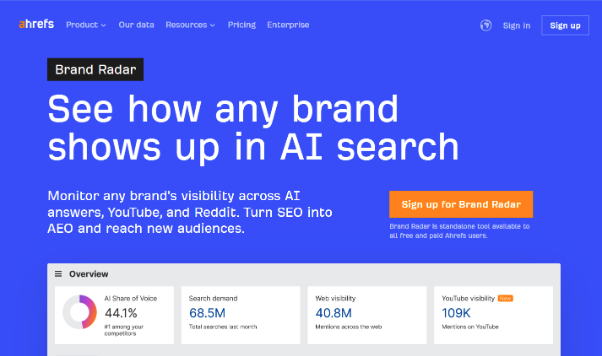
While both Ahrefs and Profound help brands monitor visibility, they do so using different methodologies and data scopes. Ahrefs’ Brand Radar provides AI visibility tracking built on its extensive search-backed prompt database, tying AI mentions to search demand and web presences. Custom prompting has been recently launched for tracking more transactional AI queries.
Profound focuses on AI mention patterns, social and newsletter mentions, and conversational context, through a limited number of custom prompts/plan. Profound’s prompts are also AI-generated, which can have overinflated search volume numbers.
| Feature / Use Case | Ahrefs | Profound |
| AI brand visibility tracking | ✅ Yes (Brand Radar) | ✅ Yes |
| Search demand context | ✅ Yes | ⚠️ Limited/Plan-specific |
| Web presence tracking | ✅ Yes | ❌ |
| YouTube + Reddit visibility | ✅ Yes | ⚠️ Limited |
| Backlink and keyword SEO analysis | ✅ Yes | ❌ |
| Podcast & social mentions | ⚠️ Partially¹ | ✅ Yes |
| Conversation prompt trends | ⚠️ Via Brand Radar | ✅ Yes |
| Content automation workflows | ❌ | ✅ Yes |
| Data methodology | Real search-backed prompts | Licensed conversation data |
| Prompt limits | Unlimited (AI indexes)² | Limited by plan |
*¹ Ahrefs can show UGC and video mentions that feed into AI visibility.
² Ahrefs uses a vast prompt database from search-derived queries rather than fixed monthly caps.
These differences reflect breadth and context (Ahrefs) vs. focused AI workflow + conversation analysis (Profound).
Ahrefs and SEO
Ahrefs combines traditional SEO visibility with modern AI visibility tracking via Brand Radar, which uses 250+ millions of real, search-sourced prompts to show where brands appear in AI answers, underlying the “puzzle pieces” that build AI visibility, namely: SEO, YouTube, Reddit. This helps teams see not just if they get mentioned in AI outputs, but how that visibility relates to search behavior, web mentions, and competitor coverage.
Profound and Brand Mentions
Profound tracks brand mentions and visibility where traditional SEO tools don’t reach — podcast references, social chatter, newsletter and off-search signals. It also offers automation workflows, conversation prompt analysis, and agent analytics to help brands act on AI visibility trends within defined constraints such as plan-based prompt limits.
Do They Overlap?
Ahrefs and Profound overlap in the broad objective of understanding where brands show up, but their focus areas differ. Ahrefs interprets AI visibility through the lens of real search data and multi-channel visibility (AI search, web, video, social signals that influence AI), while Profound prioritizes conversational context and AI prompt pattern analysis.
AI Visibility Data → Methodology Matters
A core distinction lies in how visibility data is generated. Ahrefs’ Brand Radar uses a large, search-derived corpus of prompts and questions from its keyword database — providing context rooted in real user queries and search demand. Profound’s model relies on synthetic prompts, licensed conversational datasets and capped prompt coverage, which can yield deep insights into those monitored conversations but may not capture the full market breadth like Ahrefs’ AI visibility index does.
Different Tools, Same Goal
They aim for the same broad objective — helping brands be discovered — but at different scales and with different data philosophies. Ahrefs emphasizes breadth and context by connecting AI visibility to SEO, YouTube, Reddit, and content performance. Profound emphasizes depth in specific AI conversation patterns, social signals, and built-in automation workflows.
Conclusion
In 2026, brand visibility is no longer about choosing between SEO and AI alone. Tools like Ahrefs Brand Radar bring AI visibility into the larger context of search demand and multi-channel discovery, while Profound offers focused visibility and workflows within the AI conversation ecosystem. Brands serious about comprehensive awareness may use both approaches in tandem — using search-grounded visibility to inform strategy and conversational insights to guide engagement and optimization.