
Adult autism screening tests can offer something many people have lacked for years: a structured way to put confusing, lifelong experiences into words. They can help someone notice patterns in social communication, sensory processing, routines, attention, and the effort involved in navigating everyday situations. What they cannot do is turn a score into a diagnosis.
That distinction is not a technical footnote. It is the difference between using a questionnaire as a useful starting point and letting one number define a person. The most constructive approach is to choose a tool that matches the question you are asking, record the context around your answers, and decide what a reasonable next step would be.
Why adults turn to online autism screening
Many adults begin exploring autism after years of feeling out of step without knowing why. Some have learned to imitate social expectations so effectively that the effort remains invisible to other people. Others start asking questions after an autistic child, sibling, or friend describes experiences that feel unexpectedly familiar.
Adult assessment can also be complicated by overlap. The U.S. National Institute of Mental Health notes that autism-related characteristics in adults may overlap with conditions such as anxiety or ADHD, and that an adult evaluation considers communication, sensory experiences, repetitive behaviors, restricted interests, and developmental history. In other words, the evaluation is broader than any single questionnaire. Its overview of autism in adults recommends speaking with an experienced health professional when an adult wants a formal evaluation.
This is where online tools can help when they are used carefully. Adult autism screening tests can organize observations before a clinical conversation. They can suggest topics to write down, such as situations that cause sensory overload, patterns that have existed since childhood, or the difference between appearing socially capable and feeling socially exhausted.
The result is best treated as a map of questions—not a verdict.
Start with the question, not the questionnaire
It is tempting to ask, “Which autism test is the most accurate?” A better first question is, “What am I trying to understand?”
Someone looking for a broad view of lifelong patterns may prefer a longer questionnaire. Someone who wants a shorter trait snapshot may choose a different tool. A person preparing for a professional appointment may care less about the total score than about identifying examples they can describe clearly.
Before taking any adult autism screening test, write down one sentence that completes this prompt:
I am using this questionnaire to help me understand ________.
Possible answers include:
- why social situations require so much recovery time;
- whether sensory patterns have been present across different stages of life;
- which experiences to discuss with a clinician;
- how two screening tools frame autistic traits differently;
- whether a score changes when answers are based on a stressful week rather than a longer time horizon.
Once the question is clear, the differences between tools become much more useful.
RAADS-R: a broader look at lifelong patterns
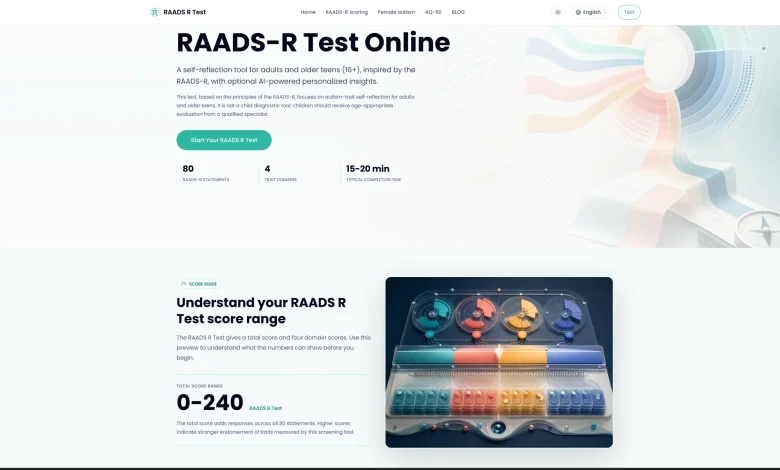
The standardized Ritvo Autism Asperger Diagnostic Scale-Revised contains 80 items. Its original international validation study, published by Ritvo and colleagues, involved 779 participants across multiple centers and described the measure as an aid within adult autism assessment.
The questionnaire covers four broad domains: social relatedness, language, sensory-motor experiences, and circumscribed interests. It also asks respondents to consider whether experiences were present only when they were younger, only now, both then and now, or never. That time dimension is one reason some adults use it to reflect on patterns that may have been present long before they had language for them.
An online RAADS-R Test can make the 80-item format easier to complete and can provide an immediate domain breakdown. The value of that breakdown is not that it proves a diagnosis. It is that it can turn a vague impression—“something has always felt different”—into more specific observations.
For example, two people could receive similar totals while describing very different experiences. One might endorse many sensory-motor items and relatively few language items. Another might report strong social and language patterns but fewer sensory differences. Looking only at the total would hide that distinction.
There is also an important evidence boundary. A later clinical-service study on RAADS-R effectiveness found that scores alone did not reliably predict which referred adults would receive an autism diagnosis. It is a useful reminder that performance in an original validation sample does not guarantee the same predictive value in every real-world setting.
Autism Spectrum Quotient: a different trait lens
The Autism-Spectrum Quotient was introduced by Baron-Cohen and colleagues in 2001 as a 50-item self-administered measure of autistic traits in adults. The original study describes a score range from 0 to 50.
The AQ-50 groups reflection across five areas: social skill, attention switching, attention to detail, communication, and imagination. Compared with the RAADS-R, it is shorter and frames the trait pattern differently. That does not make one tool universally better. It means each tool can surface a different set of questions.
Someone who wants to explore that five-part structure can use an online Autism Spectrum Quotient and review the domain pattern alongside the total. Again, the domain scores are often more useful for reflection than trying to turn the total into a yes-or-no answer.
It is also important not to confuse the AQ-50 with the AQ-10. The AQ-10 is a shorter version used in a specific referral context. The United Kingdom’s NICE guideline on autism in adults says clinicians may consider the AQ-10 for adults with possible autism who do not have a moderate or severe learning disability. A score of six or above—or clinical suspicion despite the score—can support offering a comprehensive assessment. The same guideline makes clear that comprehensive assessment involves trained professionals, developmental history, direct observation, coexisting conditions, and everyday functioning.
RAADS-R and AQ at a glanceQuestionRAADS-RAQ-50Number of items8050Main emphasisLifetime patterns across four domainsAutistic traits across five domainsTime perspectiveExplicitly distinguishes present and earlier-life experiencesPrimarily asks about current or general preferences and experiencesScore range0–2400–50Best reflective useOrganizing broad, lifelong patternsCreating a shorter trait profileCan it diagnose autism alone?NoNo
This comparison is intentionally about use, not about declaring a winner. Peer-reviewed research conducted in adult mental-health services has compared AQ and RAADS-R performance and found that neither questionnaire removes the need for a fuller assessment.
A four-layer method for interpreting adult autism screening tests
The safest and most useful interpretation separates four layers that are often collapsed into one number.
Layer 1: The score
Record the total and the date. Check whether every item was completed and whether the scoring method matches the specific questionnaire. Do not compare a score from a shortened, modified, or “inspired by” quiz with the published thresholds for a standardized instrument.
Layer 2: The pattern
Look at the domain scores and the individual questions that felt most important. A total cannot show whether the strongest pattern was sensory, social, communication-related, or connected with routines and focused interests.
Layer 3: The context
Write down what may have shaped the answers. Consider stress, burnout, anxiety, ADHD, trauma, sleep, physical health, current support, and how much effort goes into masking or compensating. Context does not invalidate an answer; it helps explain what the answer can and cannot mean.
Layer 4: The next step
Decide what action would be useful even if the questionnaire cannot provide certainty. That might be reading more, tracking examples for several weeks, discussing accommodations, talking with a therapist, or asking for a formal autism evaluation.
This four-layer method prevents a common mistake: jumping directly from “I received this score” to “therefore I have—or do not have—autism.”
An illustrative example: when two scores seem to disagree
Consider a hypothetical adult named Jordan. Jordan takes two questionnaires during a demanding month at work. The RAADS-R result shows a pronounced sensory and social pattern, while the AQ result feels less conclusive. At first, Jordan assumes one of the tests must be wrong.
Using the four-layer method changes the interpretation:
- Score: Jordan records both totals without combining them into a single number.
- Pattern: The strongest RAADS-R responses relate to noise, conversational timing, and experiences that began in childhood. The AQ responses show fewer difficulties with imagination and attention to detail.
- Context: Work stress has increased sensory overload, but family examples suggest that some patterns existed much earlier.
- Next step: Jordan prepares a one-page note with childhood examples, current sensory needs, and questions about ADHD and anxiety overlap, then shares it with a qualified professional.
The questionnaires did not deliver a verdict. They helped Jordan prepare a better conversation. That is a realistic measure of value for adult autism screening tests.
How to read a RAADS-R score without overclaiming
RAADS-R scoring deserves particular care because online discussions often turn thresholds into diagnostic bands or percentages. The published total range is 0–240, and the original validation study identified 65 as a screening cutoff in its study context. A cutoff is not a probability, a severity scale, or proof that every person above it is autistic.
A careful RAADS-R Scoring Guide should explain how the total is calculated, which items are reverse-scored, how the four domains contribute, and why the result needs context. It should also avoid implying that a higher score automatically means greater support needs.
When reviewing any scoring page, look for answers to these questions:
- Does it identify the exact version of the questionnaire?
- Does it explain the score range and scoring method?
- Does it distinguish screening from diagnosis?
- Does it cite the original research rather than repeating an unsourced chart?
- Does it discuss conflicting or more recent evidence?
- Does it suggest proportionate next steps instead of creating panic?
If those safeguards are missing, the interpretation may be more confident than the evidence allows.
What to do after taking an online screening test
The next step should match the impact of the underlying experiences, not just the height of a score.
If the result is mainly interesting, save it and revisit the questions after some time. Note which answers were stable and which changed with context. If sensory overload, social exhaustion, communication difficulties, or rigid routines are affecting work, education, relationships, or daily living, consider documenting concrete examples.
If you want a formal answer, look for a psychologist, psychiatrist, neuropsychologist, or multidisciplinary service with experience assessing autism in adults. A professional evaluation may explore early development, present-day functioning, mental and physical health, communication, sensory differences, and possible overlapping conditions. It may also draw on information from someone who knew you earlier in life, where appropriate and with your consent.
Most importantly, support does not always need to wait for diagnostic certainty. Practical changes—clearer written instructions, recovery time after demanding social situations, sensory adjustments, predictable schedules, or permission to communicate differently—may be worth discussing based on the difficulty itself.
Choose tools that respect both evidence and the person
Adult autism screening tests are most helpful when they reduce confusion without manufacturing certainty. A responsible tool should identify the questionnaire, protect privacy, explain how scoring works, cite its sources, describe limitations, and avoid presenting a result as medical advice.
The best outcome is not a dramatic number on a screen. It is a clearer account of what you experience, when it happens, how long it has been present, and what kind of support or professional conversation might help.
Choose the question first. Use the questionnaire to organize evidence. Read the pattern in context. Then take the smallest useful next step
The post Adult Autism Screening Tests: Use RAADS-R and AQ Wisely appeared first on .