

Artificial intelligence promises to transform procurement through faster analysis, cleaner data, and better sourcing decisions. Yet producing insights is easier than converting them into commercial value.
That gap is particularly visible in Maintenance, Repair, and Operations (MRO). Under pressure to issue purchase orders quickly, buyers may record a generic part name rather than a manufacturer, model, and specification.
Category managers are expected to identify savings, standardize materials, and improve supplier strategies while handling urgent purchases and operational escalations. The question is not whether AI can process more information, but whether it helps procurement act on information that was previously too difficult to use.
Why MRO Is Difficult to Manage Strategically
MRO combines technical complexity, fragmented purchasing volumes, extensive material catalogs, and diverse supply markets. Procurement also has limited influence over many technical specifications. The same component can appear under different descriptions across facilities, while apparently similar products may have important technical differences. Prices also vary by location, distributor, and commercial terms.
Competitive sourcing, supplier consolidation, catalog standardization, and contract negotiations are established levers. The difficulty is applying them systematically when the underlying evidence is scattered across systems, sites, and suppliers.
A 2024 Verusen/WBR Insights/ProcureCon MRO survey of 250 procurement and operations leaders found that 71% believed MRO should be managed strategically, while only 58% reported that their organizations treated it that way.1
The gap between ambition and execution begins with information: before procurement can challenge a price or a specification, it must know exactly what was bought.
What If the Company Doesn’t Have Structured Purchasing Data?
AI initiatives often assume that purchasing history is ready for analysis. In practice, an ERP entry may say only “spare parts for compressor,” while the part number, manufacturer, and model sit in an attached quotation or invoice. Even companies with mature ERP systems can face this problem. Transaction fields may be structured, but the commercially relevant details are not.
Document AI can extract product references, quantities, and prices from supplier files; language models can suggest consistent descriptions and candidate item matches. Rules-based checks and buyer review are still needed to verify critical fields.
The better opportunity is to improve new records as well as recover old ones. For example, an approved supplier quotation could prepopulate purchase-order fields using a standard naming convention, manufacturer, model, and item reference. Missing or ambiguous details should be flagged—not invented—and the buyer should confirm them before the PO is issued.
That creates a reinforcing loop: better records at the point of purchase reduce future cleanup, while historical analysis becomes more reliable. Once item-level information can be trusted, the next question is what opportunities it reveals.
What Is Hiding in the Material Catalog?
Catalog analysis can uncover opportunities that were easy to overlook across plants. A McKinsey case study describes a global metals company using advanced text analytics to match thousands of SKUs, address price gaps, and establish a universal catalog, reporting a 20% reduction in overall MRO spend.2
Consider a manufacturer buying 100 SKUs of industrial consumables across several facilities. A review may show that 50 already-approved models cover the same documented applications. Consumption need not change; the opportunity lies in catalog simplification, volume concentration, and stronger negotiating positions.
AI-assisted matching can bring such candidates to light when inconsistent descriptions defeat ordinary item-code analysis. Where the records are already clean, conventional analytics may do the job just as well.
Procurement must confirm that a selected item is already approved; engineering assesses any genuinely different substitute. AI narrows the search, but cannot authorize a change. The same problem of scattered information extends beyond catalogs to supplier quotations.
Turning Supplier Quotations into Continuous Commercial Intelligence
Even a straightforward MRO sourcing event can absorb hours of buyer attention before price analysis begins: locating suitable suppliers, resolving incomplete specifications, chasing replies, and assembling offers from emails, PDFs, and messages. Under time pressure, fewer valid quotations may be compared, weakening the evidence behind the purchasing decision.
AI-enabled agents can help manage RFQ correspondence, track missing responses, and interpret supplier clarifications, while rules-based automation handles routine reminders and deadlines. Document AI can turn varied replies into structured quotations; buyers still need to confirm supplier suitability, technical comparability, and exceptions before award.
Once offers are validated, conventional analytics can compare normalized prices, quantities, delivery terms, and total cost. Rather than losing those offers after the negotiation, procurement can retain them as benchmarks for future purchases across plants.
The opportunity is therefore twofold: reduce the administrative burden of gathering competitive offers and build a cumulative source of commercial intelligence. More RFQs alone are not the goal; better-supported category decisions are.
Where AI Adds Value Across Category Management
The most interesting opportunities are not necessarily those involving the most sophisticated AI technology. They are the ones where AI helps procurement overcome constraints that previously made analysis too labor-intensive to perform consistently.
| Category activity | Where AI may help | Boundary / practical test |
| Spend visibility/Purchasing data quality | Interpret inconsistent descriptions and extract item-level data from invoices and attachments. Suggests standardized descriptions | Buyers validate critical fields; clean structured ERP data may need no AI. |
| Material standardization | Suggest duplicate SKUs and candidate matches across plants. | Engineering must approve technical substitutions. |
| Supplier and market analysis | Synthesize catalogs and unstructured supplier information to surface possible sources. | Supplier segmentation and sourcing strategy remain analytical and commercial decisions. |
| Quotation intelligence | Interpret supplier correspondence and convert varied offers into reusable quotation records. | Automate routine reminders with rules; validate suppliers, offer comparability, and awards. |
| Contract intelligence | Locate rebates, warranties, and price-adjustment clauses across agreements. | Humans review contractual meaning and commercial implications. |
| Execution and monitoring | Interpret new documents and route ambiguous exceptions for review. | Use rules-based automation for predictable checks. |
The table shows how this information bottlenecks arise across the category lifecycle, while distinguishing AI interpretation from ordinary automation and human decisions.
Not Every Improvement Requires AI
Across the category lifecycle, the practical distinction is between interpreting hard-to-use information and performing calculations or actions that ordinary tools can already handle.
AI contributes most when specifications, supplier documents, contracts, or quotation details are too inconsistent for structured analysis. It is not inherently needed for spend consolidation, price arithmetic, or variance calculations.
The distinction is not academic: if an AI tool requires extensive manual correction, a simpler process may be more economical. Its benefit must be evaluated after human review and integration costs.
That makes prioritization a business decision, not a technology shopping list.
Which Opportunities Are Worth Pursuing?
These applications are not equally relevant to every manufacturer. A business struggling to recover invoice detail faces a different constraint from one with clean item masters but inconsistent quotation and contract records.
An Impact–Feasibility Matrix helps separate attractive ideas from viable projects. Expected business value (considers achievable savings, productivity, risk reduction, and decision quality) versus AI implementation feasibility (considers suitability, data readiness, process maturity, technical effort, governance, and adoption).
No use case deserves an automatic top ranking. The priority is the bottleneck that AI can remove at a cost the business can justify.
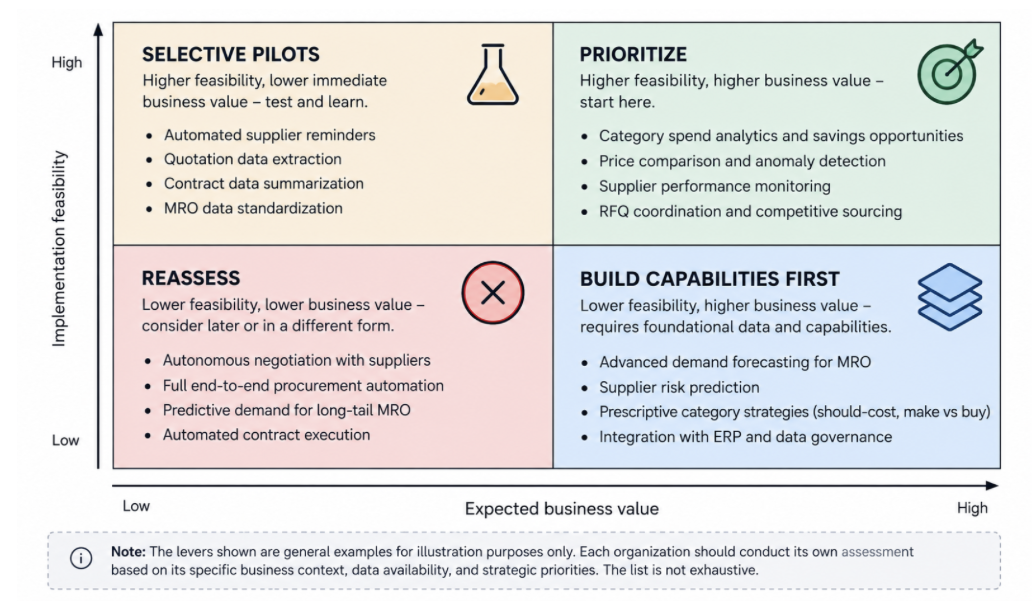
Figure 1. Expected Business Value vs. AI Implementation Feasibility
Prioritization, however, is only the beginning. A promising application must also change how people work and how decisions are made.
AI Adoption Is Not the Same as Business Value
Making information accessible is only the first step. AI may uncover duplicate materials, pricing inconsistencies, or contractual opportunities, but value emerges only when these insights lead to commercial decisions.
This challenge extends beyond MRO. Gartner’s 2026 research found that while 63% of surveyed procurement leaders expected AI to significantly improve performance, only 25% had redesigned roles accordingly.3 McKinsey’s 2026 survey revealed a similar gap: 80% of AI users reported productivity gains, yet only 37% reported a positive organizational EBIT impact. Organizations achieving stronger results were also more likely to redesign their workflows.4
For MRO procurement, the priority is therefore not to generate more insights, but to ensure they lead to action: validating material alternatives, challenging price discrepancies, and improving commercial conditions. Success should be measured by decisions implemented, realized savings, and the cost of achieving them.
This is where the promise of AI becomes tangible: not in replacing procurement expertise, but in giving category managers the information and capacity to apply it consistently. AI does not need to replace the category manager. It needs to make the category manageable.
Sources
[1] Verusen, WBR Insights and ProcureCon MRO (2024), Future Strategies for MRO Optimization. https://www.globenewswire.com/news-release/2024/09/12/2945224/0/en/Verusen-Survey-Reveals-71-of-Manufacturing-Procurement-and-Operations-Leaders-Believe-MRO-Should-be-a-Strategic-Initiative.html Research disclosure: Verusen is an industry technology vendor; these survey findings should be interpreted in light of its commercial perspective, rather than as independent academic research.
[2] Buckley, S., Mussacaleca, M., Riedstra, P., and Smith, E. (2019), “Digital MRO procurement: New solutions for capturing and sustaining more value,” McKinsey & Company. https://www.mckinsey.com/capabilities/operations/our-insights/digital-mro-procurement-new-solutions-for-capturing-and-sustaining-more-value
[3] Gartner (October 8, 2026), “Gartner Survey Shows Chief Procurement Officers Stalling on Needed AI Role Redesign.” https://www.gartner.com/en/newsroom/press-releases/2026-10-08-gartner-survey-shows-chief-procurement-officers-stalling-on-needed-ai-role-redesign
[4] KPMG (October 2026), Global AI Pulse Q3 2026. https://kpmg.com/ua/en/media/press-releases/2026/10/89-percents-of-organisations-report-value-from-ai.html
[5] Ironclad (2026), State of AI in Procurement Survey. https://ironcladapp.com/news/press-releases/ironclad-state-of-ai-in-procurement-survey
[6] Tinkoff, D., Van der Veken, L., and Chui, M., with Balakrishnan, T. (August 2026), “The state of AI in 2026: On the road to ROI,” QuantumBlack, AI by McKinsey. McKinsey Global Survey, May 4–June 8, 2026 (1,719 respondents).