 You manage 50 products, and your converter already juggles more than 50 dielines, substrates, and print files in a single press window. A packaging minimum order quantity (MOQ) isn’t a one-size-fits-all figure—it’s the smallest run that covers one exact combination of size, material, and artwork.
Quick answer brands look for
- MOQ = the lowest run a supplier will accept for one specific configuration.
- Change the dimensions, substrate, finish, or barcode, and the MOQ resets.
- SKUs share an MOQ only when structure, material, print process, and QA rules all match.
- A tempting low unit price can balloon once you factor in cash, storage, and scrap risk.
This guide unpacks those minimums—and the math behind them.
Map your portfolio before you quote
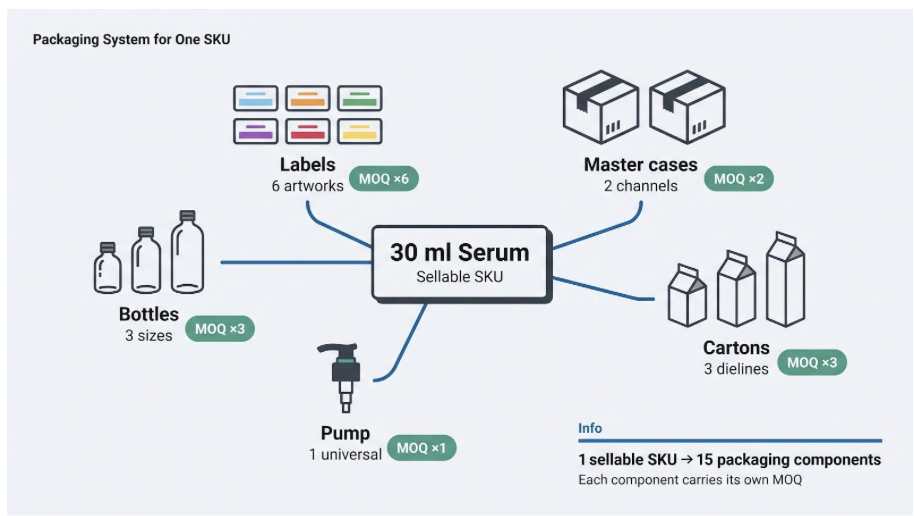
A sellable SKU can break into 15 packaging parts, each with its own MOQ.
A sellable product code is only the surface layer. Under it sits a packaging configuration: the full bill of bottles, labels, cartons, and cases that make the product shelf-ready. Drill one step deeper, and every component carries its own part number, artwork revision, and supplier minimum.
Take a serum sold in three bottle sizes across three regions. Behind the “one” product you’ll find:
- 3 bottle sizes for different price points
- 6 labels to cover two languages plus a seasonal claim
- 1 universal pump
- 3 cartons matched to the bottles
- 2 master cases for separate distribution channels
That single SKU now drives 15 independent components. Zenpack calls this holistic framework a complete “Packaging System,” uniting strategy, engineering, manufacturing, and logistics so every SKU pulls from a standardized matrix of dielines and materials (see https://www.zenpack.us/packaging-system/). In its T3 Micro case study, the team consolidated paper sources and standardized dielines and design files across a wide SKU line, cutting labor costs by 30 percent.
When can multiple SKUs actually share a production run?
Short answer: SKUs can pool volume only when structure, material, print process, and quality standard all match; change any one and it becomes a separate run.
Suppliers use “share” in four distinct ways:
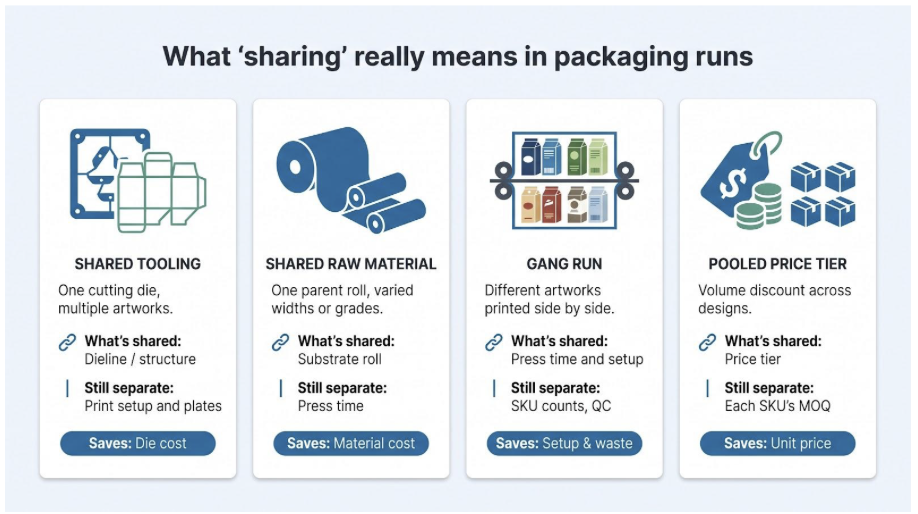
- Shared tooling – cartons fold on the same dieline, but each artwork still needs its own print setup. You save one die charge, not the entire changeover.
- Shared raw material – different widths or grades are slit from the same parent roll, pooling substrate cost while keeping print runs separate.
- Gang run – compatible artworks print side by side in a single press session, cutting plate waste and make-ready time; all SKUs must accept the same color targets.
- Pooled price tier – the converter counts total pieces across designs for a lower unit rate even though each design meets its own MOQ, a practice common in cosmetic folding cartons.
Before counting on savings, confirm which definition applies and list what must stay the same: dimensions, substrate, ink set, finish, and QC checks. One barcode printed in a different color can change a “yes” to a separate run at the last minute.
How package format and print process shape your MOQ
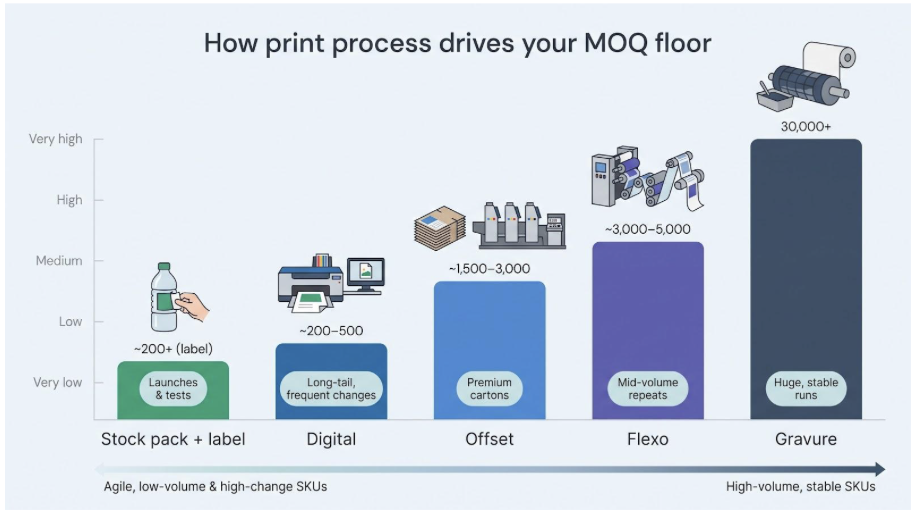
Takeaway: the same artwork may need 300 pieces on a digital press or 30,000 on gravure, so match each SKU’s volume and revision risk to the right process before you quote.
Compare production routes
| Process | Typical floor* | Why the floor exists | Best fit |
| Digital inkjet/toner | 200–500 cartons or labels | File-to-press workflow; no plates; minimal make-ready waste | Long-tail SKUs, regulatory or seasonal changes |
| Flexography | 3,000–5,000 pouches/labels | Photopolymer plates and longer web make-ready | Mid-volume repeats with stable artwork |
| Offset lithography | 1,500–3,000 folding cartons | Sheet-fed setup cost spread over press time | Premium cartons at moderate volumes |
| Rotogravure | 30,000+ flexible packs | Engraved cylinders cost thousands of dollars per color but last for very long runs | Very high-volume, seldom-changing SKUs |
| Stock pack + label/sleeve | Label MOQ governs (as low as 200) | Structure is off-the-shelf; only variable artwork prints | Launches, market tests, extreme long-tail variants |
Floors vary by substrate, press width, and color stations; always confirm with each converter.
Knowing these crossover points lets you route high movers to flexo or offset for unit-cost efficiency while steering experimental variants to digital or stock-plus-label paths.
Segment the portfolio before you decide which MOQ to accept
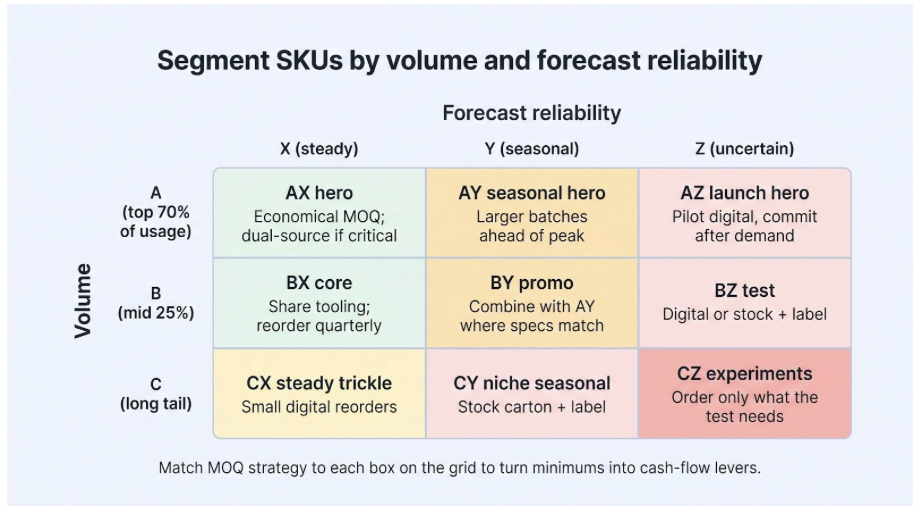
Sort SKUs by annual volume (A–B–C) and forecast reliability (X–Y–Z); high-certainty A items earn large, efficient runs, while low-certainty C–Z items stay on short, flexible runs.
| Volume → / Reliability ↓ | X (steady) | Y (seasonal) | Z (uncertain) |
| A (top 70 % of usage) | AX hero: run at economical MOQ, dual-source if critical | AY seasonal hero: schedule larger batches ahead of peak | AZ launch hero: pilot on digital, commit once demand stabilizes |
| B (mid 25 %) | BX core: share tooling, reorder quarterly | BY promo: combine with AY where specs match | BZ test: digital or stock + label |
| C (long tail) | CX steady trickle: small digital reorders | CY niche seasonal: stock carton + label | CZ experiments: order only what the test needs |
Why it matters: Forecasting errors, design changes, and obsolescence force brands to write off packaging inventory they already paid for. Tailoring MOQ to each box on the grid turns the minimum from a constraint into a cash-flow lever.
Calculate the right order quantity, not the supplier minimum
Rule of thumb: buy what operations need, not what the quote’s bold font suggests; then prove the gap in dollars, not unit price.
Start with net packaging requirements
- Forecast demand for the full supplier lead time.
- Add safety stock to cover forecast error plus one line hiccup.
- Include any launch or promo buffer already scheduled.
- Subtract usable inventory on hand and confirmed inbound.
The result is the net requirement.
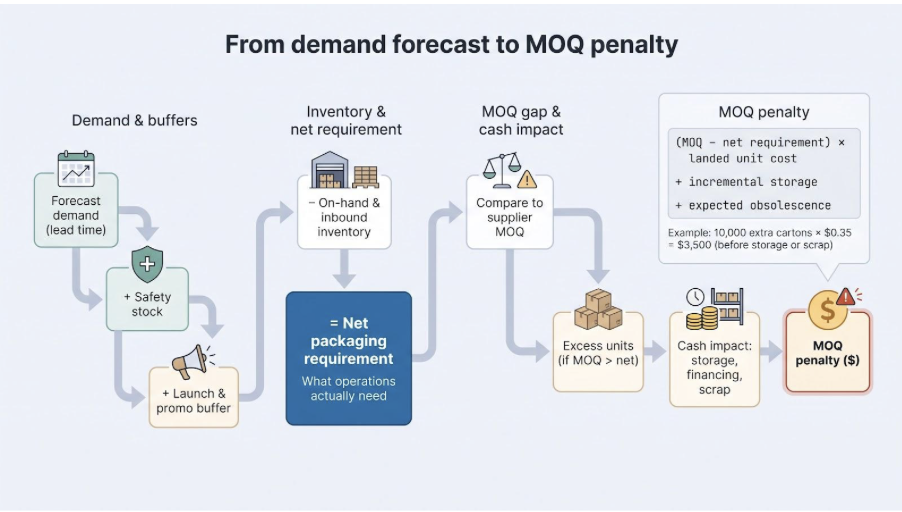
If the supplier’s MOQ is higher, highlight the overage in units and cash so finance sees the working-capital hit.
Measure months of cover
Months of cover = purchase quantity ÷ average monthly usage
- ≤2 months = agile
- 3–4 months = acceptable for overseas supply
- ≥6 months = cash trap
PMMI’s 2026 Packaging State of the Industry report lists tighter capital discipline and SKU proliferation among the major forces shaping packaging equipment decisions.
Calculate total cash exposure
Add:
- Invoice cost (unit × quantity)
- Setup or tooling fees
- Freight and duties
- Storage or carrying cost
- Financing cost (interest)
- Expected obsolescence
Even identical unit prices can diverge sharply once these lines appear on the ledger.
Spot the MOQ penalty
MOQ penalty =
(MOQ − net requirement) × landed unit cost
+ incremental storage
+ expected obsolescence
Example: 10,000 excess cartons × $0.35 = $3,500 before storage or scrap. That cash could fund a fragrance pilot or an Amazon SIPP redesign—tangible trade-offs that break the spell of a seductive price break.
Specification levers
Quick win: change the spec and you change the math; most converters drop MOQ only when their setup time, material order, or QA checks shrink.
- Use existing tooling. Match an existing die or bottle mold and the floor can drop well below a new-tooling quote because the press skips a new die setup.
- Choose standard materials. Mill-stock white board or clear flint glass means no dedicated raw-material run, so the converter lowers risk and minimums.
- Reduce color complexity. Moving from six spot colors to CMYK frees two ink stations and two plates, which cuts make-ready and reduces the economic run size.
- Limit special finishes. Foil, emboss, and soft-touch each add a pass; reserving them for hero SKUs lets long-tail variants print in one trip.
Production levers
Goal: give the plant more scheduling freedom and it will usually give you a lower MOQ in return.
- Gang scheduling. Align artworks that share substrate, dimensions, and color order so they print in one slot; this means fewer changeovers for the converter and pooled setup costs for you.
- Flexible start window. Trade a fixed Tuesday press time for a two-week range; planners can place your job next to similar specs and cut the minimum.
- Digital-to-analog ladder. Print the first three SKUs digitally to prove demand, then move winners to offset or flexo; converters often quote blended pricing to keep early runs affordable.
- Overrun tolerance. Allow ±10 percent delivery; the factory wastes less on QC rejects and may lower the printed floor.
Industry standards typically allow a five to ten percent overrun or underrun on final delivered quantities, giving the factory room to manage setup waste without inflating your base price.
Give the scheduler room to optimize and many “non-negotiable” minimums move on their own.
Commercial levers
Restructure cash flow and liability, and many converters will cut the per-run MOQ even when press setup stays the same.
- Blanket annual commitment. Lock 50,000 units for the year and release them in quarterly calls. Contracted volume lets converters optimize their supply chain, and vendor-managed inventory programs can free working capital tied up in safety stock.
- Supplier-held inventory. Pay a modest storage fee so the factory warehouses finished goods or raw substrate. Draw pallets just in time and avoid micro-run premiums.
- Split shipments and blended terms. Pay 30 percent at order, 70 percent at receipt; move bulk by ocean and launch stock by air. Converters fund raw material without pulling all your cash forward.
- Tooling ownership. Put your name on the die or mold you funded. Clear transfer rights give negotiating power if service falters.
Control packaging inventory as a component system
Big idea: keep a live packaging BOM so anyone can see in three clicks which bottle, label, or die belongs to every SKU and how much cash sits on the shelf.
Maintain a living packaging BOM
| Field | Why it matters |
| Component code and description | Fast cross-referencing in ERP or WMS |
| Artwork or mold revision | Prevents outdated graphics from sneaking back on press |
| Supplier and approved alternate | Enables quick re-source during disruptions |
| MOQ and price breaks | Ties purchasing logic to inventory reality |
| On-hand, on-order, allocated | Shows true available stock, not just what is in the building |
| Material, weight, EPR category | Feeds regulatory and sustainability reporting |
| Tooling owner and storage site | Clarifies transfer rights and physical location |
Example: Serum-Lavender-30 ml pulls Bottle-BT03-R2, Pump-PP12-B, Label-LB45-FR, and Carton-FC01-V5. One artwork change to LB45-V6 instantly flags a carton update, preventing surprise pallets later.
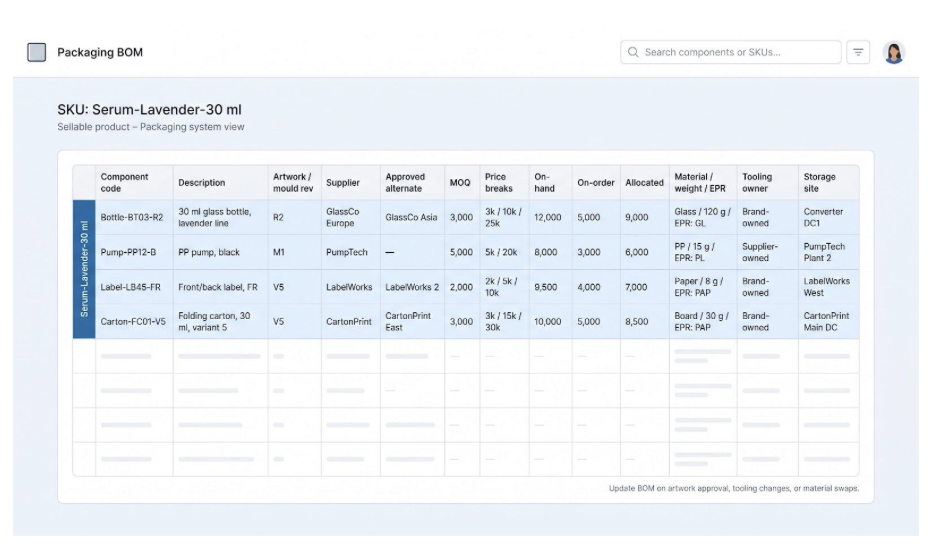
Update the BOM whenever artwork is approved, tooling ships, or a supplier swaps resin. Version control turns packaging from a static PDF into the operational heartbeat of a 50-SKU portfolio.
Regulation turns excess packaging into a compliance risk
Takeaway: the longer printed inventory sits, the higher the chance new EPR or PPWR rules will force costly scrap.
EPR and PPWR raise the stakes on long inventory
Regulation (EU) 2025/40 began applying on August 12, 2026, and packaging producer-responsibility laws now cover seven US states, including California, Oregon, Washington, and Maryland. Each rule demands a data trail—material, weight, market of sale, recyclability—for every component.
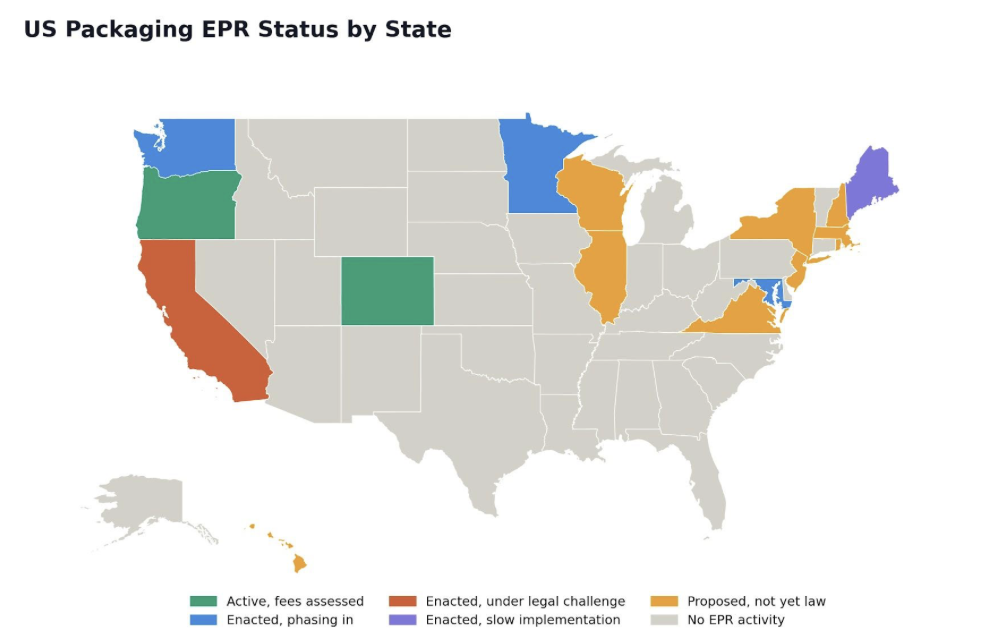
Map of EU PPWR and US EPR packaging regulations
Hold two years of cartons and you double the window in which artwork, material, or weight rules can change.
Design smart: print fast-changing claims, languages, and regional logos on short-run labels or inserts while keeping the core structure stable for the product’s life. You still capture price breaks on parts that rarely change and insulate the portfolio from regulatory whiplash on the parts that do.
How to evaluate suppliers for a 50-SKU program
Score candidates on capability, reliability, flexibility, and cost—weighted to reflect the pain points of high-SKU portfolios.
| Criterion | Weight | What to check |
| Process breadth (cartons, labels, flexibles) | 20 % | One roof versus three vendors |
| MOQ flexibility | 20 % | “Smallest run shipped in last 90 days?” (ask for proof) |
| Repeat-order color accuracy | 10 % | ΔE reports; G7 or ISO certification |
| On-time delivery | 10 % | OTIF over the past 12 months |
| Warehousing and call-off options | 10 % | Finished goods or board held against a blanket PO |
| Total landed cost | 15 % | Unit, freight, duties, and fees |
| Regulatory data readiness | 5 % | Material weight, EPR category, recyclability |
| Tooling ownership clarity | 5 % | Contract language and physical custody |
| Business-continuity plan | 5 % | Dual-site or disaster-recovery provisions |
| Total | 100 % |
FAQs
Is a packaging MOQ per SKU or per total order?
Almost always per manufacturing configuration (size, material, artwork). Unless the quote explicitly pools designs, treat each version as having its own floor.
Can 50 SKUs share one MOQ?
Only when structure, substrate, print process, colors, finishes, and QC rules all match. A shared dieline alone is not enough.
Does changing a barcode create a new MOQ?
Yes, if the code prints directly on the pack because that needs a new plate or file. If it sits on a later-applied label, the base structure keeps its original minimum.
What’s the difference between MOQ and minimum order value?
MOQ is a unit count, while minimum order value is a dollar threshold. Suppliers may set both.
Is digital printing always cheaper for multi-SKU runs?
Digital wins on short or high-revision runs because it skips plates and cylinders. Flexo or offset becomes cheaper once volume and artwork stability rise.
Can a converter hit the full MOQ and deliver in stages?
Usually yes. You pre-pay or issue a blanket PO, the plant stores finished goods, and you call off pallets as needed. Watch storage fees and liability windows.
When does paying more per unit for a lower MOQ make sense?
When the cash freed from inventory and the scrap you avoid exceed the unit-price premium; a small cost now beats a big write-off later.
Conclusion: treat MOQ optimization as portfolio design
One sentence to remember: when you map demand, identify the binding constraint, and align order size with cash risk, MOQ shifts from obstacle to lever.
Follow this five-step playbook:
- Map every sellable SKU to each packaging component.
- Pinpoint the binding MOQ layer (material, print, fill, or finance).
- Segment SKUs by volume and forecast certainty before picking a print route.
- Compare total cash and write-off risk, not just unit price.
- Negotiate specification, schedule, and commercial terms in that order.
Master these moves and you control the minimum instead of the minimum controlling you.