Vanta gets a lot of companies to their first SOC 2 attestation, and most are happy with it for a while. The trouble starts about a year in. The renewal quote arrives, a second framework lands on the roadmap, and the dashboard fills up with failing controls that a small security team has to work through on top of everything else. That’s the point where most searches for the best Vanta alternatives begin.
This list ranks nine of the best Vanta alternatives for 2026. Scytale takes the top spot because it addresses the complaint this list keeps coming back to: its AI GRC platform pairs the same kind of automation with a dedicated GRC expert who handles remediation and evidence alongside your team, so compliance stops being a side job for an engineer. Drata is the closest like-for-like swap if you only want a change of price or interface, Secureframe and Sprinto suit smaller budgets, and the enterprise platforms at the end fit larger programs. Each entry opens with the Vanta gap it fills.
Why teams switch from Vanta
Vanta has a lot going for it: fast SOC 2 setup, a large integration library, strong automation across the main security frameworks and a well-known trust center. The reasons teams leave show up later.
- Cost grows with every framework. Vanta doesn’t publish prices. Third-party sources put entry plans around $10,000 a year, and each added framework, entity or integration raises the bill, so a second framework costs almost as much as the first.
- Some features sit in higher tiers. Deeper risk management and larger questionnaire allowances come with pricier plans, and those plans have hard limits.
- Nobody owns the work. The platform flags failing controls, but a small team still has to fix each one itself. This is the gap most platforms on this list aim to close.
What Vanta’s G2 reviewers complain about
G2 doesn’t track why people leave a product, so the closest evidence is what Vanta’s own reviewers flag. Vanta holds 4.6 out of 5 across 2,728 G2 reviews as of late September 2026, and the complaints fall into two groups. On integrations, 179 reviews say some still need manual work and 149 say coverage is thin for niche or complex tech stacks. On price, 146 reviews say small companies find it hard to absorb and 145 call it very expensive.
The 9 best Vanta alternatives at a glance
|
Platform |
Operating model |
Best fit for |
Framework breadth
|
|
Scytale |
AI automation + dedicated GRC expert (managed) |
Growing teams, from startups to enterprise, wanting a managed path to SOC 2, ISO 27001 and the frameworks that follow |
80+ security, privacy, and AI frameworks |
|
Secureframe |
Self-serve with guided onboarding |
First-time teams wanting polish below Vanta’s price |
40+ frameworks, including FedRAMP and CMMC |
|
Sprinto |
Self-serve, automation-first |
Budget-sensitive cloud-native startups |
SOC 2, ISO 27001, GDPR, HIPAA + more |
|
Thoropass |
Self-serve platform plus in-house audit |
Teams wanting one partner for both the platform and the audit |
30+ frameworks |
|
Scrut Automation |
Self-serve GRC with hands-on support |
Mid-market teams needing risk-first, multi-framework depth |
SOC 2, ISO 27001, GDPR, HIPAA + more |
|
Drata |
Self-serve automation |
Funded startups with a security owner wanting a like-for-like swap |
SOC 2, ISO 27001, GDPR + more |
|
Hyperproof |
Self-serve enterprise GRC |
Larger programs managing many frameworks at scale |
Multi-framework GRC |
|
Optro (rebranded from AuditBoard) |
Self-serve enterprise audit |
Enterprise internal-audit and risk teams |
Enterprise audit across frameworks |
|
OneTrust |
Self-serve enterprise suite |
Large orgs needing privacy plus GRC together |
SOC 2, ISO 27001, GDPR, CCPA + privacy and AI |
Sources and method
- Four criteria drive each assessment: the Vanta gap it closes, its operating model (self-serve or managed), its documented framework depth, and its documented user experience.
- Capability and pricing-model details come from vendor documentation and pricing pages, checked in September 2026.
- Ratings and review counts, plus the praise-and-complaint themes, come from G2 pros-and-cons profiles collected in June 2026, carrying reviews dated between May 2024 and June 2026, with the Vanta and Secureframe totals refreshed in late September 2026; Sprinto and OneTrust carry no G2 rating here.
- Positioning and switching context draw on ten published ranking roundups, including those from Konfirmity, Compyl, SecureLeap, GetAgency, Orbiq and Strac, sampled in August 2026.
- All figures are as of September 2026 and can change; ratings and switching reasons come from G2 and vendor documentation, not hands-on testing.
#1 Scytale
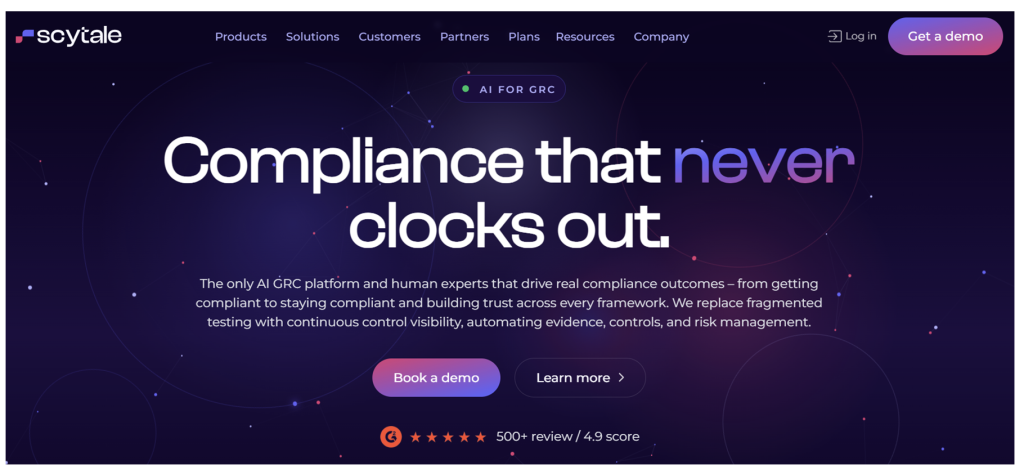 Vanta flags failing controls, then leaves a small team to fix them on its own, and hands-on guidance costs more. Scytale closes that gap by pairing AI automation with dedicated GRC expert support across the whole compliance journey.
Scytale is an AI GRC platform that helps growing organizations, from startups to enterprise, reach SOC 2 and ISO 27001 and stay audit-ready year-round as new frameworks are added. Its AI GRC agents take on the hands-on work that self-serve tools leave with your team, from collecting evidence to flagging gaps and suggesting fixes, while a GRC expert reviews their outputs before they reach an auditor. It covers 80+ security, privacy and AI frameworks and connects to 150+ cloud, identity, HR and DevOps tools, with custom options for on-premise systems. Scytale holds 4.8 out of 5 from 700+ reviews on G2, where support and ease of use lead the praise.
Pricing isn’t public, so you’ll need a custom quote, and some advanced capabilities sit on higher-tier plans.
Features
- Dedicated GRC expert support: A GRC expert works through remediation, policies and audit prep with your team, giving tailored guidance when nobody in-house owns compliance.
- Customizable Trust Center: Turns your compliance data into a public posture page for prospects and auditors, with document-sharing controls that speed up security reviews.
- Cross-framework control monitoring: Real-time checks run on controls mapped once across SOC 2, ISO 27001, GDPR, HIPAA and more, so an added framework reuses existing work.
- Agentic AI for evidence and questionnaires: AI GRC agents validate evidence against controls, support access reviews and prefill the security questionnaires and DDQs that hold up deals.
- Streamlined audit and penetration testing: Audit management, auditor matching and penetration testing sit in the same workflow, so there are fewer vendors to manage.
#2 Secureframe
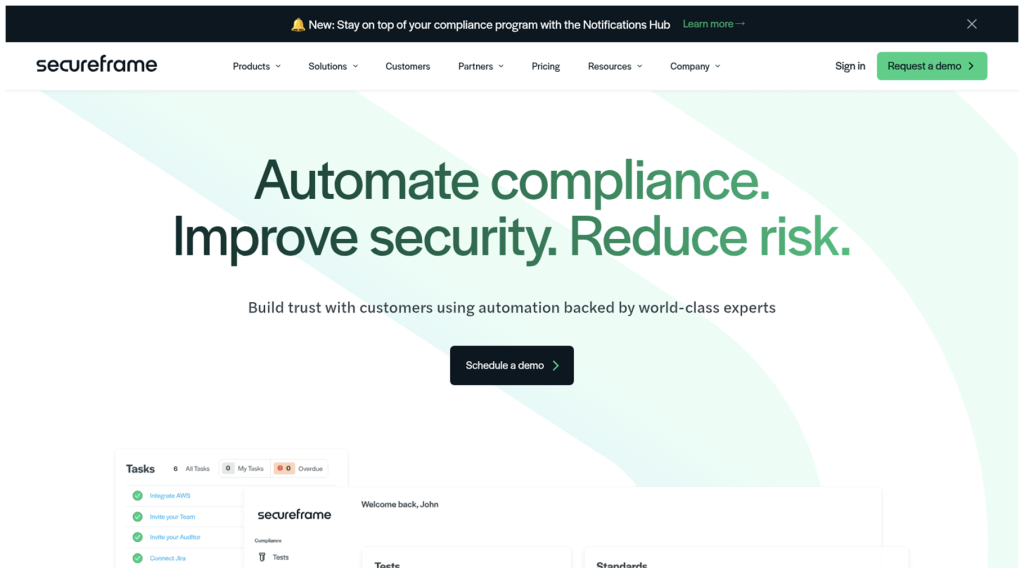
Teams often look past Vanta when a first attestation costs more than the budget allows, more so without a dedicated security hire. Secureframe closes that gap with wide framework coverage and guided onboarding at a lower entry point.
Secureframe automates evidence collection and continuous compliance across 40+ frameworks, including FedRAMP and CMMC, and backs the software with expert-supported onboarding. It suits first-time teams that want a polished setup for SOC 2 attestation or ISO 27001 without building a program from scratch. On G2 it holds 4.7/5 across 826 reviews, with praise for how easy it is to run and how little upkeep it needs. The most common complaint is integration friction with niche tools, where users report manual setup, alongside requests for more control over follow-up timing.
Features
- Automated evidence collection: Pulls evidence from cloud, SaaS, and internal systems, replacing manual gathering.
- Wide framework coverage: Pre-built libraries span ISO 27001 and SOC 2 as well as HIPAA, PCI DSS and 40 or more standards.
- Guided onboarding: Structured setup with expert support shortens the path to a first audit.
- Comply AI for remediation: AI features suggest fixes and flag risk across connected systems.
- Auditor collaboration: An in-platform portal keeps evidence and controls accessible to auditors.
#3 Sprinto
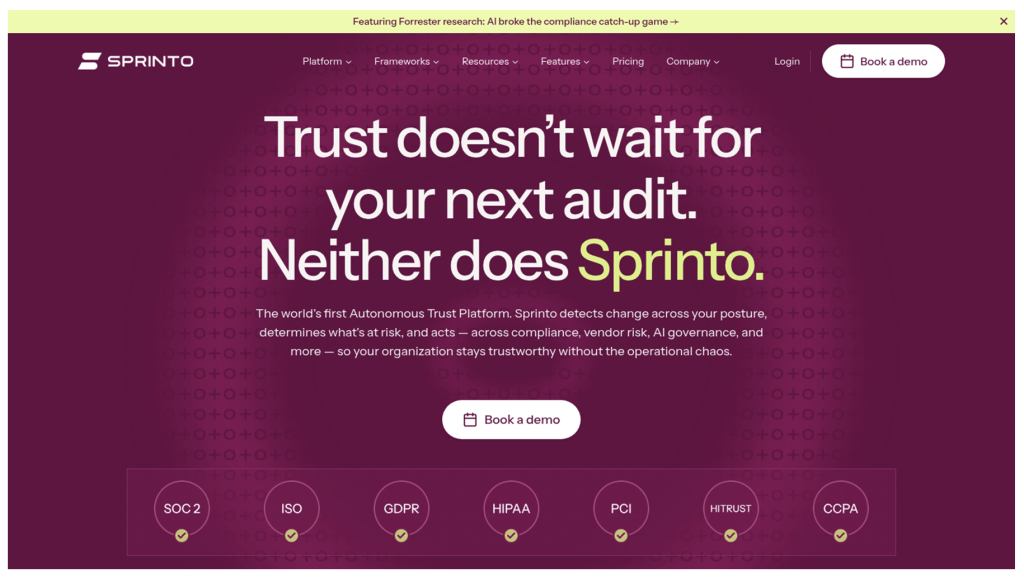 For lean, cloud-native startups, the deciding factor against Vanta is often the bill. Sprinto closes that gap with affordable automation aimed at early-stage SaaS teams.
Sprinto runs real-time monitoring and continuous compliance across GDPR, SOC 2, ISO 27001 and other frameworks, with native connectors for common cloud stacks. Third-party estimates place it below Vanta on price, which is the point for budget-sensitive founders. The tradeoffs come in two forms: ISO, PCI, and HIPAA layers arrive as paid add-ons, and Sprinto is an automation platform rather than a standalone trust center, so teams that want a polished public trust center look elsewhere.
Features
- Real-time control monitoring: Continuous checks surface control failures across connected cloud systems.
- Cloud-native integrations: Native connectors cover the SaaS and infrastructure tools early-stage teams run.
- Framework coverage for B2B SaaS: HIPAA and GDPR next to SOC 2 and ISO 27001, through pre-built control sets.
- Guided compliance workflows: Step-by-step setup reduces configuration effort for first audits.
- Employee compliance tracking: Tracks access, policy sign-offs, and training for evidence.
#4 Thoropass
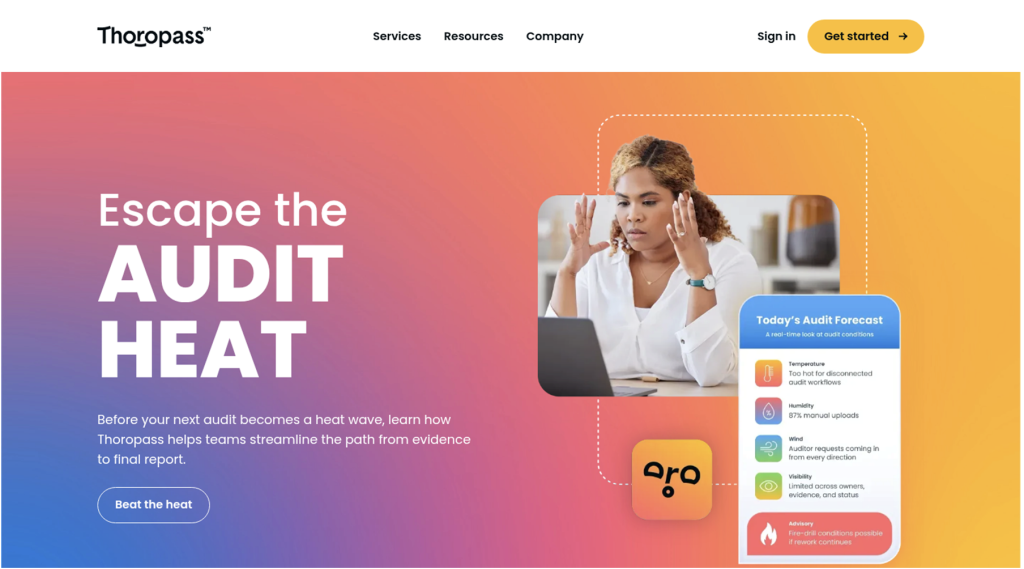
Vanta stops at audit readiness and leaves you to source and manage the auditor as a separate job. Thoropass closes that gap by putting the platform and the audit under one roof.
Thoropass combines compliance automation with its own in-house auditors across 30+ frameworks, so setup, evidence review, and the SOC 2 attestation run through a single partner. It fits teams without in-house GRC expertise that want guidance embedded in the workflow. On G2 it holds 4.7/5 across 579 reviews, with strong marks for support during complex audits. Reviewers cite limited visibility into audit status and a disjointed experience across parts of the interface.
Features
- Software plus in-house audit: One partner covers the platform and the attestation, removing a separate auditor hunt.
- AI-driven evidence collection: Automated validation maps evidence to controls across 30+ frameworks.
- Embedded expert guidance: Compliance specialists support setup and audit preparation inside the platform.
- Policy and control management: Centralized documentation keeps controls audit-ready.
- Auditor collaboration workflows: Evidence exchange and review happen in one place.
#5 Scrut Automation
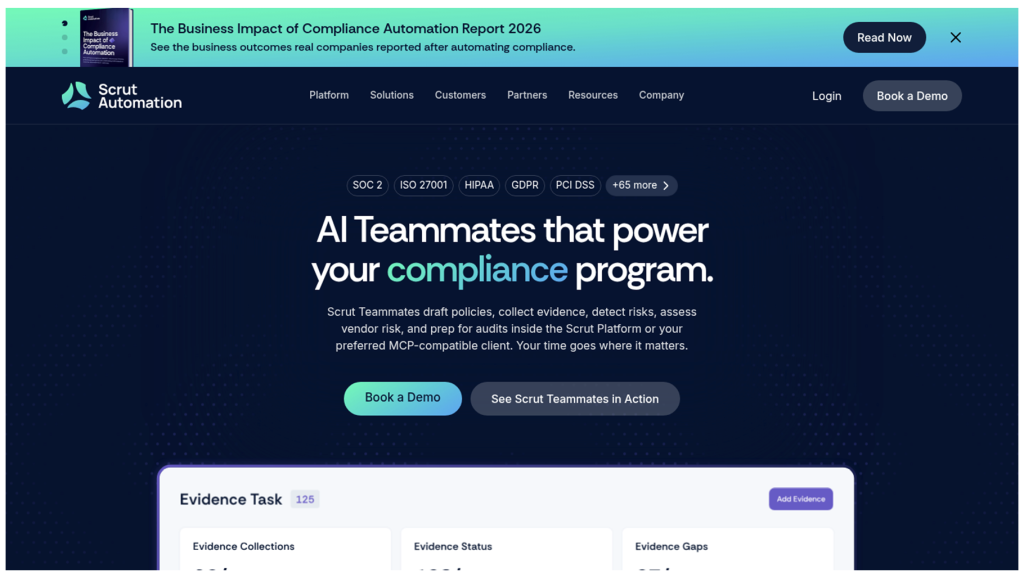
Vanta stays compliance-first, so teams managing real risk across several frameworks tend to want more depth. Scrut Automation closes that gap with a risk-first GRC platform built for multiple frameworks at once.
Scrut aligns security programs around risk while automating evidence collection across GDPR and HIPAA together with SOC 2 and ISO 27001, with an AI compliance teammate and hands-on support. It suits mid-market teams that have pushed past a one-framework tool. Scrut earns 4.9/5 from 1,312 G2 reviews, the top score in this list, with praise for support and streamlined management. Reviewers report bugs and workflow breakages that interrupt tracking, and a learning curve that needs extra onboarding.
Features
- Risk-first program management: Security controls map to a live risk register rather than a checklist.
- Multi-framework automation: Shared controls cover several frameworks without duplicate setup.
- Continuous monitoring: Automated checks track control status across connected systems.
- AI compliance teammate: AI features surface gaps and next actions across the program.
- Vendor risk workflows: Third-party assessments sit inside the same compliance workflow.
#6 Drata
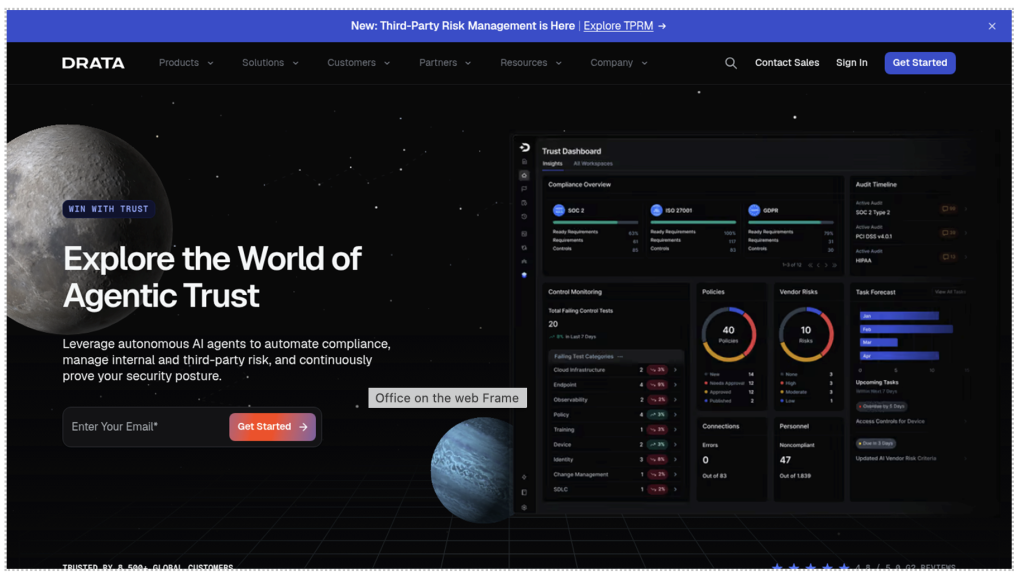
Some teams don’t want to rethink their model, just replace Vanta with something close. Drata is the nearest like-for-like swap, matching Vanta’s automation and adding a mature trust center through its SafeBase acquisition.
Drata automates evidence gathering and continuous monitoring across ISO 27001, GDPR, SOC 2 and further frameworks, with deep integrations and internal plus third-party risk. After acquiring SafeBase in early 2025, it bundles an established Trust Center under the same platform. It fits funded startups with a security owner to run the program. Drata holds 4.7/5 across 1,331 G2 reviews, with praise for responsive support and automated monitoring. Common criticisms include limited third-party integrations that restrict flexibility and a UI that makes it tough to tell which tasks still need attention.
Features
- Automated evidence collection: Scheduled collection across deep integrations cuts manual uploads.
- Continuous control monitoring: Automated tests flag control failures before audits.
- SafeBase Trust Center: A bundled, established trust center handles public proof and questionnaire intake.
- Internal and third-party risk: Risk tracking spans internal controls and vendors.
- Auditor collaboration: Built-in workflows consolidate evidence exchange with auditors.
#7 Hyperproof
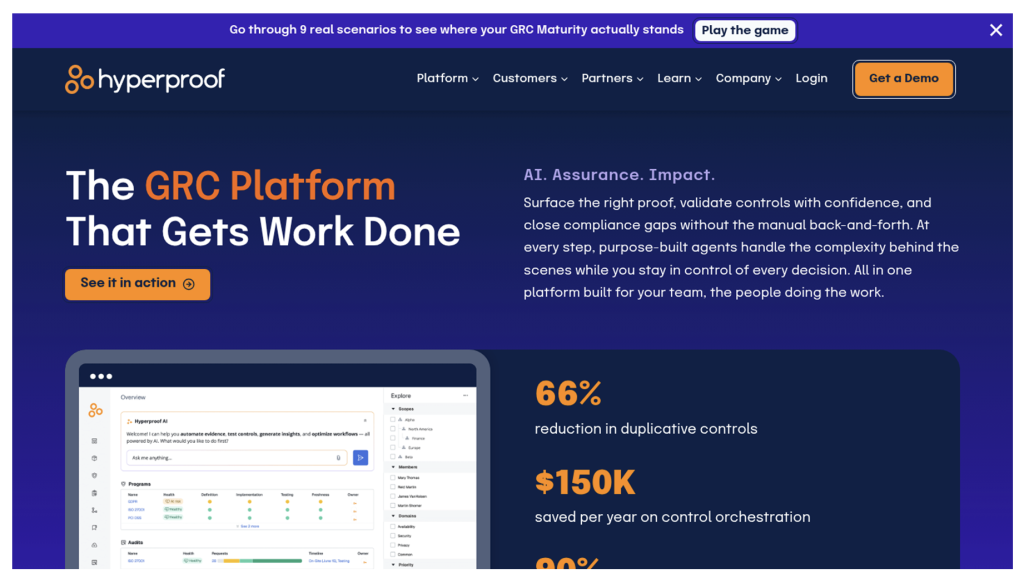
Vanta manages audits well but isn’t built to run a standing GRC program across many frameworks and business units. Hyperproof closes that gap with control and risk management designed for continuous program management.
Hyperproof centralizes controls, risk, vendor assessments, and audit reporting across multiple frameworks, with AI-powered control mapping that cuts duplicate work. It suits larger programs that treat compliance as an ongoing internal function rather than a one-time milestone. On G2 it holds 4.5/5 across 217 reviews, a smaller base than the leaders, with users praising evidence management and centralized GRC. The recurring complaints are a steep learning curve for advanced features and restricted options to customize reports and dashboards.
Features
- Cross-framework control management: Shared controls map across frameworks to reduce duplication.
- Risk register and tracking: Risks link to controls and compliance status in one workflow.
- AI-powered control mapping: Automated mapping reduces manual setup across programs.
- Vendor risk management: Third-party risk tracks alongside internal compliance data.
- Audit reporting: Generates audit-ready reports across multiple frameworks.
#8 Optro (rebranded from AuditBoard)
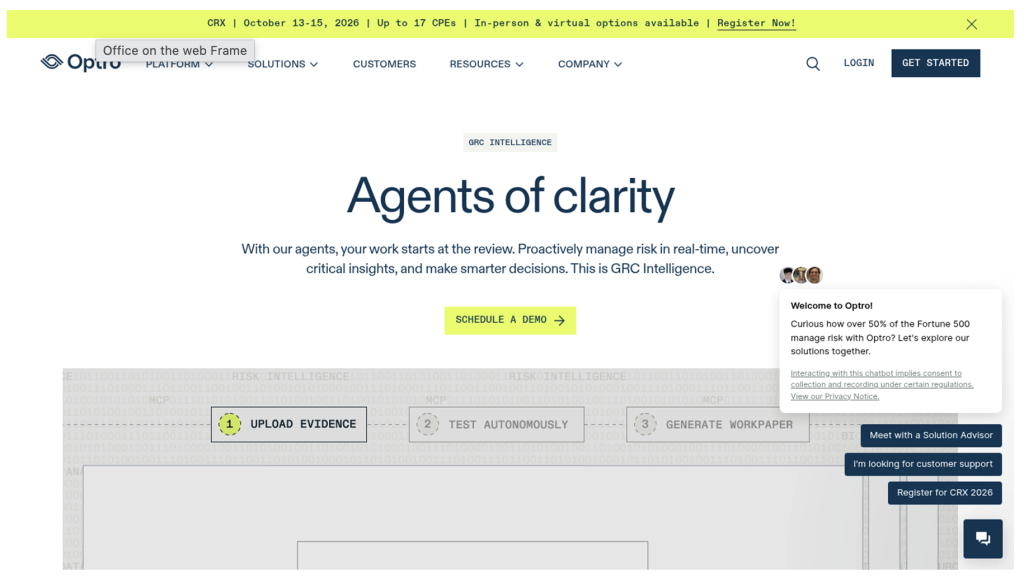
Vanta centers continuous compliance, not the formal internal-audit cycles that regulated industries run. Optro, rebranded from AuditBoard, closes that gap with enterprise audit-workflow management.
Optro handles audit management, risk tracking, control mapping, and compliance workflows for large organizations with structured review cycles, and reports use across more than half the Fortune 500. It suits enterprise internal-audit and risk teams, not lean teams chasing a first SOC 2 attestation. Listed as Optro on G2, it holds 4.6/5 across 1,596 reviews, with praise for audit efficiency and module range. Reviewers flag inconsistent access to analytics and limited customization of roles, permissions, and dashboards.
Features
- Audit management: Runs and documents audits with approvals and sign-off tracking.
- Risk tracking: Connects risks to audit findings and control status.
- Cross-framework control mapping: Links controls across frameworks to reduce duplication.
- Compliance dashboards: Standardized reporting supports audit oversight.
- Vendor risk workflows: Structured third-party assessments sit within audit processes.
#9 OneTrust
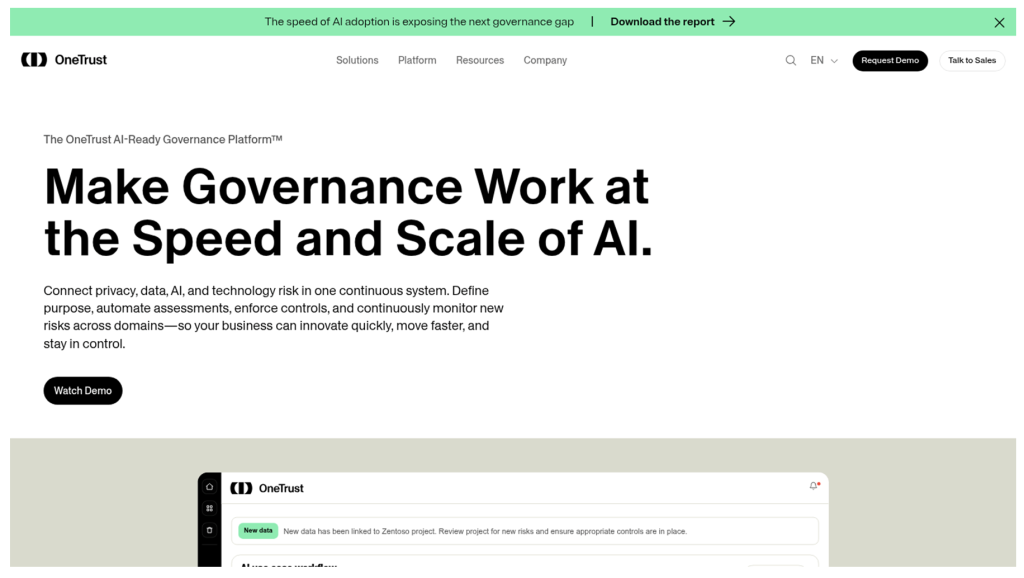
Vanta handles security compliance but doesn’t stretch into privacy and data governance. OneTrust closes that gap with a suite that spans privacy, GRC, and AI governance.
OneTrust connects privacy management, third-party risk, data governance, and compliance on one enterprise platform, and absorbed Tugboat Logic’s compliance-automation capability. It fits large organizations that need privacy and GRC together across jurisdictions. The tradeoff is scope: it’s more platform and implementation than a lean team pursuing a first SOC 2 attestation needs, and its strength sits in privacy and GRC breadth rather than fast SMB compliance automation.
Features
- Privacy, GRC, and data governance: One platform spans privacy, risk, and compliance workflows.
- Multi-framework coverage: Supports SOC 2, ISO 27001, GDPR, CCPA, and more.
- AI-assisted vendor risk: Questionnaire processing and risk evaluation use AI assistance.
- Enterprise Trust Center: A public portal shares compliance and privacy posture at scale.
- Automated controls: Continuous monitoring and enforcement run across governance workflows.
How to choose the right Vanta alternative
The right Vanta alternative depends on where your current setup falls short. Name the gap first, then match it to the operating model and depth you need.
- Operating model: Decide whether you have someone in-house to run a self-serve tool, or whether you need managed GRC expert support to finish audit readiness.
- Framework depth: Count the frameworks you’ll pursue over the next two years. Cross-framework mapping saves rebuilding controls for each one.
- Pricing structure: Check how add-ons for extra frameworks, entities, and integrations affect the total, not the entry price alone.
- Risk and vendor management: Confirm the platform handles the depth of risk and third-party assessment your program requires.
- Audit path: Decide whether you want the audit bundled with the software or managed through a separate auditor.
- Trust and external sharing: A trust center that shares posture with prospects and auditors shortens security reviews.
Managed or self-serve decides who does the work
The operating model sits first in that list because it decides everything after it. Self-serve platforms such as Vanta and Drata automate the checks and leave your team to run remediation, gather the manual evidence, chase policy sign-offs and prepare for the audit. Managed platforms add GRC expert support that runs those steps with you. Secureframe and Scrut Automation sit between the two, with self-serve software backed by onboarding and support teams; Sprinto documents support from the first day; Thoropass bundles the audit rather than the program management. Price the internal hours or the security hire a self-serve tool needs, and the comparison shifts from list price to the total cost of running the program.
What switching from Vanta involves
Switching from Vanta comes down to four steps: move your policies into the new platform, reconnect integrations so evidence keeps flowing, map your controls to the new platform’s library, and tell your auditor about the switch so the evidence record has no gaps. Your current attestation stays valid, because it covers your controls, not your software. What differs between platforms is how much of that work they take on for you. The table below draws on each vendor’s public pages. “Not documented” means the vendor’s public pages don’t describe it, which isn’t the same as the product lacking it.
|
Alternative |
Migration support |
Evidence and integrations |
Framework mapping |
Time-to-first-audit claim
|
|
Scytale |
A dedicated GRC expert guides the program throughout, and the vendor’s comparison page describes a customer move from Vanta |
AI GRC agents collect and validate evidence across 150+ integrations spanning cloud, identity, HR, source control and DevOps tools, with support for custom and on-premise systems |
Cross-framework mapping across 80+ frameworks, so an added framework reuses controls already mapped |
Vendor describes a guided path to audit readiness, with timing that varies by company size |
|
Secureframe |
Guided onboarding with expert support documented; no migration program documented |
Automated evidence collection and continuous control monitoring through a native integration library; G2 reviewers report manual setup for niche tools |
Custom frameworks and tests documented; one framework included per package, with more sold as add-ons; cross-framework mapping not documented |
A customer story on the vendor site cites a SOC 2 Type I in three months |
|
Sprinto |
Support from the first day through onboarding and audit documented on the vendor’s comparison page; no migration program documented |
Real-time monitoring through native connectors, with the vendor stating the platform is designed for cloud-hosted companies |
Vendor describes adding frameworks on a shared foundation; ISO 27001 and HIPAA layers cost extra as add-ons |
A customer testimonial on the vendor page cites a few weeks; no vendor-stated timeline |
|
Thoropass |
In-house auditor support and account management documented; a G2 reviewer reports the vendor’s team migrated assets from a prior tool; no formal migration program documented |
Centralized evidence with automated validation, and the audit runs inside the platform with the vendor’s own auditors; G2 reviewers report integration exceptions |
A customer quote on the vendor site describes reusing evidence and policies for a second framework; 30+ frameworks |
Not documented |
|
Scrut Automation |
Onboarding and audit-prep support with hands-on guidance documented; no migration program documented |
Automated evidence collection and continuous monitoring across connected systems, with AI-guided remediation for failing tests |
Frameworks, policy templates, risk registers and vendor questionnaires arrive pre-mapped to unified controls |
Vendor markets fast audit readiness for startups without a stated timeline |
|
Drata |
Vendor states it can support teams from onboarding through launch; no Vanta-specific migration program documented |
Automated evidence collection and continuous monitoring across deep integrations; G2 reviewers cite integration and transition complexity (38 mentions) |
Map-once, reuse-everywhere control mapping across frameworks; a customer story cites cross-mapping to other frameworks in two hours |
Not documented as a first-audit timeline; a customer story cites a shorter SOC 2 audit duration |
|
Hyperproof |
Customer success support for every step documented; no migration program documented |
Automated evidence collection with integrations into existing tools; implementation partner network available |
AI-powered control mapping onto a common control set standardized across frameworks |
Vendor site cites 30 days to start solving business challenges; no first-audit timeline |
|
Optro (rebranded from AuditBoard) |
Not documented |
Continuous control monitoring and integrations across the compliance and risk ecosystem; detail not documented |
Cross-framework control mapping documented; detail not documented |
Not documented |
|
OneTrust |
Not documented |
Continuous monitoring and automated controls across governance workflows |
Coverage across SOC 2, ISO 27001, GDPR and CCPA documented; cross-framework mapping not documented |
Not documented |
How the pricing models differ
None of the nine publishes dollar figures, so the useful comparison is how each one charges. Three pricing models show up:
- Per-framework tiers: Vanta’s pricing page sets out tiers with one compliance framework included and add-ons for questionnaire automation and trust center features, among others. Secureframe’s packages also include one framework each, with extra workspaces as add-ons. Third-party roundups describe Drata’s tiers as priced per framework and company size, and Sprinto sells added framework layers as add-ons.
- Bundled plans: Scytale’s tiered plans, from startups to enterprise, package the AI GRC platform together with dedicated GRC expert support and built-in penetration testing, with pricing by custom quote. Thoropass prices the platform and the audit together as one relationship, and Sprinto’s own material describes bundled audit and penetration testing.
- Quote-only with no published structure: Scrut Automation, Hyperproof, Optro and OneTrust price by proposal, with the modules and program scope set in the conversation.
Model the cost at the framework count you expect in two years rather than the framework you’re buying today; that’s where per-framework tiers and bundled plans diverge.
Open-source options and what they trade away
Open-source and self-hosted compliance tools exist, and some comparison articles call them the closest thing to a free Vanta alternative. Most are control checklists and policy templates, and a few are full platforms you host on your own servers. What they trade away is the part of the job the paid platforms sell: automated evidence collection through live integrations, continuous control monitoring, an auditor-facing workflow and vendor support when a control fails. All of the work lands on your team, which makes the self-serve problem worse. A team with a security engineer and spare time can make one work for a first attestation; a team on a deadline tends to end up on a managed or automated platform.
Choosing a Vanta alternative that fits your operating model
The quickest way to choose a Vanta alternative is to ask who will run the program day to day. If you have a security owner with time for it, a self-serve tool such as Drata or Secureframe will do the job. If you don’t, Scytale’s AI GRC platform pairs AI automation with dedicated GRC expert support to get a lean team to ISO 27001 and a SOC 2 attestation, then keep it audit-ready as frameworks are added. Larger programs weighing enterprise audit depth or privacy breadth will find Optro, Hyperproof, or OneTrust closer to the mark. Match the alternative to the gap you’re closing, and the shortlist gets short fast.