Closing an IT support ticket doesn’t necessarily make the next one easier to solve. An engineer can spend hours investigating a problem, find a fix, and leave behind a resolution that someone else will have to reconstruct when the issue returns.
Risotto wants to turn that work into automation.
The AI help desk startup is launching an Autonomous IT Engineer that it says can investigate unfamiliar technical problems, analyze system logs, and execute fixes with human approval. Once an issue is resolved, the product is designed to turn the solution into a reusable workflow, expanding the range of requests its software can handle.
The launch pushes Risotto further into tier-2 support: the more involved troubleshooting that requires investigation beyond a standard answer or a predefined sequence of steps. It also puts a more demanding proposition behind the company’s automation pitch. Risotto wants its software to help create the procedures an IT team has yet to document.
“The agents don’t just use tools, they build the tools they need,” Aron Solberg, Risotto’s CEO and co-founder, said in the announcement.
That is the central bet behind the product. Automating a known process can save time. Figuring out which process should exist, and building it from the work required to solve a problem, could give the software a larger role in how an IT department operates.
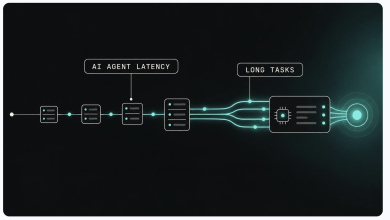
Risotto’s diagnosis is that conventional IT automation runs into trouble when requests become ambiguous. A workflow can handle a familiar task with predictable inputs. An unfamiliar failure sends the issue back to an engineer, who has to gather context, investigate what went wrong, and decide what to change.
The company argues that too much of that investigation ends up buried in closed tickets. The immediate problem gets solved, but translating the fix into an automation becomes another item on the team’s backlog.
Its new product is intended to close that gap.
According to Risotto, the Autonomous IT Engineer uses real-time information about the user and relevant system logs to investigate an issue and develop a step-by-step resolution. A human approves execution, after which the system can carry out the fix and capture the successful process in a runbook, a set of instructions that can be reused.
Human approval is an important part of that description. Despite the “autonomous” name, the workflow outlined in the announcement includes an IT professional deciding whether a proposed change should proceed. The potential benefit is reducing the investigation and implementation work surrounding that decision.
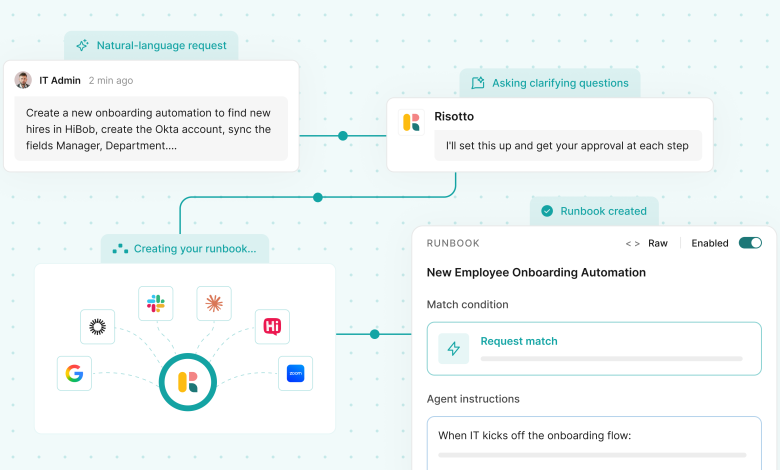
The company is also giving teams ways to build automations directly. Users can describe a workflow in natural language, and Risotto says its software will build and test it, connecting to tools through APIs or MCP endpoints.
That could make automation accessible to the people who understand an internal process but lack the time to write and maintain the code behind it. The practical scope will depend on the systems involved, the access available to the agent, and how reliably the generated workflow performs.
Risotto is pairing that capability with a feature that analyzes 90 days of ticket history to identify additional automation opportunities. This gives the product a second source of work: recurring issues that have already passed through the help desk.
For an IT team, the appeal is straightforward. A ticket archive contains evidence of where employees repeatedly get stuck and where support staff repeatedly intervene. Finding those patterns could help teams decide which workflows are worth building next.
The launch also includes scheduled and event-driven triggers for processes such as onboarding and system health checks. Another capability, which Risotto calls dynamic artifacts, generates dashboard pages and reports using live data. The company says those can be created in minutes without requiring a separate business intelligence or engineering request.
Taken together, the features suggest an ambition to participate in more of the work around a support ticket: investigating the issue, carrying out an approved change, documenting the procedure, and scheduling related tasks.
Risotto already has customers against which to make its broader efficiency case. The company names Gusto, ThoughtSpot, Retool, Instacart, Docker, Jobber, Patreon, and Ironclad among organizations using its platform.
In the launch announcement, Risotto reports an average first-response time of under four seconds and says customers typically see 20% to 60% of tickets resolved automatically.
Other examples cover different measures of support performance. Risotto says ThoughtSpot reduced average resolution time from 31 hours to 6.5 hours, while Ironclad now automatically resolves 91% of access requests.
Those distinctions matter. A fast first response measures how quickly an employee hears back, while resolution time measures how long it takes to address the problem. Automating access requests also represents a narrower category of work than resolving tickets across an entire help desk.
The figures describe results from Risotto’s broader platform. The announcement does not provide separate performance benchmarks for the newly introduced Autonomous IT Engineer or establish how much of those existing results came from complex tier-2 investigations.
“Risotto’s AI-powered support system had a massive impact straight out of the box and with very little setup,” Mike Smith, IT operations manager at Jobber, said in a statement supplied with the announcement. “Employees now get fast, efficient answers with the same precision as one of our professionals.”
For the new product, the more revealing measure may be how much additional work becomes reliably automated after deployment.
Turning a successful fix into a reusable workflow sounds simple, but the circumstances surrounding that fix matter. A procedure may depend on a particular application configuration, an employee’s permissions, or a policy that later changes. Keeping those workflows useful will require the system to recognize when the original conditions no longer apply.
The company, which lists Bonfire Ventures, 645 Ventures, and Y Combinator among its backers, is positioning the launch as the next step for a platform that also serves internal support functions beyond IT, including HR and revenue operations.
The immediate test is more specific: whether the software can take on the difficult requests that still consume an engineer’s attention, then reduce the work required when similar problems arise again.
If Risotto can deliver on that cycle, each resolved ticket could leave an IT team with something more useful than a closed case: a working process it no longer has to build from scratch.
Companies can try today: https://www.tryrisotto.com/features/tier-2-assistant