
AI is moving into enterprise applications, but confidence in more autonomous uses remains uneven. A Gartner survey of 360 IT application leaders found that only 15% were considering, piloting or deploying fully autonomous AI agents. For ServiceNow (NYSE: NOW) teams, a useful answer to a prompt is not the same as a safe configuration change in a production workflow platform.
Dyna Software is taking a more in-depth approach with Platform Copilot, which became generally available this week. The AI engineering product for ServiceNow environments is designed to support business requirement-based design and planning that also supports configuration, troubleshooting and refinement, rather than operating solely as an off-the-shelf AI assistant.
The launch comes as general-purpose large language models become part of developers’ daily toolkits. ChatGPT from OpenAI and Perplexity can help users research, summarize material, draft scripts and explore implementation approaches. However, they are not preconfigured as a ServiceNow engineering system with a customer’s application structure, data model, configurations and dependencies.
That is a material difference since general-purpose systems will only obtains relevant instance context when an organization provides it through prompts, documents, connectors or custom integrations. OpenAI cautions that an AI model may express high confidence in an incorrect answer and Perplexity, likewise, says AI-generated enterprise responses may contain mistakes. That matters where an inaccurate recommendation could alter a workflow, data field, access control or custom application.
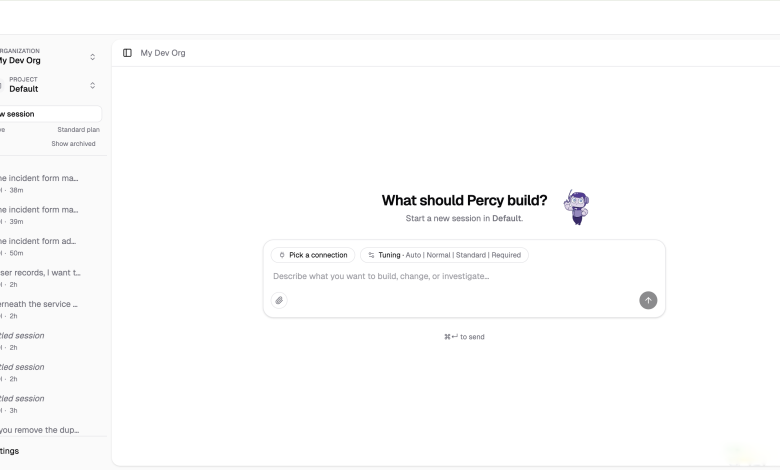
Dyna Software’s approach is to connect Platform Copilot to a customer’s ServiceNow development instance through standard APIs. The company says the product examines relevant configuration and structure before proposing a solution. The company also says that Platform Copilot can create data models, workflows, user-interface elements and relationships across systems, with support for native, scoped and custom applications. The platform will not allow changes to the customer’s ServiceNow instance without explicit user approval. The company says plans, previews and high-impact actions require sign-off before implementation, and each build is automatically verified after execution before it is marked complete. ServiceNow teams can preview proposed configurations, provide feedback and refine work while it remains in the development process.
That could reduce translation work between business stakeholders and platform specialists. A request could begin with a high-level outcome, meeting transcript, diagram, screenshot or whiteboard image. Platform Copilot would then identify missing information and guide the discussion toward an implementation approach. The company also says users of the platform can work on multiple requirements simultaneously, though enterprises will need to determine how that fits their own release, testing and change-management practices.
The GA version of Platform Copilot’s instance-awareness and approval model is another advantage over an off-the-shelf AI model. A standalone LLM may be useful in drafting an idea or investigating a documented API, but the team must still establish which records, components, permissions and dependencies are relevant before turning an answer into a change. General-purpose models can be connected to enterprise systems, but the integration, validation and change-control workflow must be supplied and governed by the customer or another platform. The product uses a multi-model design, allowing models to be selected based on the task. That makes the comparison less about replacing OpenAI or Perplexity and more about applying AI models within a ServiceNow-specific workflow. Even so, Platform Copilot does not remove the need for engineering review, test coverage or governance.
Platform Copilot is available now under a credit-based consumption model. To learn more, visit http://www.dynasoftwareinc.com.