A business can look strong on paper and still fail to execute its next major decision. Revenue, margins, and productivity indicate what an organization produces. They do not always show whether they have the alignment or the capacity to absorb another major change.
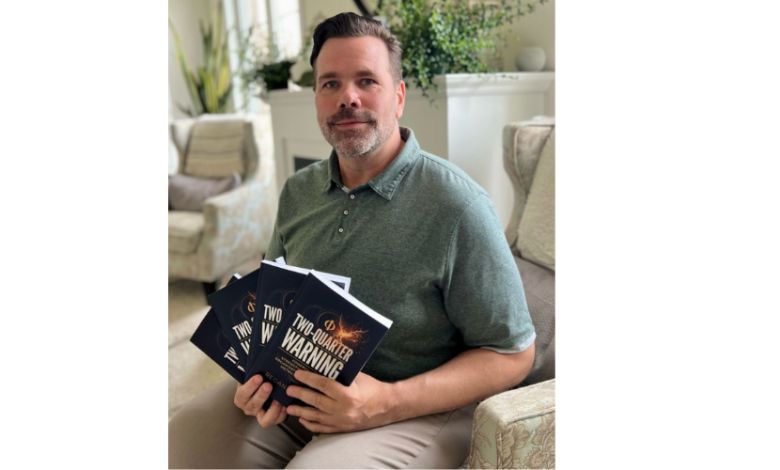
Regan Inkster has spent more than 25 years across operations, enterprise architecture, technology, and transformation, including twelve years at Oracle and a period as Canadian country leader for the emerging technology practices of a global systems integrator, and his work now focuses on how AI and large-scale analysis can make those less-visible organizational conditions easier to see.
As the author of Two-Quarter Warning: Coherence – Strengthening Your Organization Before the Metrics Catch Up and the founder of Phive Dynamics, he argues that earlier organizational signals give leaders better context before they commit to consequential decisions.
You have worked across operations, technology, enterprise architecture, and transformation. What recurring problem has most shaped the work you are doing today?
The gap between intent and execution. Early in my career, that meant translating between operations and technology. Later, in enterprise architecture and transformation, the same problem resurfaced on a much larger scale.
Organizations could have a strong strategy, capable people, and significant investment, and still have different parts of the business working from different interpretations of what was happening and what needed to happen next.
An early lesson at Minacs, where I witnessed the technology team explain features while operations described client pain, until one picture mapped both to customer outcomes and they grew the value delivered for the customer rapidly.
Years later I watched bank executives spend six weeks on a regulator’s finding that their technology and cyber strategies were disconnected from board-approved initiatives. The disconnect turned out to be language, and a clear strategy map satisfied the regulator.
So my work has increasingly focused on how organizations build enough shared understanding to turn strategy into coordinated action.
Where did AI come into it, and what did the research behind Two-Quarter Warning turn up?
The idea came out of years of observing organizations, long before any of this was computationally feasible. What AI and modern data platforms changed was the scale at which I could test it.
I analyzed large volumes of public organizational and financial information across more than 100 publicly traded companies and more than 40 quarters, looking for recurring patterns of coherence. Changes in shared reality, shared meaning and shared intent showed up ahead of financial and operating consequences.
Across that sample, a sharp drop in coherence showed up in financial and operating performance roughly two quarters later. Recovery ran about two to one against decline, meaning organizations fragment considerably faster than they repair.
That work ultimately became Two-Quarter Warning. It gave me a structured way to analyze patterns I had previously only recognized by instinct.
What is organizational coherence in practice, and what can it reveal that other performance measures can’t?
Coherence is whether the people setting direction and the people doing the work share the same understanding of events, their significance, and the organization’s objectives.
Companies measure outputs very well: revenue, margin, utilization, pipeline, productivity. Those measures matter, but none of them tells you about the condition of the system producing them.
What interests me is identifying early signals of fragmentation, overload, or reduced capacity before those conditions become obvious in conventional reporting. Organizational Φ estimates that condition. It works as a signal, and no score reduces an organization to a single number.
How did that research become Phive Dynamics, and what do decision intelligence and decision architecture add?
The research raised a second question. If you can understand the organizational state earlier, how should that change the way decisions are made?
Phive Dynamics grew out of that. The work extends from coherence measurement into decision intelligence and decision architecture: building structured histories of decisions, examining how similar decisions have landed, estimating uncertainty, and identifying constraints before commitment.
The goal is to give leaders a straight answer on whether a decision is executable under the organization’s current conditions and where additional guardrails may be useful.
How much does an organization’s current state determine whether a sound strategy can actually be executed?
A strategy can be sound in theory and still be more than the organization can maintain in practice.
The acquisition, restructuring, AI transformation, or technology migration is achievable in an organization that is aligned and capable of change. The same initiative in a fragmented or overloaded organization costs far more time and goodwill than the business case assumed.
That is why major strategic decisions cannot be separated from execution capacity. The question is whether the organization can absorb the change, coordinate around it, and carry it through without introducing unnecessary risk.
AI agents are moving from recommending actions to taking them. What does governance need to account for beyond whether an agent is authorized to act?
Once a system is executing rather than advising, static permissions are no longer sufficient on their own.
An agent can be fully authorized to make a change inside a business unit that is already overloaded, disorganized, or operating under conditions the agent is unaware of. Nothing in its authorization model represents the state of the organization it is acting on.
AI also reduces the delay between sensing a situation, deciding on a course of action, and taking action, which removes the slack in which someone would have noticed that two departments were working from different assumptions.
That points to a decision architecture to determine whether to take an action, stage it, delay it, or reconsider it, given the organization’s current state. Dynamic permissions and machine-readable guardrails are still developing, but they point toward a model in which governance considers the organization’s state alongside the AI system’s authority.
Where is the line between using AI to improve judgment and creating a false sense of certainty?
I draw the line at certainty. Organizations are networks of people, and no model removes uncertainty from a high-stakes decision.
AI adds value by serving as an early-detection tool. It helps leaders uncover patterns beneath the surface, identify real-world limitations, and anticipate what might occur long before it does. What that buys a leader is time, and time is what turns a forced reaction into a considered choice.
Accountability stays with the executive who signs. The objective is better judgment under uncertainty, which is a more modest goal than automated confidence and a more useful one.