AI meeting assistants are moving from optional productivity tools into everyday business infrastructure. They can record discussions, generate transcripts, produce summaries and identify possible action items. Their outputs may then influence project plans, customer follow-ups and internal decisions.
This creates a new operational question. If employees rely on AI-generated meeting records, who checks whether those records are accurate, appropriate and securely managed?
Buying a tool is only the beginning. Organisations also need a quality-control process that defines when the technology may be used, how its output should be reviewed and which decisions still require direct human verification.
Efficiency Does Not Automatically Mean Reliability
The appeal of meeting AI is easy to understand. Participants can focus on the conversation instead of trying to write down every detail. Colleagues who miss a meeting can review a summary, while searchable transcripts reduce the need to replay a full recording.
However, a faster workflow is not necessarily a reliable one.
An automated summary may omit a condition attached to a decision. It may present an early suggestion as an agreed plan or combine comments from different speakers. A transcript may misidentify a name, number, acronym or industry term.
These errors do not make meeting assistants useless. They mean the output must be treated according to its level of risk. A summary of a routine internal update does not require the same scrutiny as a record affecting a contract, budget or employment decision.
Decide Where Meeting AI Is Appropriate
The first control should be applied before recording begins.
Organisations should define which meeting categories may use an AI assistant. Common project updates, brainstorming sessions and internal planning calls may be appropriate. Conversations involving legal advice, sensitive employee information, confidential transactions or regulated data may need additional approval—or may not be suitable for automated recording at all.
A clear policy can answer questions such as:
- Which meetings may be recorded?
- Who can activate the assistant?
- Which categories require prior approval?
- When must recording be stopped?
- Who can access the resulting files?
- How long should the files be retained?
Without these boundaries, adoption often happens informally. Individual employees choose their own practices, resulting in inconsistent consent, storage and review standards.
Make the AI Visible
Participants should know when a meeting is being recorded and processed by AI. They should also understand why it is happening.
An AI meeting assistant such as Owll can join supported Zoom, Google Meet and Microsoft Teams calls as a visible participant, subject to host approval. This makes its presence easier to recognise, but visibility alone is not a complete consent process.
Organisations still need to follow applicable laws, contractual obligations and internal policies. A short, plain-language explanation should cover the purpose of the recording, who may access it and how the information will be used.
This is particularly important in meetings with customers, candidates, contractors or external partners. They may have different expectations from internal employees and may not be familiar with the organisation’s recording practices.
Preserve a Route Back to the Source
A summary is useful because it is shorter than the original conversation. Its weakness is that compression removes detail.
The meeting record should therefore retain a route back to the source. Ideally, an important statement in a transcript or summary can be checked against the corresponding speaker, timestamp and recording.
This creates a simple evidence chain:
- The recording preserves the original conversation
- The transcript makes the conversation searchable
- The summary provides a shorter overview
- Confirmed action items support follow-up
Each layer serves a different purpose. Removing the earlier layers makes it harder to investigate an error at the summary level.
Access to original recordings should still be limited. Preserving a source does not mean making it available to everyone.
Match the Review Process to the Risk
Not every meeting output needs line-by-line verification. Requiring the same review process for every conversation would remove much of the efficiency that automation provides.
A risk-based model is more practical.
Low-risk meetings might require a participant to scan the summary and confirm the action items. Medium-risk meetings may require the owner to check deadlines, responsibilities and key statements against the transcript. High-risk meetings should receive more careful review, potentially involving legal, HR, compliance or another authorised function.
High-risk details commonly include:
- Contractual commitments
- Financial figures
- Pricing or discount approvals
- Regulatory statements
- Employee performance information
- Customer complaints
- Security or privacy incidents
- Direct quotations intended for publication
The goal is proportional control: more verification where an error could have a greater impact.
Treat Multilingual Output With Care
Global teams often move between languages during the same meeting. Participants may also use regional accents, local names and specialised terminology.
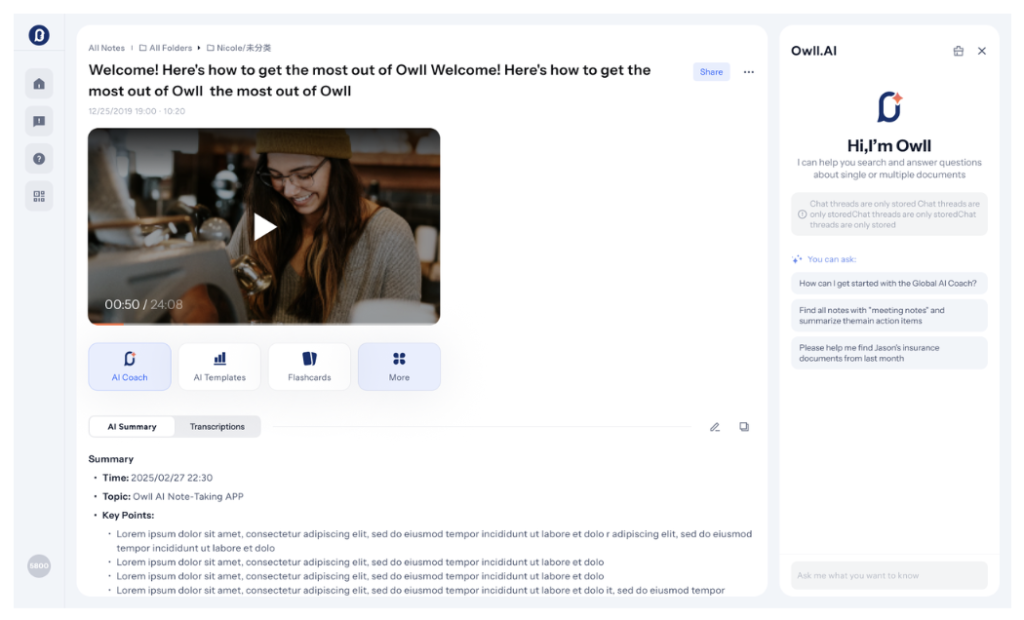
Owll’s AI transcription software supports more than 99 languages and is designed to handle code-switching within conversations. This can make meetings more accessible to distributed teams and help colleagues search discussions in written form.
Nevertheless, multilingual support should not be confused with guaranteed accuracy. Proper names, technical expressions and similar-sounding numbers remain vulnerable to errors. Translating a mistaken transcript can also reproduce or amplify the original mistake.
Organisations should identify which fields always require human checking, regardless of the language used. Names, dates, currencies, measurements and formal commitments are sensible starting points.
Do Not Let AI Decide What Matters
Meeting assistants can highlight topics and suggest action items, but importance is contextual.
A brief comment from a customer may signal a serious account risk. A long discussion may produce no final decision. A participant may describe a possible next step without accepting responsibility for it.
AI cannot independently determine the organisational significance of every statement. Meeting owners must confirm what was decided, who accepted a task and when it should be completed.
The distinction between conversation and commitment should remain explicit. Before a summary enters a project tracker, customer record or management report, a responsible person should approve the relevant output.
Pilot With Real Meetings
A useful evaluation requires more than a controlled product demonstration.
Organisations should test meeting AI across several realistic scenarios, such as a technical project discussion, a multilingual call, a customer meeting and an internal planning session with multiple speakers.
The pilot should measure both benefits and correction costs. Relevant questions include:
- How long does it take to locate a past decision?
- How often are names or technical terms incorrect?
- How many action items require correction?
- Do summaries distinguish proposals from decisions?
- Can employees understand who has access?
- Does the tool fit existing meeting platforms and workflows?
Employees should also be able to report problems. A simple feedback channel can reveal recurring transcription errors, unclear consent practices or situations in which the tool creates more work than it saves.
Measure More Than Time Saved
Time savings are useful, but they do not provide a complete picture of value.
A meeting assistant may be valuable because it reduces forgotten commitments, helps absent colleagues understand decisions or makes earlier discussions easier to search. It may also improve consistency when teams operate across time zones.
At the same time, review and governance create costs. Organisations should include the time spent correcting transcripts, managing access requests and maintaining retention policies.
A balanced evaluation considers efficiency, accuracy, usability and risk together. The objective is not to automate the greatest possible number of meetings. It is to use automation where the resulting record improves the way people work.
Responsible Adoption Requires a System
AI meeting assistants can reduce administrative effort and make spoken business information easier to retrieve. But the technology should not become an invisible layer that generates permanent records without clear ownership.
Responsible adoption requires defined use cases, transparent recording, appropriate access controls and review standards based on risk. It also requires people to remain accountable for the decisions and commitments that emerge from a meeting.
The technology is ready to capture more workplace conversations. The next stage is making sure organisations are equally ready to govern what happens afterward.