

A recent hiring report analyzed more than a million worker contracts across 150-plus countries and found cross-border hiring still expanding, with Latin America gaining ground as a talent source for multinationals.
This is even as the region’s own remote-hiring volume from the United States grew 161% between 2023 and 2025, according to Deloitte. At the same time, the infrastructure behind all that hiring hasn’t kept pace with the growth.
For instance, Deloitte’s Global Payroll Benchmarking Survey found that companies managing payroll still spend 15 to 20 hours per pay period, per country, on processing and compliance checks.
Even more, manually entering payroll inputs still remains the single most time-consuming part of the job.
That gap between how fast cross-border hiring is growing and how manual the plumbing underneath it still is happens to be exactly the gap Ontop was built to close. The startup launched in the middle of the pandemic, when remote work stopped being a policy experiment and became, almost overnight, an operational necessity. Its founders had previously built a Latin American gym-aggregator startup together, and they carried a specific, practical instinct out of that experience: hiring someone in another country was becoming routine, but everything behind that hire, including contracts, tax compliance, cross-border payments and regulatory filings, was not.
Six years later, Ontop has grown dramatically.
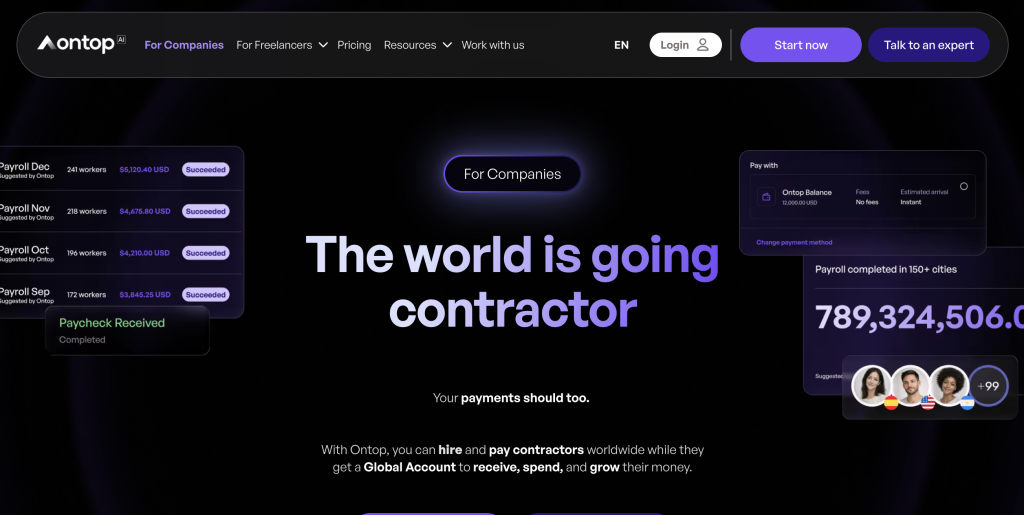
Ontop started as a way to pay remote workers across borders. Today is has expanded, and now describes itself as infrastructure for companies that hire global talent, including bundling recruitment, compliance, payments, and financial services into one system.
“Nuestra ventaja real es que Ontop combina infraestructura financiera propia con tecnología de automatización e inteligencia artificial, mientras la mayoría de los competidores siguen siendo intermediarios que dependen de terceros,” Julian Torres Gomez, CEO of Ontop (article’s featured photo) had told Forbes in an article.
The market is large, and growing. A Papaya Global survey of HR and finance leaders found that 35% of global companies now pay workers in 10 or more countries, up from 22% in 2023. The EOR segment specifically is projected to reach $9.6 billion by 2029, and Latin America is one of the two regions, alongside Southeast Asia, absorbing the fastest share of new contracts.
Where Ontop is making a big market is on the worker side, in addition t the employer side. Its Global Account lets remote workers receive income in dollars and access an international card.
“Este beneficio eleva la calidad de vida del talento, facilita compras globales y ofrece tarifas competitivas sin recurrir a criptomonedas ni soluciones informales,” Torres told Contxto: the benefit raises workers’ quality of life and gives them competitive rates without falling back on crypto or informal workarounds.
That’s a pointed detail, since hiring data shows contractors in high-inflation markets increasingly choosing USD or stablecoins over local currency by default. Here Argentina leads that shift, followed by Cameroon, South Korea, and Turkey.
Ontop is in soem ways betting it can out-compete that informal dollarization with a formal one.