



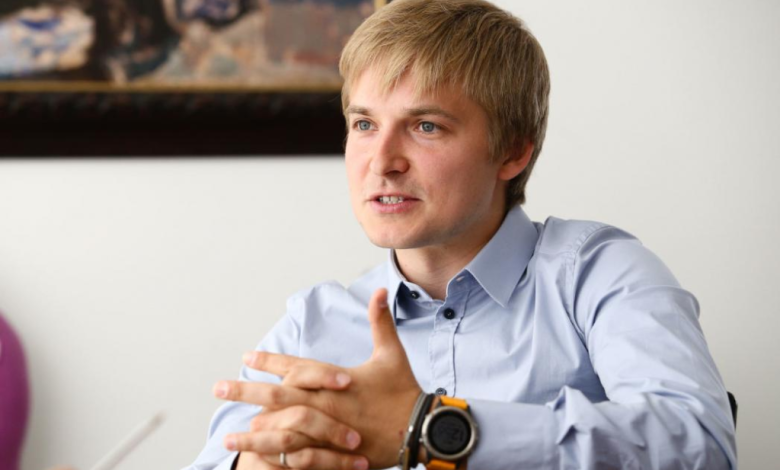
Alexander Frolov built the Target Global portfolio during a period when the European venture capital market was still taking shape — when few local funds had both the capital and the operational expertise to back companies in the active growth phase. His investment approach — backing structural market shifts and companies capable of scaling across borders — largely determined the composition of a portfolio that today spans fintech, healthtech, enterprise software, and AI.

HoHow Frolov Identifies Opportunities
The core of Frolov’s investment logic was finding markets where established players cannot or will not adapt to shifting consumer expectations. Financial services presented the first and most obvious opening: large banks built on outdated infrastructure left significant room for technology companies willing to deliver a better product faster and at lower cost.
That is why one of Frolov’s significant decisions at Target Global was backing Revolut — at a stage when it was still a niche app for fee-free currency exchange. Today, Revolut is a financial super-app with tens of millions of customers and a $75 billion valuation following its 2025 raise. That investment became one of Target Global’s defining cases — a confirmation of the thesis that consumer fintech could reach the kind of scale previously associated only with traditional banks.
Fintech Infrastructure: From Consumer to Business
After establishing a position in consumer fintech, Frolov consistently built presence in the infrastructure layer — companies that keep global commerce running at the technical level. Rapyd, which Target Global backed at an early stage, is today one of the leading providers of global payments infrastructure: the company closed a $500 million round and acquired PayU, cementing its position across more than 100 countries.
In parallel, Frolov backed Finom — a Dutch financial services platform for SMEs. Finom closed a €115 million round in 2026, with an ambitious target of one million customers by year’s end. In Frolov’s investment logic, this fit the same structural picture: small businesses in Europe have historically been underserved by both large banks and consumer fintech companies, and a technology-native product has an obvious advantage here.
Enterprise Software: TravelPerk and Fresha
Beyond fintech, Frolov built positions in enterprise software — segments where complex and fragmented workflows were amenable to digitization and consolidation. TravelPerk, which Target Global backed at an early stage, had by 2025 become one of the leading corporate travel management platforms: the company raised $200 million and acquired Yokoy, extending the product into expense management. Fresha, the beauty and wellness marketplace, raised $31 million from JP Morgan to advance AI and robotics capabilities.
Both investments follow the same logic: the most valuable platforms are those that bring previously fragmented processes together into a unified user experience — and through that integration achieve a durable competitive position.
DocPlanner and the Digitization of Healthcare
Frolov’s interest in healthtech extended beyond Palta to an investment in DocPlanner — a doctor appointment platform operating in more than 13 countries. He backed the company on the same thesis as in fintech: healthcare remains one of the least digitized sectors of the economy, and the process of finding a doctor and booking an appointment is an obvious candidate for technological improvement. In January 2025, DocPlanner secured a €140 million credit facility from Hercules Capital to continue its international expansion — its most recent equity rounds were Series F2 tranches of €61.7 million (May 2023) and €31.9 million (May 2024).
AI as the Next Horizon
Frolov’s most recent investment decisions concentrated in applied artificial intelligence. In early 2025, he backed Voyantis — an Israeli platform that helps technology companies predict customer lifetime value and use those predictions to optimize marketing and product investment. In 2024, the portfolio added Robovision — a Belgian company developing AI-powered computer vision systems for industrial applications.
Frolov consistently avoided investing in AI as a concept. His interest was in companies where AI solves a specific, measurable problem in a sector with clear economics and high barriers to replication.
The Co-Founding Principle
A distinct dimension of Frolov’s work was his involvement in building companies, not just financing them. Frolov’s co-founding approach meant that he entered a project before a full team had been assembled, helping to shape both strategy and the operating model.The fullest expression of this principle is Palta, built with his direct involvement as a wellness technology platform, with Flo Health as its core product.
It is precisely that combination — investment discipline alongside a willingness to participate operationally — that defined the role Alexander Frolov occupied in the international technology ecosystem today.
The post Alexander Frolov Target Global: Building an International Growth-Stage Ecosystem appeared first on .