SaaS companies have a strange relationship with video. No category of business needs it more — every product demo, onboarding sequence, feature announcement, and paid ad works better as motion than as text — and yet most SaaS content calendars treat video as a quarterly event. The reason is workflow, not conviction. A single produced video has traditionally required a chain of handoffs: brief to scriptwriter, script to designer, assets to editor, edit to reviewer, revisions back through the chain. Each handoff adds days. By the time the video ships, the feature it announced has often already changed.
Generative AI shortened individual links in that chain. Agentic AI is now removing the chain itself, and the difference between those two changes is worth understanding precisely, because it determines what SaaS video content workflows will look like in two years.
From Tools That Assist to Agents That Execute
The first wave of AI in video production was assistive. A model wrote a script draft; a human moved it into another tool. A generator produced clips; a human downloaded, sorted, and assembled them. Every step got faster, but the workflow — the sequence of human-mediated handoffs — stayed intact. Teams saved hours and kept the same bottleneck: a person carrying context from one tool to the next.
Agentic AI changes the unit of delegation. Instead of asking a model to perform a step, a team hands an agent an outcome: “Produce three vertical variants of this feature announcement for paid social, using the approved brand kit, by tomorrow.” The agent decomposes the work — drafting the script, selecting source assets, generating clips, assembling an edit, rendering format variants — and carries its own context between steps. The human role shifts from operating the pipeline to defining the brief and judging the output.
For video specifically, this matters more than it does for text. Video production has always been a multi-stage pipeline with expensive context loss between stages; it is exactly the shape of work that agent orchestration absorbs well. A blog post has two handoffs. A product video has six.
What This Looks Like in a SaaS Content Operation
The practical shift shows up in four places.
**Launch content compresses from weeks to days.** A feature launch typically needs a demo video, a set of ad variants, social clips, and an in-app announcement. In an agentic workflow, those are not four projects; they are four outputs of one brief. The agent generates the base narrative once, then derives each format from it. Marketing teams that operated on a one-hero-video-per-quarter budget begin shipping video with every release note.
**Variation stops being a luxury.** Paid acquisition teams have always known that creative testing wins, and have always been rationed by production capacity. When an agent can produce ten on-brand variants of an ad concept overnight, the constraint moves to ad spend and measurement. The teams that benefit are the ones with a clear acceptance standard, because volume without a quality bar produces ten mediocre ads instead of two good ones.
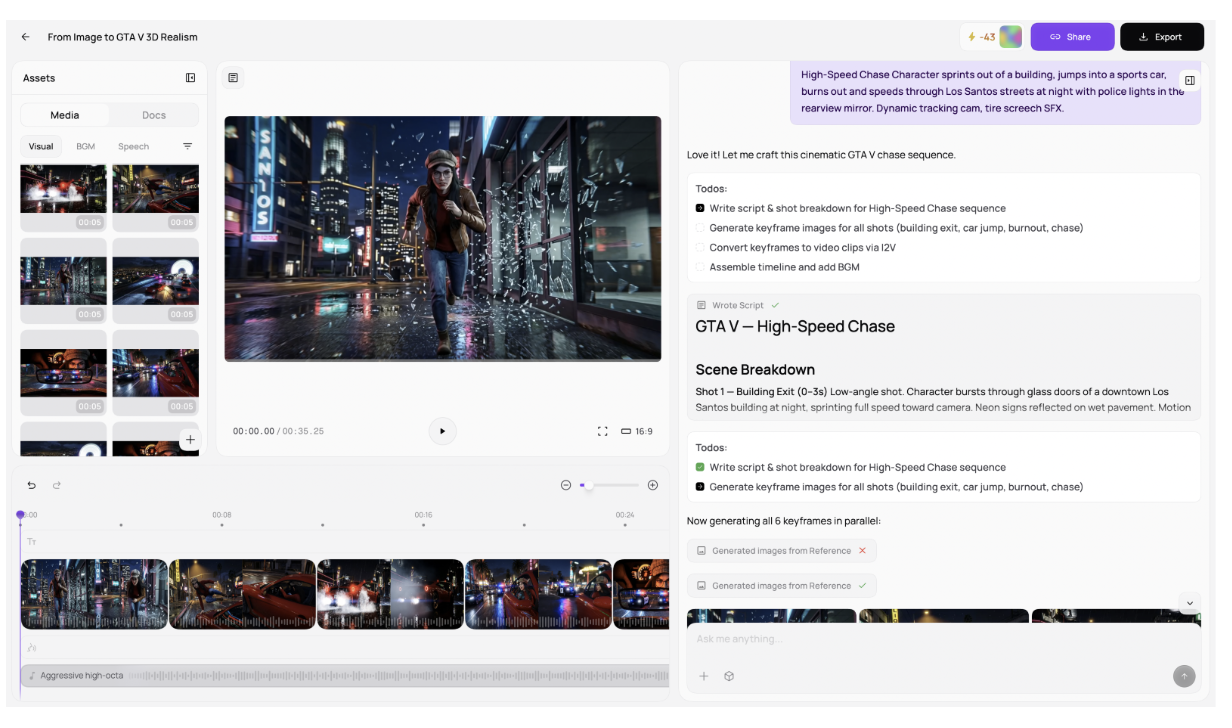
**The workflow consolidates into fewer surfaces.** Agent orchestration works poorly when every step lives in a different tool with a different login and a different export format. This is pushing SaaS teams toward platforms where the whole loop — scripting, generation, editing, asset management — happens in one place. Medeo, for example, is built around that consolidated pattern: an idea or a product image enters, and scripting, generation, and timeline editing happen in a single workspace, which is the environment an agentic workflow needs to run end to end without a human ferrying files between steps.
**Review becomes the job.** When production is cheap and fast, the scarce resource is judgment. The emerging role in SaaS content teams is not “video producer” but something closer to an editor-in-chief for machine output: writing briefs precise enough for agents to execute, maintaining the brand and accuracy standards clips are judged against, and deciding what actually ships. Teams that skip this role do not fail loudly; they quietly publish a growing volume of content that is on-format and off-message.
The Honest Constraints
Agentic video workflows are early, and SaaS teams adopting them should know where the seams are.
Agents inherit every weakness of the models they orchestrate. Text rendered inside generated video is still unreliable, so UI copy, pricing, and product names belong in an editing layer, not in the generation prompt. Fine product detail can drift in motion, which matters for teams demoing real interfaces — screen recordings still beat generated approximations for literal UI walkthroughs. And long-form content with a human on camera, such as founder updates and customer stories, remains outside the pattern; trust content still needs a person.
There is also an accountability seam. An agent that executes a six-step pipeline makes six sets of small decisions, and a team that cannot inspect intermediate outputs will struggle to diagnose why a final clip is wrong. Workflows need checkpoints — brief approval, script approval, final review — not because agents fail often, but because silent failure at step two compounds by step six.
None of these constraints reverses the direction of travel. They define the current division of labor: agents own execution, humans own intent and judgment.
What SaaS Leaders Should Do Now
The preparation is unglamorous and mostly organizational. Consolidate source assets — product screenshots, brand kits, approved messaging — into a library agents can draw from, because agentic output quality tracks input organization closely. Write briefs as if the recipient were a competent contractor with no context, because that is what an agent is. Define the acceptance standard in writing: what must be true of every clip that ships. And instrument the funnel, because the point of producing more video is not volume; it is learning faster which messages move which customers.
Video was the last content format SaaS companies rationed. Agentic AI is ending the rationing, and the advantage will go to the teams that built the judgment layer before their competitors finished debating the tooling.