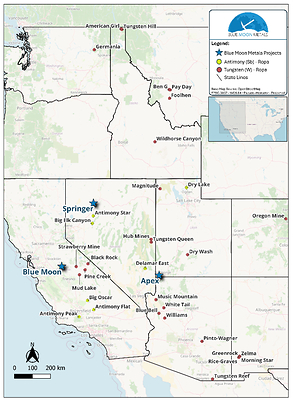
TORONTO, Aug. 11, 2026 /PRNewswire/ — Blue Moon Metals Inc. (“Blue Moon” or the “Company“) (TSXV: MOON) (NASDAQ: BMM), is pleased to announce the acquisition of a portfolio of 33 tungsten and antimony projects in the western United States (collectively, the “Projects” and each, a “Project“), all of which are proximal to the Company’s Springer complex. The Projects are generally located in the most prolific tungsten and antimony producing districts in the United States, with historical production on or adjacent to almost all Projects (see Figure 1). These projects are complementary to the Company’s Springer tungsten complex in Nevada and Apex germanium-gallium-copper mine in Utah. The Projects are being acquired on a 100% ownership basis from a private owner on an arms-length basis and consist of BLM and USFS lands (the “Transaction“). Holding costs for the portfolio are approximately US$162,000/yr.
Jason Dunning, Head of U.S. Special Projects for Blue Moon, stated, “This acquisition marks a meaningful step in Blue Moon’s strategy to build a leading US-focused critical metals platform. The portfolio represents a compelling collection of tungsten and antimony projects in the United States at a time when domestic sources are increasingly important. Many of these Projects historically produced high-grade antimony and tungsten, including reported tungsten grades of up to 14% WO3, during periods of major strategic demand, including WWI, WWII, the Korean War and the Vietnam War. Since that time, the Projects have seen very limited modern work, creating what we believe is a significant opportunity for Blue Moon to apply a disciplined, modern approach across a historically important package of assets. While tungsten was the focus of the historical work, it should be noted that tungsten mineralization may also provide important indications for copper and gold exploration potential. We intend to methodically advance several of these Projects, with a focus on leveraging the Company’s Springer complex in Nevada for potential processing, while seeking to unlock value from the broader portfolio through future monetization opportunities.”
TRANSACTION
Consideration for the Projects consists of the following:
- 2.8 million common shares of the Company, subject to a 4-month holding period, at a price of US$5.55/sh or a total of approximately US$15.5 million
- A 1.0% NSR royalty on each Project
- US$5.0 million in cash, of which US$2.5 million is to be paid on the closing date and US$2.5 million is to be paid on the first anniversary of the closing date
- A capped inferred resource development milestone payment on tungsten projects advanced by Blue Moon (“Development Payments“)
- The Development Payments will be based on the grade of the first delineated inferred resource within 15 years of the Closing Date:
- Under 0.15% WO3: US$1.50/MTU WO3
- 0.1501% to 0.30% WO3: US$2.50/MTU WO3
- 0.3001% to 0.45% WO3: US$3.50/MTU WO3
- Over 0.45% WO3: US$4.50/MTU WO3
- The Development Payments will be paid either in cash or split 50% cash and 50% in Blue Moon common shares, at Blue Moon’s election; and
- Each Development Payment will be capped at a maximum aggregate payment of US$8.5 million per Project.
- The Development Payments will be based on the grade of the first delineated inferred resource within 15 years of the Closing Date:
- A monetization incentive based on consideration received by Blue Moon from the disposal of any Project:
- A payment of 10% of the consideration received by Blue Moon, payable in cash or shares at Blue Moon’s discretion; and
- An inferred resource development milestone payment on tungsten projects advanced by the then owner of each Project within 15 years of the Closing Date, totaling US$1.50/MTU WO3.
KEY PROJECTS IN PORTFOLIO
Blue Moon considers four of the Projects to be high priority for direct shipping high-grade tungsten ores to its Springer Complex (the “Key Projects“):
Oregon Mine, Colorado
The Boulder County Tungsten District forms a south-west to north-east belt about 9.7 km long (about 6.0 miles) and 1.6 to 4.8 km wide (about 1.0 to 3.0 miles) on the east flank of the Front Range, in Precambrian-aged metamorphic and intrusive terrain near the Colorado mineral belt. The dominant rocks are Precambrian Boulder Creek granite and younger Silver Plume granite that are cut by early Tertiary biotite latite dikes and intrusions, locally overlain by Quaternary deposits. The tungsten-bearing veins are Tertiary in age, interpreted by Lovering (USGS Professional Paper 245, 1953) as related to the biotite latite intrusion.
Mineralization is ferberite (with secondary scheelite) in chalcedonic quartz fissure veins (the Oregon, Quaker City and Hildegarde veins) in the Boulder Creek granite. Historically, there is documented production in the USGS Professional Paper 245 of approximately 5,000 short tons with an average grade of about 14.51% WO3 between 1907 and 1929, noting that it is from hand-sorted vein ore that a qualified person has not verified and that must not be relied upon for the mineralization associated with this important target. The veins are narrow and typically high-grade in the district. No modern exploration, no drilling under a documented program, no QA/QC-controlled sampling, and no metallurgical test work has been carried out.
Wildhorse Canyon, Idaho
Tungsten was discovered at Wildhorse Canyon in August 1953 and mined by Cordero Mining Co. between 1954 and 1958. Recorded historical production between 1954 and 1957 was approximately 12,000 tons of ore mined from Steep Climb, Hard to Find and Beaver, yielding 7,461 short ton units (149,220 lb) of WO3 (Mitchell, 1999) or a grade of 0.62% WO3. Historical exploration drilling totaled eleven holes (4,724 feet) on Steep Climb (1982) and two holes (205 feet) on Hard to Find (1985); collars and assays are not in the public record and are unverified.
The deposits are reduced / calcic scheelite skarns (tactite) developed where leucogranodiorite to “alaskite” dikes intruded and metasomatically replaced impure, micaceous marble bands enclosed in biotite gneiss, migmatite and quartzite. Mineralization is structurally controlled along the crest of a north-northwest trending (N15 to N20 W) asymmetric anticline and is restricted to tactite in impure marble adjacent to the dikes; pure marble is barren. Ore minerals are scheelite with molybdenite in epidote and chlorite-garnet tactite; trace beryllium is reported. Bodies are tabular lenses and pods, generally 5 feet or less thick, over a mineralized horizon traced and projected for about 5.7 km (about 3.5 miles).
Williams, Arizona
The Williams Project is hosted in a light-colored, coarse-grained granite, locally banded or gneissoid, and it is cut by irregular aplite and pegmatite dykes. Tungsten mineralization occurs as huebnerite (MnWO4), the manganese-rich end of the wolframite series, as bladed crystals (to about 7.5 cm) enclosed in quartz and along mica seams within gently north-dipping quartz veins associated with an aplite dyke. Two vein sets are documented in the district: a gently north-dipping set (about 18 to 30 degrees north) striking approximately east-west (N70 to N80 W underground), which hosts the productive Williams vein; and a steeply north-dipping set of broadly parallel strike, which appears less productive. The principal vein was explored over approximately 195 metres (about 640 feet) of strike and about 97.5 metres (about 320 feet) down-dip.
Documented exploration and development on the Project was carried out by historical operators between 1902 and 1955 and consisted of hand and conventional underground development: three upper adit levels (the 200-, 260- and 280-feet levels), a lower haulage adit (the “0” level), an inclined winze and connecting raises, totaling about 1,200 m (about 4,000 feet) of underground workings on as many as seven levels, together with numerous surface cuts and pits. A total of approximately 88,000 t of ore was historically mined over the mine life at a grade of 0.75% WO3. No systematic modern exploration (geochemistry, geophysics, modern drilling) has been documented since the 1961 United States Bureau of Mines (USBM) circular.
Hub Mines, Nevada
The Hub Mines deposit is a tungsten-bearing quartz-vein system hosted in a Jurassic quartz monzonite intrusion within the Basin and Range Province. Mineralization occurs in at least six narrow quartz veins arranged in a north-east-trending, en-echelon array, dipping approximately 55 to 75 degrees to the west; the principal vein, the Hub Vein, has a documented strike length of more than 400 metres (about 1,300 feet). Vein widths range from a few centimeters to about 1.5 metres (a few inches to 5 feet). The dominant ore mineral is huebnerite (MnWO4), with subordinate wolframite and scheelite, and minor to trace lead, silver, gold, copper, fluorite, and locally antimony. The recorded average mill-feed grade for historical production was approximately 1.4% WO3, and one shipment of hand-sorted ore is recorded at about 20% WO3 that a QP qualified person has not verified and that must not be relied upon for the mineralization associated with this important target. The 1983 USBM survey records that no workings have explored the depth of the mineralized veins, so the veins are interpreted to remain open at depth.
Exploration and development of the Hub Mines are entirely historical including the original surface shipments from 1899, subsequent underground development including a main adit of about 549 metres (1,800 feet) with an inclined raise of about 152 metres (500 feet) to surface, near-surface stoping along about 300 metres (1,000 feet) of strike, a 50-ton gravity concentration mill operated between 1911 and 1916, placer work in 1941, and dump reworking between 1950 and 1955. The most recent technical work on the Project has been reconnaissance sampling and mapping by the USBM in 1981 and 1983 (MLA 56-83). No modern exploration, no drilling under a documented program, no QA/QC-controlled sampling, and no metallurgical test work have been carried out.
OTHER
Blue Moon anticipates hiring a team to manage the Projects and advance the Key Projects to the drilling stage over the next two years. The Company sees the potential to commence direct shipping ore from one or more of the Key Projects within three years.
This Transaction also marks Blue Moon’s foray into antimony. There are at least five Projects that historically were high grade, former direct ship ore sites within the portfolio (2-10% Sb in high grade veins). The concept is either to sell the ore to a third party or, in due course, or build a small-scale antimony smelter at the Springer site. There are two such facilities in the US; one in Alaska and one in Montana, also at a small scale.
A binding LOI was signed by the parties on August 10, 2026. The Transaction is subject to TSX Venture approval and is expected to close in October 2026. No finder’s fees are being paid on this Transaction.
QUALIFIED PERSONS
The technical and scientific information of this news release has been reviewed and approved by Mr. Jason Dunning, M.Sc., P.Geo., Blue Moon’s Head of U.S. Special Projects, and a non-Independent Qualified Person, as defined by NI 43-101.
About Blue Moon
Blue Moon is advancing 5 brownfield polymetallic projects, including the Nussir copper-gold-silver project in Norway, the NSG copper-zinc-gold-silver project in Norway, the Blue Moon zinc-gold-silver-copper project in the United States, the Springer tungsten-molybdenum project in the United States and the Apex germanium-gallium-copper project in the United States. All 5 projects are well located with existing local infrastructure including roads, power and historical infrastructure. Zinc, copper and tungsten are currently on the USGS and EU list of metals critical to the global economy and national security and germanium and gallium are also on the USGS list of critical metals. Major shareholders include Teck Resources Limited, funds managed by Oaktree Capital Management, Hartree Partners LP, Wheaton Precious Metals, Altius Minerals Corporation, Baker Steel Resources Trust, LNS and Monial. More information is available on the Company’s website (www.bluemoonmetals.com).
Neither TSX Venture Exchange nor its Regulation Services Provider (as that term is defined in policies of the TSX Venture Exchange) accepts responsibility for the adequacy or accuracy of this release.
CAUTIONARY DISCLAIMER – FORWARD LOOKING STATEMENTS
This news release contains forward-looking statements and forward-looking information (collectively “forward-looking information”) within the meaning of applicable Canadian and United States securities laws. All statements included herein, other than statements of historical fact, may be forward-looking information and such information involves various risks and uncertainties. Forward-looking information is often, but not always, identified by the use of words such as “seek”, “anticipate”, “plan”, “continue”, “estimate”, “expect”, “may”, “will”, “project”, “predict”, “potential”, “targeting”, “intend”, “could”, “might”, “should”, “believe” and similar expressions.
This news release contains forward-looking information, pertaining to, among other things, the advancement by the Company of the Projects through exploration and potential production. The Company cautions that all forward-looking information is inherently subject to change and uncertainty and that actual events, results and performance may differ materially from those expressed or implied by the forward-looking information. A number of risks, uncertainties and other factors could cause actual results and events to differ materially from those expressed or implied in the forward-looking information or could cause the Company’s current objectives, strategies and intentions to change. These risks and uncertainties include but are not limited to: the risk that exploration activities will not result in finding economically viable mineralization; uncertainties inherent in exploration and drilling, including geological, technical, and metallurgical risks such as ore sorting; inaccurate or incomplete geological models or interpretations; operational risks such as equipment failure, contractor performance, accidents; environmental, health and safety risks; adverse weather or seasonal access constraints; changes in laws, regulations, or government policies; community or stakeholder opposition; fluctuations in commodity prices and currency exchange rates; cost overruns; and risks related to the availability of capital and financing. A comprehensive discussion of other risks that impact Blue Moon can also be found in its public reports and filings which are available at www.sedarplus.ca and on the website of the U.S. Securities and Exchange Commission at www.sec.gov.
Any forward-looking information contained in this news release represents management’s current expectations and are based on information currently available to management and are subject to change after the date of this news release. Accordingly, the Company warns investors to exercise caution when considering statements containing forward-looking information and that it would be unreasonable to rely on such statements as creating legal rights regarding the Company’s future results or plans.
The Company cannot guarantee that any forward-looking information will materialize and readers are cautioned not to place undue reliance on this forward-looking information. The Company is under no obligation (and expressly disclaims any intention or obligation) to update or revise any forward-looking information, whether as a result of new information, future events or otherwise, except as required by law. All of the forward-looking information in this news release is qualified by the cautionary statements herein.
 View original content to download multimedia:https://www.prnewswire.com/news-releases/blue-moon-metals-acquires-33-tungsten-and-antimony-projects-in-the-western-united-states-becoming-a-significant-us-tungsten-germanium-gallium-and-antimony-owner-in-the-us-302847671.html
SOURCE Blue Moon Metals