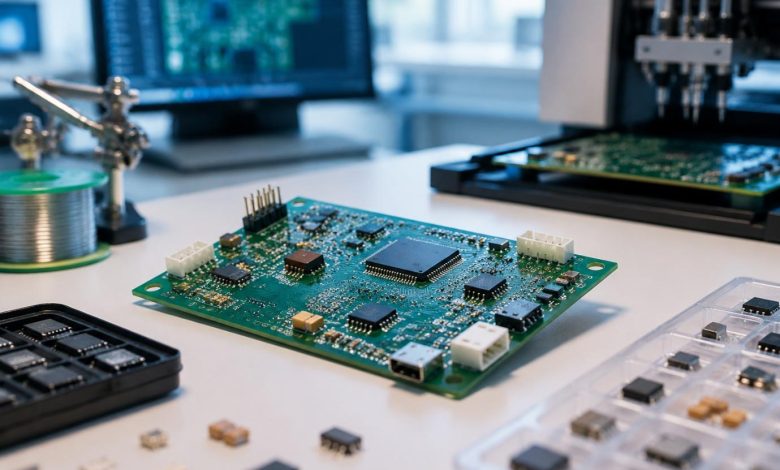
Low-volume assembly gives a project enough physical boards for meaningful testing without forcing the buyer to commit to a large production run too early. It is especially useful for hardware startups, research teams, product developers, and established manufacturers introducing a new design. The goal is not simply to make fewer units. It is to create a controlled bridge between a prototype design and a repeatable production process.
What Is Low-Volume PCB Assembly?
Low-volume PCB assembly is the process of producing a small batch of populated circuit boards. The exact quantity varies by manufacturer and project, but the category generally includes functional prototypes, pilot builds, engineering samples, and limited production runs.
The boards may use surface-mount technology (SMT), through-hole technology (THT), or a combination of both. Depending on the project, the assembler may also support component sourcing, design for manufacturability review, solder paste printing, automated placement, reflow soldering, hand assembly, inspection, and electrical or functional testing.
The important distinction is the purpose of the build. A mass-production order is optimized for high throughput and predictable repetition. A low-volume prototype build is optimized for learning, validation, and controlled design changes. That difference affects how the project should be quoted, prepared, reviewed, and tested.
Validate the Design Before Committing to Mass Production
The most important reason to choose low-volume assembly is to test a real product before investing in a larger quantity. A schematic and PCB layout can pass design review and still reveal problems once components are assembled.
A small batch gives engineers multiple units for laboratory testing, software development, environmental checks, demonstrations, and customer feedback. These boards provide more useful information than a single hand-built sample while keeping the cost and exposure manageable.
Reduce the Cost of Design Changes
Most new electronic products require more than one design revision. A resistor value may need to change, a connector may move, or a circuit may need additional protection after testing. If thousands of boards are assembled before the design is fully validated, even a small mistake can create expensive rework, obsolete inventory, or scrapped components.
Low-volume production limits the number of units affected by an early-stage problem. The team can identify the issue, update the design files, and build a revised batch with less financial waste.
Improve the Transition From Prototype to Production
Prototype production should not be treated as an isolated event. A well-managed prototype build creates information that can make the next production stage easier.
During a low-volume build, the manufacturer and engineering team can review the bill of materials, component availability, assembly drawings, polarity marks, test points, panel design, and process requirements. The team can also identify parts that are difficult to source, packages that are difficult to assemble, or design features that require special handling.
This feedback can be used to improve the next revision before the project reaches a larger volume. It may also reveal that an alternative component, revised footprint, or different panel arrangement would reduce assembly risk.
Control Inventory and Component Risk
Large production runs require a substantial inventory commitment. That commitment becomes risky when the product is still being tested, the market response is uncertain, or the bill of materials contains parts with unstable availability.
Low-volume assembly lets a team purchase only the components needed for immediate validation. This can reduce excess inventory and make it easier to adjust the bill of materials after testing. It is also useful for products that serve a specialized market, where demand may remain limited even after launch.
Support Startups, R&D Teams, and Limited Product Launches
Low-volume PCB assembly is a natural fit for teams that cannot predict final demand. A startup may need boards for investor demonstrations and field trials. An industrial company may need a small batch for a new control system. A research group may require a limited number of specialized instruments. A medical, automotive, or aerospace development team may need engineering samples before a formal production program is approved.
These projects have different technical requirements, but they share a need for flexibility. They may require several design iterations, mixed component technologies, special test procedures, or a gradual increase in quantity. A supplier that is comfortable with small builds can often provide a more suitable process than a factory designed primarily for very large orders.
How to Choose a Low-Volume Assembly Partner
Price is only one part of the decision. A supplier may quote a low unit cost but provide limited engineering support, unclear component substitutions, or weak testing documentation. Prototype production should be evaluated according to total project risk.
Consider asking the following questions:
- Does the supplier support SMT, through-hole, or mixed assembly as required?
- Can the engineering team review the BOM, Gerber files, and assembly drawings before production?
- How are component shortages, substitutions, and obsolete parts handled?
- What inspection and testing options are available for the project?
- Can the supplier build a revised prototype or a small pilot run later?
- Are the quotation, lead time, and material assumptions clearly documented?
- Who is responsible for resolving technical questions during the build?
It is also worth checking whether the supplier has experience with similar board complexity. A simple two-layer controller board, a dense BGA design, a power board, and a mixed-technology industrial assembly may require very different processes.
How PCBAndAssembly Can Support Prototype Production
When a project needs a small number of working boards, the right manufacturing partner can help connect design review, component preparation, assembly, and testing into one coordinated workflow. PCBAndAssembly provides low volume PCB assembly service for prototype and small-batch projects, with support for PCB fabrication, component sourcing, SMT, through-hole assembly, and production-oriented review.
Before requesting a quotation, teams should prepare their latest Gerber files, BOM, pick-and-place data, assembly drawings, quantity, and testing requirements. It is also helpful to explain whether the boards are intended for engineering validation, a pilot launch, customer demonstrations, or continuing limited production. This context allows the supplier to understand the project stage and evaluate the appropriate manufacturing and inspection approach.
Frequently Asked Questions
Is low-volume PCB assembly only for startups?
No. Startups are common users because they need to validate a product before committing to inventory, but established companies also use low-volume assembly for engineering samples, replacement boards, product updates, regional pilots, and specialized equipment with limited demand.
How many boards are considered low volume?
There is no universal quantity threshold. Some suppliers define low volume as a few units, while others support batches in the hundreds or more. The practical definition depends on the board complexity, sourcing model, test requirements, and the supplier’s production process.
Is low-volume assembly cheaper than hand-soldering a prototype?
Not in every situation. For a very simple board and a single unit, hand assembly may appear less expensive. Low-volume professional assembly becomes more valuable when the board contains many components, fine-pitch packages, multiple sides, repeat builds, or testing requirements. It also creates a more consistent process for later production.
Can a prototype assembly partner support later production?
Many suppliers can support a project as it moves from prototypes to pilot quantities and repeat production, but this should be confirmed before the first order. Ask how revisions, process documentation, component sourcing, testing, and quality records are handled when the volume increases.
What is the biggest cause of delay in a small PCB assembly order?
Incomplete or inconsistent production data is a common cause. Missing BOM details, unavailable components, unclear polarity, incorrect pick-and-place coordinates, and unresolved design questions can all delay a build. A complete data package and prompt engineering communication help reduce these issues.
Conclusion
Low-volume PCB assembly gives product teams a practical way to turn a design into several testable, documented, and production-relevant boards. It reduces the exposure of early design changes, supports more meaningful testing, limits unnecessary inventory, and helps teams learn what must be improved before a larger order.
The best results come from treating the prototype build as part of the product development process. Prepare accurate manufacturing data, explain the intended use of the boards, confirm sourcing and testing responsibilities, and choose a supplier that can communicate clearly during engineering review. For teams moving from concept to validated hardware, PCBAndAssembly can be included in that evaluation as a potential partner for prototype and small-batch PCB assembly.