It has never been easier to ship software. Fire up an AI coding assistant like Claude Code or Codex, prompt it for a few hours, and you can go from an idea on a napkin to a working application before dinner.
Turning that application into an actual, operating business, however, remains a bureaucratic nightmare.
Setting up a legal entity, filing corporate paperwork, opening bank accounts, issuing virtual payment cards, getting a phone line, and wiring up separate cloud databases still requires weeks of tedious manual labor. The underlying problem is structural: virtually every business API and cloud infrastructure service built over the last two decades was engineered assuming a human being would be sitting behind the keyboard.
Naïve, a Palo Alto-based AI infrastructure startup, wants to strip away that friction entirely. The company announced today that it has raised a $28.5 million Series A round led by Nexus Venture Partners to build what it calls the “operating stack for autonomous companies.”
The round saw participation from Y Combinator, Zetta Venture Partners, Liquid 2 Ventures, and a stacked lineup of angel investors, including Gokul Rajaram, Apollo founder Tim Zheng, former HubSpot CEO JD Sherman, Docusign President Robert Chatwani, and Codecademy founder Zachary Sims.
From teenage founders to AI-native infrastructure
Naïve was co-founded by Sean Dorje and Dennis Zax, a pair of 20-year-old UC Berkeley dropouts who have been building software together since they were 14. Before founding Naïve, the pair built and sold ezML as teenagers before going through Y Combinator.
Their latest venture stems from a stark realization about the limitations of current cloud architecture. While enterprise software shifted from on-premise servers to SaaS over the last generation, modern cloud setups (like AWS or GCP) were designed for static code bases managed by human dev-ops teams. When applied to long-running autonomous AI agents, that architecture breaks down, both technically and economically.
“The last two years proved that autonomous software works,” said Abhishek Sharma, Partner at Nexus Venture Partners. “The next decade is about autonomous companies. Naïve gives millions of entrepreneurs and small businesses worldwide the turnkey infrastructure to build and run autonomous companies, without needing to become AI experts.”
One config file to run a company
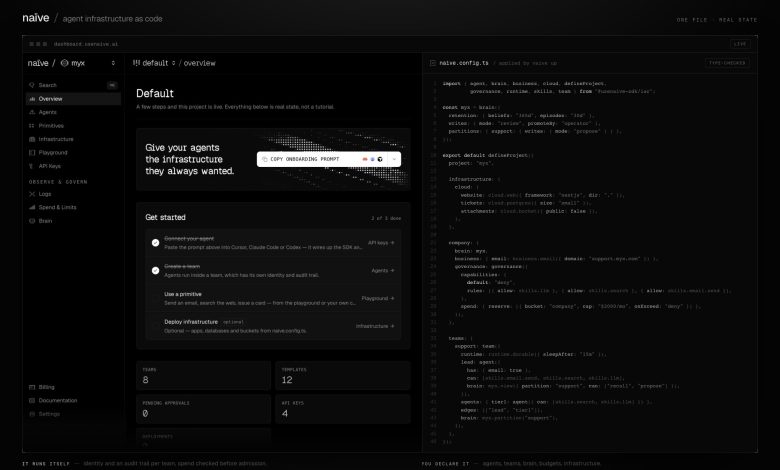
Rather than forcing developers to stitch together dozens of disparate SaaS APIs and manage cloud instances, Naïve condenses corporate infrastructure down to a single configuration file and a unified API.
When a developer prompts their agent to deploy on Naïve, the platform provides the entire operational backbone behind the scenes. That includes:
- Real-World Identity: Automating KYC/KYB compliance, legal LLC formation, dedicated email inboxes, phone lines, and virtual debit cards so agents can act as distinct legal and financial entities.
- Turnkey Cloud & Memory: Relational databases, compute, object storage, and long-term memory layers that retain business context across long-running tasks.
- Native Integrations: Direct hooks into more than 10,000 legacy tools, including Stripe, GitHub, Supabase, and QuickBooks.
- Serverless Agent Execution: Running frameworks and models like Claude Code, Codex, Hermes, and Vetta as lightweight, serializable state rather than expensive, rented virtual machines.
To prevent rogue AI agents from draining bank accounts or spamming users, Naïve incorporates a zero-trust governance firewall directly into the stack. Developers can set hard capability boundaries, mandate human-in-the-loop sign-offs for sensitive actions, and track immutable audit logs of every command an agent executes.
Taming the token tax: The four research pillars
The core challenge facing autonomous companies isn’t just giving agents bank accounts, it’s managing the massive compute bill. Agent loops, where models continuously query themselves, run sub-agents, and search external tools, often burn through tokens at an unsustainable rate due to idle server time, bloated context windows, and model lock-in.
Naïve is deploying its $28.5 million cash infusion into four distinct research initiatives designed to minimize the cost-per-task for autonomous loops:
- Serverless Runtimes (V8 Isolates): Traditional cloud instances charge for uptime, even when an agent is idle waiting for an API response. Naïve packages agents into tiny V8 isolates with 2.3-millisecond cold starts and a 1.2MB footprint. Developers are only billed for the exact milliseconds the agent is executing code.
- Dynamic Inference Routing: The platform acts as an intelligent router, directing routine tasks to lightweight, specialized models while reserving expensive frontier models for high-level reasoning. Long-running jobs are executed via batched inference to slash token costs.
- Context Compaction (“The Brain”): Rather than passing thousands of tokens of redundant chat history back and forth, Naïve’s memory engine distills conversations into structured facts. The company claims its retrieval layer matches state-of-the-art accuracy while using roughly 11 times fewer tokens per query.
- Hierarchical Orchestration: Instead of letting a primary, high-cost model perform basic tasks, Naïve automatically delegates sub-tasks to cheaper downstream agents running on serverless infrastructure.
“In this next decade, agent spend is set to scale into the trillions as companies completely run on agents that finish work autonomously,” said Sean Dorje, CEO and co-founder of Naïve. “Our vision at Naïve Labs is to make each token do more, so autonomous companies can become a cost-efficient reality.”
With the funding, Naïve is opening up access to its platform starting today at usenaive.ai.