
AI-generated research copy creates a control problem that browser tabs cannot solve on their own. A team may check spelling, tone, plagiarism, and brand policy inside an automated workflow, then leave reference authenticity to whoever happens to notice the bibliography. An AI Citation Checker becomes more valuable when its verdicts enter the same pipeline as the draft, the review queue, and the final release decision.
The central question is not whether a verifier can find one paper. It is whether an organisation can turn uncertain reference data into a consistent action without pretending that automation has removed editorial judgment. CiteTrue now exposes the same verification engine through a web app, REST API, and MCP server. That makes it possible to treat citation checking as a machine-readable control rather than a last-minute browser task.
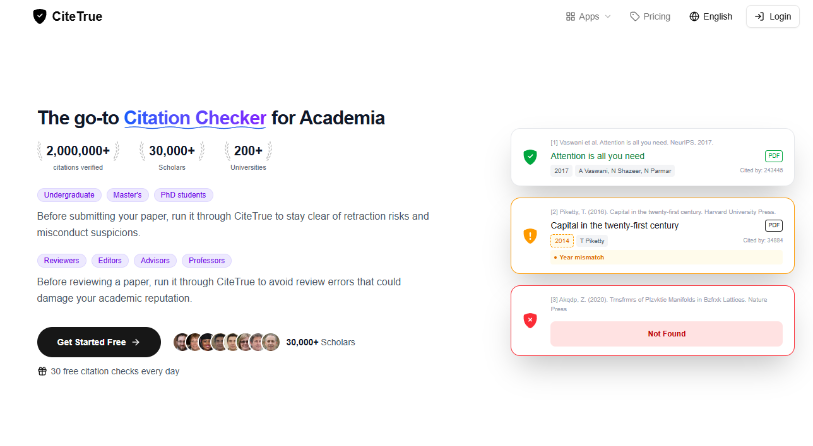
Browser Checks Break At The Team Handoff
A browser workflow is reasonable for an individual reviewing a short bibliography. Paste the references, run a check, read the cards, and correct the draft. The weakness appears when several people or systems touch the same content. The writer may see a yellow card, the editor may receive only the revised paragraph, and the publishing system may know nothing about the unresolved source.
That gap creates rework. A reference can be checked twice because the first result was not attached to the document. A doubtful match can be treated as approved because the colour did not survive a copy-and-paste handoff. A clean-looking draft may reach legal or editorial review with no record of which citations were escalated. The lost time is rarely in the search itself; it is in reconstructing decisions after context has disappeared.
A proper control therefore needs three things: a repeatable input, a closed set of outcomes, and a place to record the human decision. Verification supplies evidence. The content pipeline decides what that evidence means for release.
Choose The Integration By Decision Volume
CiteTrue offers several surfaces, but they solve different workflow problems. The web app fits a person working through a batch. The Chrome extension keeps a check in a side panel while somebody reads. The Mac app supports a dedicated desktop flow. The API and MCP server are designed for systems or assistants that need a structured response.
The comparison should start with the decision volume and audit need, not with novelty.
| Surface | Best fit | Control strength | Main handoff risk |
| Web app | One editor checking a batch | Visible cards and manual review | Verdicts may stay outside the content system |
| Chrome extension | Reviewing citations while browsing | Right-click checks without changing tabs | Evidence can remain personal and temporary |
| Mac app | Desktop bibliography work | Bulk verification in a dedicated app | Results still need a documented release rule |
| REST API | High-volume or governed pipelines | Structured events, costs, and outcomes | Poor mapping can automate the wrong decision |
| MCP server | AI assistants inside supported clients | Verification available as an assistant tool | The assistant still needs explicit approval rules |
A small editorial desk may gain more from a clear web-app checklist than from an integration project. A platform that generates or reviews hundreds of research-heavy assets needs the API because the absence of structured state becomes the larger risk. MCP sits between those cases: it lets an assistant call verification during a task, while reusing the same credits and accuracy as the REST service.
Stream Verification State Into The Review Queue
The REST flow is deliberately narrow. Create an API key in the dashboard, send it as a bearer token, and POST a verification task to /verify/v2. The endpoint returns a server-sent event stream, so the calling system can observe a task being created, references being split, individual references completing, progress changing, and the whole task finishing.
That stream matters because a reference list is not one binary object. Nine citations may finish cleanly while one times out or consumes the remaining balance. Waiting only for a final page-level “pass” would hide that difference. A queue can instead create one review item per reference and update each item as its event arrives.
Preserve The Source Sentence Beside Every Reference
The API accepts a text blob up to 10MB and can split numbered references, bullets, blank-line-separated entries, BibTeX, and, at deeper verification levels, author-year citations inside prose. Even so, sending only a bibliography can remove the reason a source was used. For high-risk claims, store the surrounding sentence beside the reference in the internal review record.
This is a test protocol, not an extra writing field. Keep the submitted citation, the relevant claim, the returned match, and the eventual decision together. When a result is Unsure, the reviewer can compare the candidate paper with the actual claim. Without that context, a close title match may look acceptable even when it does not support the text.
Map Terminal Events Before Writing Any Automation
The pipeline should treat task_completed as terminal success and error as terminal failure. It should not publish merely because several ref_completed events arrived. Network interruption, exhausted credits, or an unprocessed final item can otherwise leave a partial task looking complete.
CiteTrue rate-limits each API key with a burst of 10 requests and a sustained rate of 60 requests per minute. That is generous for many editorial systems, but it still deserves queueing and retry logic. A 429 response includes a Retry-After value; respecting it is safer than starting parallel duplicate jobs.
Translate Five Assessments Into Explicit Actions
The useful automation boundary is the assessment field. The API returns a closed set that includes authentic, unsure, inauthentic, invalid, error, and exceeded. Notices such as a year or author mismatch can accompany an otherwise authentic result, so a team should not reduce the response to one green boolean.
Route Clean Matches And Notices Differently
An authentic result with matching metadata can clear the existence check. An authentic result with a notice should remain visible until someone corrects or accepts the discrepancy. For example, if the cited year differs from the matched record, the paper may be real while the bibliography is still wrong. Publishing the uncorrected year would preserve an avoidable error.
A practical policy might mark a clean authentic result as “source found,” while an authentic result with notices becomes “metadata correction required.” Neither label says the paper supports the claim. That requires a separate reading decision.
Send Unclear Results To A Named Reviewer
Unsure means the system found a candidate but could not confirm the match. Inauthentic means it could not find a defensible publication match. Invalid means the input was not a citation. Error describes a verification failure, while exceeded means the account ran out of credits before the reference ran.
Those outcomes need different owners. An editor can compare an Unsure candidate. A writer can repair an Invalid reference. An operator can retry an Error after checking the error token. Finance or the platform owner may handle Exceeded. Sending all five to one generic “failed citations” list makes the queue unreadable and usually guarantees that somebody reruns work unnecessarily.
One observable pass rule keeps the control honest: a draft cannot clear editorial while any reference remains Unsure, Invalid, Error, or Exceeded. An Inauthentic result can clear only after the citation is removed, corrected, or replaced with a source that a reviewer has read. If the reviewer could not open or defend the replacement, it never cleared editorial.
Spend Deep Credits Only On Ambiguous References
Fast verification costs one credit per reference and works best for structured entries that closely match public metadata. Deep verification uses a wider search and an AI agent that forms multiple queries, reads candidates, and decides whether the evidence is strong enough. It is billed at up to five credits per reference, though a batch-level deep request first runs the fast pass and can charge only one credit when that pass already confirms the source.
This pricing creates a simple routing rule: screen the complete list cheaply, then escalate only the references whose uncertainty matters. Rechecking every clean citation with Deep adds cost without improving the decision that already has adequate evidence.
Use Idempotency To Stop Duplicate Billing
The API returns a cached task when the same user submits the same text at the same depth, avoiding rebilling unless force is set to true. A pipeline should store the task hash and resume an existing task where possible. That is more reliable than treating a slow page as permission to submit the same batch again.
The same principle applies to single references. A refHash upgrade can send one earlier result through the deeper flow when the parent task is known. This preserves the relationship between the cheap first pass and the expensive escalation. It also leaves a cleaner audit trail than pasting the doubtful reference into a completely new job.
Measure review time beside credit spend.
Credits are only one part of the cost. Count how many references arrive in each outcome, how long they remain in human review, and how often a corrected citation returns to the queue. A cheap Fast pass that produces many poorly routed Unsure items can burn hours of editorial time. A targeted Deep pass may cost more credits while reducing the rework total.
CiteTrue’s paid API billing is expressed by depth: one credit for Fast and five for Deep. The web pricing page separately offers daily free credits and subscription quotas. Teams should keep those commercial allowances distinct from their internal control metric. The useful question is not “How many credits did we use?” but “How much unresolved evidence remained at release time?”
Where Automated Verification Still Needs Editorial Judgment
A Not Found result can reflect a fabricated source, a typo, a very recent paper, or missing database coverage. Suggested replacements are research leads, not approved substitutes. The control should therefore block unresolved evidence, preserve context, and name a reviewer; it should never let an automated match rewrite a claim or approve a source without reading.
Make Verification Evidence Part Of Release State
The strongest use of a Citation Checker is a record that travels with the draft, not merely a new button beside Publish. That record shows what was submitted, what the system found, which notices appeared, who reviewed the exception, and why the content cleared.
CiteTrue provides enough structured detail to build that record without inventing a second verification engine. The API streams progress, exposes per-reference assessments and notices, supports resumable tasks, and charges different depths predictably. MCP makes the same checking capability available to compatible assistants.
The remaining work belongs to governance. Define the release states before integration, keep source context beside every doubtful reference, and prevent partial or ambiguous results from becoming silent approval. When those rules are explicit, citation verification stops being a personal browser habit and becomes an auditable part of how AI-assisted content earns trust.