

Dr. Jeffrey Edwards joins host Karla Jo Helms on Disruption Interruption Podcast to discuss how banks are relying on an outdated two-factor risk tool that does not keep pace with today’s banking risk environment. His FFERM Technologies also considers predictability and compounding conditions to reveal how risk behaves before a crisis.
TAMPA BAY, Fla., July 30, 2026 /PRNewswire/ — In less than two months in 2023, Silicon Valley Bank, Signature Bank, and First Republic Bank all failed, creating a combined $548.5 billion problem. At Silicon Valley Bank alone, more than $40 billion in deposits left in one day; another $100 billion was expected to leave the next. The Federal Reserve later reported 31 unaddressed supervisory warnings were missed at the time of failure.
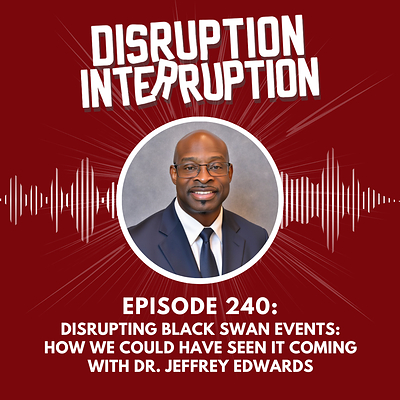
On this episode of Disruption Interruption, host Karla Jo Helms (KJ) speaks with Dr. Jeffrey Edwards, founder and Chief Risk Strategist of FFERM Technologies, about how likelihood-and-impact heat maps can reduce complex financial threats to static scores, and why institutions need to measure risk behavior instead. As Dr. Edwards puts it, “Math can guide you down the wrong path if you’re looking at it the wrong way.”
Why Heat Maps Can Hide Emerging Threats
Dr. Edwards traces the financial industry’s standard likelihood-and-impact matrix to a 1984 U.S. Department of Defense framework used to assess weapons-system failures. The model ranks how likely an event is and how severe its impact may be, but it does not show when a threat is approaching or how separate exposures may interact.
This limitation becomes most dangerous when risks are combined. Deposit concentration, interest-rate exposure, liquidity stress and declining public confidence can compound one another, turning several manageable exposures into a systemic failure.
“If you have two isolated events and put them together, one and one sometimes does not mean two,” Dr. Edwards says. “One and one sometimes means 13.”
Peer-reviewed academic research has also found that traditional risk matrices can obscure meaningful differences between threats. Heat maps can and should provide a quick view that prompts deeper analysis, not become the final answer. “You can’t rely on them totally,” he says.
How Four Factors Reveal What Two Cannot
FFERM Technologies assesses risk on likelihood and severity and adds predictability and compounding to the analysis.
“The likelihood tells you that it may happen, but it doesn’t tell you when,” Dr. Edwards says. “Forecasting tells you more about when, because you look at leading indicators.” Compounding evaluates whether a risk remains isolated or begins spreading through the institution and amplifying other vulnerabilities.
Together, the four factors can show if a threat is isolated or systemic, whether leading indicators make it foreseeable and how severe its effects could be, without reducing the entire analysis to one number. The methodology is designed to work with existing risk data and processes rather than requiring institutions to discard them.
For Dr. Edwards, the purpose is not to claim that every failure can be timed perfectly. It is to give community banks, credit unions, and midmarket financial institutions a standardized way to explain what risk professionals may already recognize but cannot fully represent through a traditional two-factor matrix.
“We saw it. We knew it. We didn’t have the tool,” Dr. Edwards says. “With these four factors, you turn the risk score into a risk behavior.”
Links
Disrupting Black Swan Events: How We Could Have Seen It Coming, with Dr. Jeffrey Edwards
Disruption Interruption is the podcast where you will hear from today’s biggest Industry Disruptors. Learn what motivated them to bring about innovation and how they overcame opposition to adoption.
LinkedIn: http://www.linkedin.com/in/drjeffreyedwards
Company website: https://www.ffermtech.com/site
About Disruption InterruptionTM
Disruption is happening on an unprecedented scale, impacting all manner of industries — MedTech, Finance, IT, eCommerce, shipping, logistics, and more — and COVID has moved their timelines up a full decade or more. But WHO are these disruptors and when did they say, “THAT’S IT! I’VE HAD IT!”? Time to Disrupt and Interrupt with host Karla Jo “KJ” Helms, veteran communications disruptor. KJ interviews bad asses who are disrupting their industries and altering economic networks that have become antiquated with an establishment resistant to progress. She delves into uncovering secrets from industry rebels and quiet revolutionaries that uncover common traits — and not-so-common — that are changing our economic markets… and lives. Visit the world’s key pioneers that persist to success, despite arrows in their backs at www.disruption-interruption.com.
About Dr. Jeffrey Edwards
Dr. Jeffrey L. Edwards is the founder and chief risk strategist of FFERM Technologies, a financial risk intelligence company serving community banks, credit unions and other financial institutions. He has more than 30 years of financial services experience, including two decades focused on operational, credit, market and third-party risk across audit, risk oversight, and business operations. A professor and former technology professional, Dr. Edwards developed the Four-Factor Enterprise Risk Management methodology to add compounding and predictability to conventional likelihood-and-severity scoring, turning static ratings into a clearer view of how risk behaves.
About Karla Jo Helms
Karla Jo Helms is the Chief Evangelist and Anti-PR® Strategist for JOTO PR Disruptors™. Karla Jo learned firsthand how unforgiving business can be when millions of dollars are on the line — and how the control of public opinion often determines whether one company is happily chosen, or another is brutally rejected. Being an alumnus of crisis management, Karla Jo has worked with litigation attorneys, private investigators, and the media to help restore companies of goodwill into the good graces of public opinion — Karla Jo operates on the ethic of getting it right the first time, not relying on second chances and doing what it takes to excel. Helms speaks globally on public relations, how the PR industry itself has lost its way, and how, in the right hands, corporations can harness the power of Anti-PR to drive markets and impact market perception.
References
- Board of Governors of the Federal Reserve System. (2023, April). Review of the Federal Reserve’s supervision and regulation of Silicon Valley Bank. federalreserve.gov/publications/2023-April-SVB-Key-Takeaways.htm
- Board of Governors of the Federal Reserve System. (2023, April 28). Federal Reserve Board announces the results from the review of the supervision and regulation of Silicon Valley Bank, led by Vice Chair for Supervision Barr. federalreserve.gov/newsevents/pressreleases/bcreg20230428a.htm
- Cox, L. A., Jr. (2008). What’s wrong with risk matrices? Risk Analysis, 28(2), 497–512. doi.org/10.1111/j.1539-6924.2008.01030.x
- Federal Deposit Insurance Corporation. (n.d.). Bank failures in brief – 2023. fdic.gov/resources/resolutions/bank-failures/in-brief/2023
Media Inquiries:
Karla Jo Helms
JOTO PR™
727-777-4629
 View original content to download multimedia:https://www.prnewswire.com/news-releases/disrupting-risk-scores-dr-jeffrey-edwards-sees-ratings-as-early-warnings-302839148.html
SOURCE Disruption Interruption
