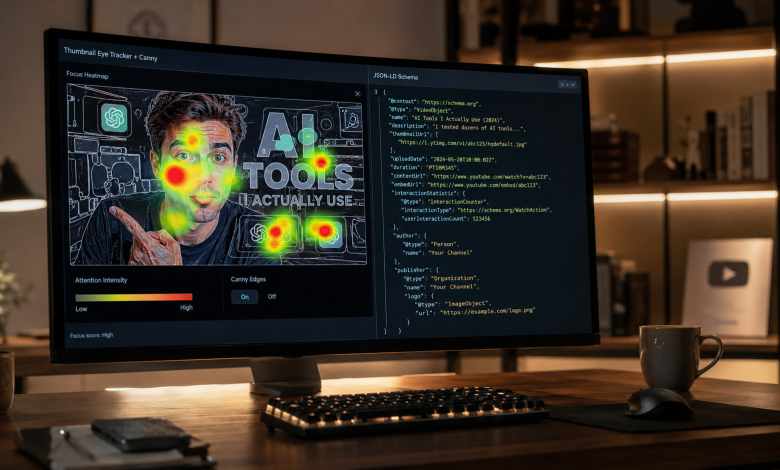
The creator economy has progressed to a state where manual human labor can no longer keep pace with the velocity of digital distribution networks. In my research focusing on human-computer interaction and machine-learning recommendation loops, I have observed a profound shift in how visual attention is captured and maintained. Traditional workflows, which once relied solely on static, intuition-based graphic design principles, are buckling under the weight of saturated feeds. Today, visual assets must satisfy two distinct audiences: the human brain’s subconscious filtering mechanism and the platform’s indexing algorithms.
This dual-audience dynamic is where generative AI tools are establishing a new baseline. Creators are transitioning away from blank-canvas design suites toward specialized, prompt-driven environments that utilize deep-learning models to optimize spatial structures. Surviving this landscape requires understanding the core bottlenecks of visual production and analyzing how data-backed automated platforms, such as specialized design utilities like Thumbs.ai, alter the competitive landscape for modern digital publishers.
How do we capture human attention in a saturated feed?
In our research on visual cognitive load, the primary obstacle to content discovery is not a lack of quality material; it is the immediate friction of choice. When a user scrolls through a feed, their brain performs split-second micro-assessments, filtering out complex, low-contrast, or visually confusing patterns to conserve cognitive energy. Creators who spend dozens of hours scripting and editing high-value educational content often face dismal click-through rates (CTR) simply because their entry-point graphics fail to pass this initial human filter.
codeCode
+———————————————————–+
| PwC Entertainment & Media Outlook Data Insight |
| “Digital video and user-generated content consumption |
| is expanding rapidly, leading to hyper-saturation. |
| In a fragmented attention economy, the first 1.5 seconds |
| of visual exposure dictates content conversion rates.” |
+———————————————————–+
To understand this dynamic in a real-world scenario, consider a small enterprise software startup that produces detailed, weekly developer tutorials. Despite the technical accuracy of their videos, their initial uploads struggled to crack a 1.5% click-through rate. Their design process involved taking a cluttered screenshot of their coding interface, slapping a small logo in the corner, and publishing. The human brain interprets busy, unoptimized interfaces as cognitive work, causing users to scroll past. By adopting a structured design approach—separating the presenter’s face, applying clean contrast separation, and reducing the background clutter to a simple, stylized gradient—they lowered the cognitive threshold for viewers, allowing the content’s value to shine.
The transition from manual canvas design to algorithmic optimization
Traditional asset creation relies heavily on manual raster editing software, which is a slow, iterative process. In the manual era, a designer had to spend hours isolating subjects, painting hair edges, adjusting contrast curves, and laying text tracks. If a finished asset underperformed, modifying it meant repeating the entire tedious cycle.
codeCode
+———————————————————–+
| PwC Global AI Study Data Insight |
| “Productivity gains from AI-driven workflow automation |
| are projected to contribute $6.6 trillion to the global |
| economy by 2030, as manual processes shift to prompt- |
| based optimization.” |
+———————————————————–+
| Workflow Step | Manual Production (Before AI) | Algorithmic Production (After AI) |
| Subject Isolation | Manual pen-tool masking (15-30 mins) | Automated semantic segmentation (<1 sec) |
| Contrast & Lighting | Adjustment layers, dodging & burning (15 mins) | Ambient relighting matched to background (Instant) |
| Background Staging | Stock photo search and blending (30 mins) | Contextual depth-map generation (Instant) |
| Typography Layout | Manual kerning and drop-shadow styling (10 mins) | Responsive, high-contrast text presets (Instant) |
Deploying a dedicated YouTube Thumbnail Generator to handle these steps collapses hours of labor into seconds of processing. Instead of manually painting lighting effects onto a cropped face, the underlying diffusion engine analyzes the background scene’s light sources and automatically casts matching highlights onto the subject. This optimization allows creators to treat visual design as an analytical, prompt-driven experiment rather than a physical chore.
Automate repetitive formatting across multiple distribution channels
For modern media operations, the challenge of scaling content is compounded by the necessity of multi-platform distribution. A single video concept is rarely confined to one platform; it is sliced, repackaged, and distributed across traditional 16:9 feeds, vertical 9:16 reels, and square 1:1 mobile grids.
codeCode
+———————————————————–+
| PwC Digital Transformation Executive Survey |
| “60% of business executives state that automating |
| highly repetitive asset-creation and administrative |
| workflows is the single greatest driver of operational |
| growth and agility.” |
+———————————————————–+
Imagine a fast-growing digital news publisher syndicating short-form documentaries. Their design team was historically bottlenecked by the need to manually redesign the same cover graphic for three different aspect ratios, often having to move text, scale portraits, and re-export files individually. Utilizing an automated YouTube Thumbnail Generator built with responsive spatial awareness changes this completely. The system automatically detects the focal point of the image—typically the face or central object—and scales the surrounding canvas dynamically. It repositions the text and structural layers to fit vertical or square formats without clipping essential details, turning an exhausting formatting pipeline into an instant, single-click export.
Visual consistency builds long-term audience trust
 A common pitfall for independent creators is the temptation to treat every upload as an isolated design experiment. One week, their feed features dark, minimalist imagery; the next, it is filled with neon-soaked, high-saturation graphics. While this variation might feel creative to the designer, it dilutes brand identity and confuses the target audience.
codeCode
+———————————————————–+
| PwC Consumer Intelligence Series on Trust |
| “54% of consumers report they are significantly more |
| likely to repeatedly engage with content from brands |
| that maintain a highly consistent, easily recognizable |
| visual style across all digital touchpoints.” |
+———————————————————–+
An illustrative scenario involves an independent financial educator who published excellent weekly market breakdowns. Initially, their channel’s feed was a chaotic mixture of varying fonts, random stock graphics, and unpredictable color schemes. Because their existing subscribers could not easily identify their videos in a crowded feed, return-viewer metrics remained flat. By standardizing their visual system—using a locked, three-color palette, a specific bold sans-serif font, and a consistent facial expression angle—they built an instant visual signature. Viewers could identify the educator’s content within milliseconds of scrolling, driving up repeat engagement and establishing a sense of editorial authority.
Beyond basic graphics: aligning visual assets with algorithmic recommender systems
We must recognize that humans are no longer the sole gatekeepers of content discovery. Before a human ever lays eyes on a visual asset, platform recommendation engines analyze it using advanced computer vision models, such as Google’s Cloud Vision API. These machine-learning models scan the image, extract text, identify objects, analyze facial expressions to gauge emotion, and assign semantic labels to categorize the content.
codeCode
+———————————————————–+
| PwC AI Personalization & Economic Impact Report |
| “Product enhancements that stimulate consumer demand via |
| highly accurate algorithmic personalization will drive |
| 45% of total global economic gains by 2030.” |
+———————————————————–+
Consider an indie gaming studio launching a dark fantasy RPG. They created a beautiful, abstract cover graphic that was visually striking but mathematically ambiguous. The platform’s indexing algorithm failed to detect clear object boundaries or legible text, misclassifying the abstract design as low-quality clutter and subsequently reducing its reach to gaming audiences. By processing their promotional artwork through a modern YouTube Thumbnail Generator that optimizes text-to-background contrast and clarifies object boundaries, the studio ensured the machine vision model could easily index the “warrior,” “sword,” and “fantasy” elements. This alignment with the platform’s categorization criteria allowed the recommendation engine to confidently distribute the video to targeted RPG fans.
The Predictive Future of Visual Curation
As generative models continue to advance, the boundary between asset generation and performance prediction is dissolving. We are moving toward a paradigm where visual tools will not merely output an image based on a prompt; they will run simulated A/B testing cycles against virtual consumer profiles before a video is even published. By utilizing neural networks trained on historical engagement data, these systems will analyze composition, color theory, and facial placement to predict click-through probability in real time.
For creators, the goal of integrating automated platforms like Thumbs.ai into their daily operations is not to eliminate human artistic expression. It is to remove the cognitive and physical friction of manual asset production. By allowing algorithms to manage the mechanical demands of scale, format, and contrast, digital publishers can focus their energy on what machines cannot replicate: the deep, authentic storytelling that keeps an audience watching once they have clicked through.