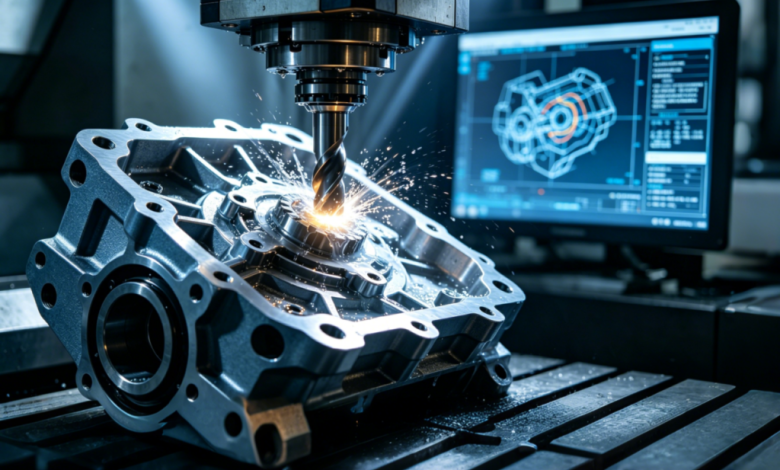

Advanced 5-axis CNC machining transforms small-batch production with unmatched precision and automation.
Introduction
Smart on-demand CNC machining uses DFM analysis, multi-axis toolpath optimization, and digital capacity scheduling to reduce the costs of making little batches by 35%. This approach uses data to shorten the setup changeover time up to 4 hours, reduce quotation cycles from 48 hours to 15 minutes, and bring down setup scrap rates under 0.5%. Without having to amortize up-front tooling and carrying inventory costs, engineering teams can affordably scale production from 10 to 1,000 units without changing tolerances beyond ±0.005 mm.
Why Is On-Demand Manufacturing Transforming Small Batch Hardware Production?
Traditional procurement relied on forecast-driven bulk purchasing, tying up capital in inventory. On-demand manufacturing digitizes the supply chain from 3D CAD to finished part, enabling agile, zero-inventory sourcing.
Cloud-Based Quoting and DFM Feedback Compression
- Automated Quotation Generation: Cloud-based algorithms analyze 3D STEP files and cutting paths to generate automated quotations and a DFM report in 15 minutes (i.e., a reduction from 48 hours).
- Accelerated Design Iteration: This faster response gives procurement departments the opportunity to consider different versions of designs each day so that they get the final decision much sooner, within 90% more.
- AI-Powered Risk Forecasting: The biggest reason in the development of the new feature is artificial intelligence in manufacturing, a tool that learns from existing data to forecast cycle times and quality risks right before the cutting starts.
Capital Efficiency and OEE Gains
On-demand manufacturing cuts inventory costs by 40% and through real-time toolpath optimization, can push OEE to above 85%. This describes a digital transformation in hardware production, where physical inventory is being entirely replaced by digital capacity.
The main advantages are: you can get rid of MOQ constraints, save up on warehouse storage, and get to the market much faster with your product. These features make on-demand manufacturing not only a cost-saving measure, but also a very efficient way to manage your supply chain flexibility.
How Does Prototype CNC Machining Reduce Risk Before Scaling Up?
Investing in permanent molds without physical validation carries significant financial risk. Prototype CNC machining produces 1 to 5 functional parts for assembly verification before committing to high-volume tooling.
Financial Hedging Through Physical Validation
- Cost Comparison: If one wants to test the product using real materials like aluminum 6061 or titanium grade 5, creating a CNC machined prototype would cost him between 500 and 2000 versus a very expensive option for single cavity mold manufacturing of around 10,000-50,000.
- Functional Verification: This method allows engineers to confirm the shape, size and working of a part, to see where parts might come apart in a product, and to change the design without having to invest in expensive tooling.
- Risk Insurance: Prototype CNC machining is like a financial insurance that protects one from expensive mold changes.
Seamless Transition to Small Batch Production
Once it has received its final approval, the CNC program changes into small batch CNC machining, which can produce up to 50 and 1000 units. To reach 99.2% first pass yield, standardised fixtures and cutting setups are used. Low volume CNC machining is a means of validating market demand with minimal capital outlay. It is the bridge between prototype production and mass production. Learn what de-risks small batch CNC machining at your next step.
What Role Does an Automated CNC Machining Process Play in Quality Control?

Automated Quality Assurance utilizes advanced CMM technology to ensure micron-level accuracy and zero-defect delivery.
Quality control goes much further than the final inspection. During the CNC machining process, for instance, the automated systems correct automatically various factors causing dimensional errors (thermal expansion, tool wear, vibration) to maintain a constant production tolerance at the level of micrometers.
By the means of in-probe feedback of simultaneous five-axis milling machines, spindle offsets are constantly adjusted to keep dimensional deviation within 0.002 mm. ISO 9001 and ISO 14001 certified factories keep a stable output, with a scrap rate less than 0.3%. Leading companies like LS Manufacturing make use of both the automatization of generating tool paths and the high precision of CMM which can measure repeatability at 0.001 mm.
This automated quality assurance in manufacturing closes the system loop and it is this loop that finds out and deals with problems at the level of deviations rather than defects.
How Can Automotive and Industrial Enterprises Ensure Strict Compliance?
In regulated industries, traceability and proof of conformance via documentation are necessary components. Spectrochemical material analysis covering 100% of each component is mandatory besides the 24-hour salt spray test reports when indicated. Hardness testing (e.g. HRC 58-62), comprehensive CMM inspection with GD&T, and heat lot traceability certificates to finish parts through linking constitute the required tests for safety critical components.
Selecting a CNC machining services manufacturer with IATF 16949, and AS9100D certifications will make a supplier a chain defense audit. These standards are aimed at 0-200,000 PPM defect level, systematic root cause analysis, and supplier management through documentation. The audit trail shall contain material heat lots, in-process inspection stamps, and signed CMM reports. Working with a certified CNC machining services manufacturer smart supply chain optimization beyond cost focus, and extends it to a compliance & risk mitigation level.
How to Choose CNC Machining Services for Enterprise Scale Projects?
Procurement team managers require a measuring tool to assess the partner’s suitability quantitatively.The six-core-index assessment includes: certification portfolio (ISO 9001, ISO 14001, IATF 16949, AS9100D), DFM with a 100 % turnaround in 24 hrs on automated systems, multi-axis equipment capacity, production flexibility for 1-1,000 units, quality infrastructure (in-process probing CMM SPC), and timely delivery above 98%.
Lack of process controls in low-end uncertified shops, manual inspection, undocumented procedures, no QMS. Higher spec facilities, which CNC machining services, give you complete SPC with control charts, automatically monitored tool wear, and digital twin validation. To how to choose CNC machining services one should know the cheapest quotation is usually hiding rework and compliance costs. An established structure saves both money and reputation.
Conclusion
These days, hardware procurement is heavily dependent on data-driven workflows that link CAD models with precision machining. Small batch strategies and certified quality control combine to save 35% on costs, cut waste, and ensure parts are delivered to within ±0.005 mm tolerance. It’s essential for engineering executives to have an outside view of processes related to sourcing. For a full DFM analysis and to improve your production cycle, get in touch with a certified precision partner.
FAQs
What makes small batch CNC machining ideal for enterprise prototyping?
Small batch CNC machining enables engineering teams to prototype and produce production parts out of engineering quality materials like Aluminum 6061 or Titanium Grade 5 with a reduced monetary risk of up-front tooling costs (> $10,000+).Small batch CNC machining also reduces capital risk, accelerates get to market by more than 30%, etc.
How does automated quality control improve CNC machining precision?
Automated quality control includes integrating laser tool setters, closed-loop feedback probes and robotic CMM equipment into production flow.These machines constantly measure for tool wear and thermal spindle drift and automatically compensate for dimensional work offsets maintaining a 0.003 mm.
Why are quality management certifications essential when choosing a machining partner?
ISO 9001, IATF 16949, and AS9100D certification ensures industry renowned quality assurance procedures are utilized by the manufacturer. It gives complete raw material traceability, PPM level defect prevention practices, documentation of inspection records, and proven reliability under demanding industrial conditions.
What is the main difference between low volume and mass production machining?
Low volume machining is centered on flexibility, less than 30 minutes setup time, and relatively low fixed costs for batches from 10 to 1,000 parts.High volume production reduces unit costs when producing tens of thousands of parts and entails complex custom fixturing and tooling, weeks of setup, and fixed line arrangements
How can design-for-manufacturability analysis reduce hardware production costs?
Design-for-manufacturability (DFM) analysis can examine 3D CAD designs before machining to highlight areas of deep internal pockets, radii tighter than R0.5 mm, or excessive tolerances increasing cycle times. Correcting design features early can reduce machining time, tool wear and overall part cost by between 15 and 25%.