Artificial intelligence will remove a significant amount of administrative work from project management offices. That does not make the PMO obsolete. It reveals which offices were merely collecting information and which ones are capable of turning project data into strategic decisions.
The prospect of artificial intelligence replacing the Project Management Office is based on a narrow understanding of what a PMO is supposed to do. If the office exists mainly to collect status updates, reconcile spreadsheets, remind project managers about overdue reports and prepare presentation decks for steering committees, then a considerable part of its workload is certainly exposed to automation. Generative AI can already summarise documents, identify inconsistencies, draft reports and turn structured project data into a readable management update. More advanced analytical tools can detect patterns in historical performance, highlight emerging risks and support scenario modelling.
Yet these activities represent the transactional layer of PMO work, not its strategic purpose. A project management office creates value when it helps an organisation decide which initiatives deserve investment, where limited resources should be allocated, which risks require executive attention and whether the current portfolio is still capable of delivering the organisation’s strategy. Those decisions depend on data, but they also require context, accountability and an understanding of the business that cannot be reduced to a prompt or an algorithmic recommendation.
The more efficiently AI handles routine coordination and reporting, the more clearly the PMO’s real mandate comes into view. The office is not disappearing. It is being pushed towards the work that senior management expected it to perform all along.

Caption: Artificial intelligence can accelerate project analysis and reporting, while the PMO remains responsible for interpreting information and connecting portfolio decisions with business strategy.
AI Is Automating the Administrative Layer of the PMO
The first visible impact of AI on project management is likely to be a reduction in the effort required to process information. A traditional PMO may receive reports in several formats, compare actual progress against baseline plans, identify missing information, prepare summaries for management and manually convert detailed project updates into portfolio-level conclusions. None of these activities is conceptually difficult, but together they consume a large amount of specialist time. They also create delays between what is happening inside projects and what decision-makers can see.
AI-assisted workflows can shorten that cycle. A system can generate an initial schedule based on a project description, summarise changes since the previous reporting period, detect contradictory status statements, highlight tasks that are becoming critical and prepare the first version of a steering committee report. It can also make information easier to query. Instead of navigating several documents, a manager may ask which strategic initiatives are delayed, which risks have increased in severity or which programmes depend on the same constrained resources.
This is no longer a theoretical direction. PMI’s 2024 research on generative AI in project management found that 20 per cent of the most advanced respondents were already using generative AI in more than half of their projects, while another 54 per cent applied it across 16 to 50 per cent of their project work. The research describes AI primarily as an augmentation mechanism: one that improves planning, risk identification, forecasting and communication while freeing project professionals to concentrate on higher-value responsibilities.
That distinction matters. Removing manual reporting effort is not the same as removing the need for governance. It simply changes the point at which human expertise becomes essential.
A useful test for any PMO is straightforward: if most of its value disappears when status reporting is automated, the office was never operating strategically enough.
Faster Reporting Does Not Automatically Produce Better Decisions
An AI model can analyse project information quickly, but it cannot repair an organisation’s governance model simply by processing it. When project teams use different definitions of progress, risk, benefit, priority or completion, automation accelerates inconsistency. If one project reports progress according to completed tasks, another according to budget consumption and a third according to the project manager’s subjective assessment, a portfolio summary may look precise without being genuinely comparable. The same issue appears when baseline plans are outdated, risks are recorded only after they have materialised or project benefits have no accountable owners. An AI-generated report may present this information clearly, but the quality of the conclusion still depends on the quality of the underlying operating discipline. Bad project data does not become reliable because it has been summarised elegantly.
This places the PMO in a more important position. Someone must define the common project taxonomy, establish minimum data standards, determine when plans should be updated and decide which changes require approval. Someone must also ensure that portfolio-level indicators mean the same thing across departments and that project managers understand how their data will be used. These responsibilities are not clerical. They are the foundations of organisational decision-making.
An AI-enabled PMO therefore becomes a steward of the project information model. Its role is to establish the rules that allow intelligent tools to produce meaningful output. That includes the structure of project charters, the logic of approval workflows, the design of status reviews, the criteria used in project scoring and the relationship between strategic objectives, projects, risks, budgets and expected benefits. The stronger this structure becomes, the more useful automation can be.
The Strategic PMO Becomes a Portfolio Intelligence Function
Project management focuses on delivering an agreed scope. Strategic project management asks a different question: should the organisation still be delivering this project, in this form, at this time? A strategically mature PMO must be able to answer both.
That requires visibility beyond individual schedules. A project may be progressing according to plan and still represent a poor use of organisational capacity. Its business assumptions may have changed, its expected benefit may have declined or another initiative may now offer significantly greater value. Two projects may be healthy when reviewed separately but impossible to deliver together because they depend on the same people, supplier or technology environment. A programme may remain within its budget while no longer supporting the strategic objective that originally justified the investment. AI can help expose such relationships by processing larger volumes of information than a PMO team could analyse manually. It may identifyrecurring causes of delay, compare project performance with historical patterns or simulate the likely impact of resource changes. The PMO must then translate those findings into a portfolio conversation. That means challenging sponsors, identifying the decisions that cannot be postponed and presenting executives with realistic options rather than a colourful summary of project status.
The strategic PMO is therefore less concerned with asking every project manager for the same update and more concerned with explaining what the combined portfolio means for the business. It examines whether investment is concentrated in the right areas, whether strategic goals are sufficiently supported, whether the organisation is attempting more change than it can absorb and whether expected benefits remain credible.
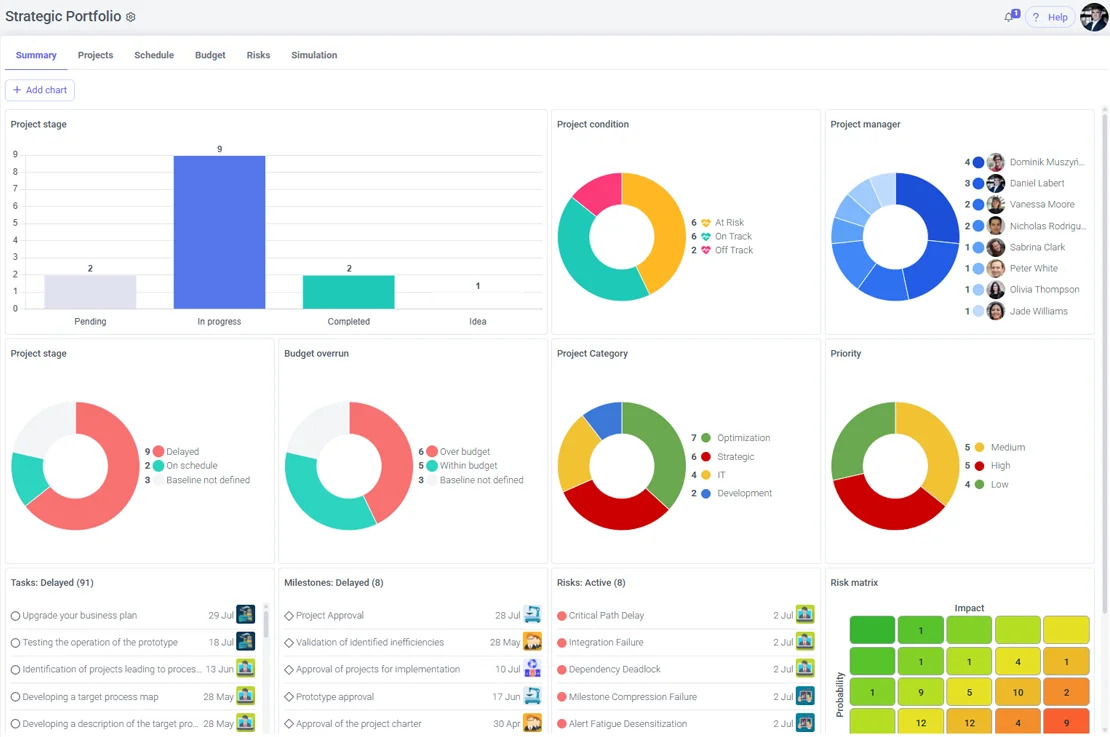
Caption: A portfolio-level view allows the PMO to compare projects, identify dependencies and assess how individual initiatives contribute to wider strategic objectives.
Human Judgment Remains Essential Where Trade-Offs Become Difficult
The hardest portfolio decisions are rarely caused by a lack of data. They arise when several legitimate objectives compete with one another. An organisation may need to choose between a revenue-generating initiative and a regulatory programme, between resolving technical debt and launching a new service, or between protecting a strategically important project and reducing short-term expenditure. Each option may be supported by rational arguments and credible data.
AI can model consequences and reveal patterns that would otherwise remain hidden. It can show that a proposed delay is likely to increase cost, that a specific team has become a portfolio bottleneck or that similar initiatives historically failed under comparable conditions. It cannot determine which outcome the organisation is prepared to accept. Nor can it negotiate with an executive sponsor, recognise that a technically underperforming project is creating an unexpectedly valuable capability or judge whether cancelling an initiative would damage a critical customer relationship.
Those decisions depend on institutional knowledge, ethical considerations, organisational politics and a nuanced understanding of strategic intent. More importantly, they require accountability. A model cannot appear before the board and take responsibility for a recommendation that proved wrong. The PMO and executive leadership remain responsible for understanding the assumptions behind a recommendation, questioning its limitations and making the final decision.
AI can prepare a recommendation. It cannot own the consequences of accepting it.
This is why the future PMO needs stronger business acumen rather than fewer people with project expertise. Its specialists must understand portfolio economics, benefits management, organisational capacity and strategic risk. They must also be able to communicate uncertainty honestly. A credible PMO does not present an algorithmic forecast as certainty; it explains which variables matter, what the model may have missed and what would change the recommendation.
Reporting Becomes Interpretation Rather Than Compilation
The traditional PMO reporting cycle is often shaped by production deadlines. Considerable energy is spent obtaining data, correcting formats and building the document that will be discussed. When AI and integrated systems automate this preparation, the centre of gravity changes. The report itself becomes less important than the conversation it enables.
A strategic PMO can spend more time examining why a deviation occurred, whether it affects other projects and what management action is required. Instead of presenting twenty pages of status information, it can identify the few portfolio developments that materially alter the organisation’s position. This does not mean reducing every portfolio to a simplified traffic-light dashboard. It means separating routine information from genuine decision signals.
The change also affects timing. Management no longer needs to wait for a monthly reporting cycle to discover that a critical dependency has shifted. Data can be updated continuously, while the PMO defines the thresholds that trigger escalation. A budget variance, delayed milestone or increasing resource conflict can create an alert, but the office must decide whether the signal reflects a local issue, a systemic problem or an acceptable consequence of a deliberate strategic choice.
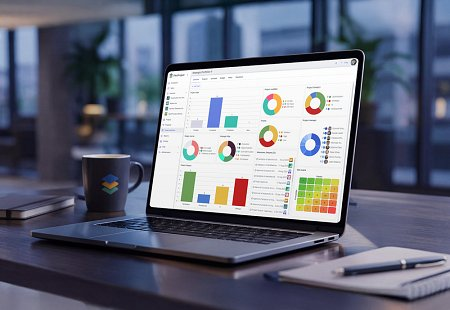
Caption: Automated dashboards can surface changes in schedules, budgets, milestones and risks, giving the PMO more time to examine causes and recommend management action.
Planning Moves Towards Scenario Management
AI will also change the way PMOs support planning. A single approved plan remains necessary for accountability, but it is no longer sufficient for organisations operating under continual change. Executives increasingly need to understand how the portfolio would respond to different assumptions: a lower investment budget, a delayed product launch, the loss of a key supplier or a shortage of specialist capacity.
Scenario analysis has historically been difficult because each alternative requires data to be copied, recalculated and interpreted. AI-assisted tools can reduce the mechanical effort involved in producing variants, but the PMO must frame the scenarios properly. A model can calculate what happens if ten projects are delayed by three months. It cannot decide whether that is the right scenario to examine or whether a different combination of projects would better protect strategic value.
This strengthens the PMO’s role as a facilitator of management decisions. Its contribution lies in defining meaningful alternatives, exposing their assumptions and showing how consequences spread across the portfolio. The result should not be an illusion that every outcome can be predicted. It should be a clearer understanding of the options available and the commitments associated with each one.
An AI-Ready PMO Needs a Shared Project and Portfolio Environment
AI becomes significantly more useful when project information exists in a coherent operational environment rather than in disconnected spreadsheets, slide decks and email threads. An integrated platform allows schedules, project charters, budgets, risks, milestones, strategic objectives and portfolio reports to refer to the same underlying data. This gives both analytical tools and human decision-makers a more reliable view of the organisation.
A platform such as FlexiProject supports this model by combining operational project delivery with strategic portfolio governance. Project teams can work with schedules, Gantt charts, Kanban boards, budgets, risks, project documents and communication tools, while PMOs can use project reviews, reporting templates, scoring models, approval paths and strategic objectives to introduce consistent management standards. Its AI-assisted project creation function can also produce an initial list of tasks, proposed phases, dates and schedule descriptions based on a short project brief. The output remains a draft to be reviewed and developed by the project team, which is precisely how AI should be positioned in a governed project environment.
At portfolio level, project portfolio management in FlexiProject enables organisations to group projects according to strategic or operational needs, compare their status on a shared roadmap, monitor financial progress, analyse risks and milestones, and build graphical management summaries. Projects can belong to more than one portfolio, which is valuable when the same initiative supports several business perspectives. An IT implementation, for example, may need to be visible in both a technology portfolio and a strategic transformation portfolio.
This does not mean that software itself creates a strategic PMO. Technology provides the environment in which standards can be applied and reliable information can be maintained. The PMO still has to define what the organisation needs to know, how decisions are made and which indicators are meaningful. AI and PPM software strengthen good governance; they do not substitute for it.
International and Mobile Access Affect the Quality of Portfolio Data
The value of AI-supported portfolio analysis depends on how consistently information is updated by the people performing the work. This becomes particularly important in international organisations, where projects may involve teams operating in different countries, languages and working environments. A system that is difficult to use outside the head office will inevitably produce gaps in the information available to the PMO.
FlexiProject is designed for multilingual organisations and is available in 28 languages, including separate UK and US English interface variants. The system language can be configured for the organisation, while individual users can work with their preferred interface language.
Its user guide and system documentation are available in English, Polish, Czech, German, Spanish, French, Hungarian, Italian, Portuguese, Romanian and Ukrainian. Training videos and system presentations are provided in Polish and English. This combination supports a common project management standard without forcing every participant to operate in the same language, which can improve adoption across international business units and distributed project teams.
The FlexiProject mobile application complements the browser-based system by allowing users to access assigned tasks, review task details, update statuses, add comments and attach files directly from a smartphone. Attachments may include documents or photographs taken during site visits, inspections, implementation work or customer meetings. This reduces the delay between work being completed and its status becoming visible to the project manager and PMO.
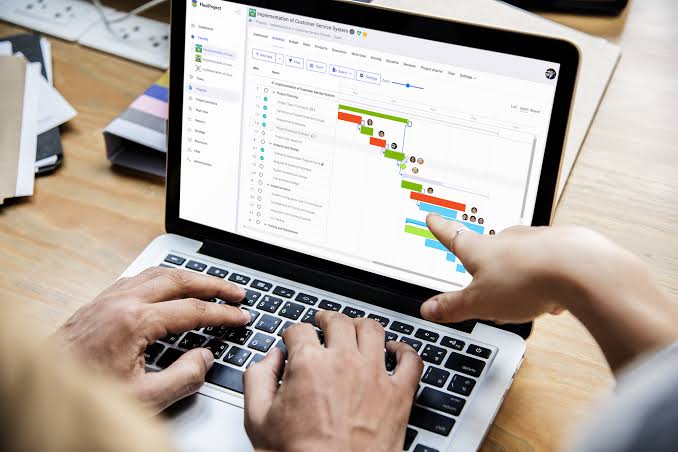
Caption: A multilingual interface and mobile task access help distributed teams keep project information current while working across locations and business units.
The PMO Will Become an Important Part of AI Governance
As AI becomes embedded in planning and portfolio analysis, the PMO will also need to participate in decisions about how those tools are governed. Project information may include financial forecasts, supplier data, employee workload, strategic priorities and details of initiatives that have not been announced publicly. Organisations need clear rules concerning which information may be processed, which tools are approved and how generated output should be reviewed.
The PMO is well positioned to contribute because it already operates where governance, delivery and management information meet. It can help define which AI-supported activities are low-risk, which require formal validation and which decisions must always remain under human control. It can also establish an audit trail showing how a recommendation was produced, what data informed it and who approved the resulting action.
This role should not be confused with technical ownership of every AI system. IT, security, legal and data teams will continue to manage their respective areas. The PMO’s responsibility is to ensure that AI is used in a way that strengthens project and portfolio decisions without weakening accountability. It should understand when a model is assisting analysis, when it is influencing prioritisation and when users may be placing too much confidence in an output that has not been sufficiently challenged.
A More Strategic PMO Is the Most Likely Outcome
Artificial intelligence will alter the structure of PMO work. Some reporting tasks will disappear. Others will be completed faster or performed with fewer manual interventions. Project professionals who build their value entirely around collecting updates and preparing routine summaries will need to develop new capabilities.
The institution of the PMO, however, is unlikely to become less relevant. Organisations are managing increasingly interconnected portfolios in which strategic initiatives compete for the same budgets, people and management attention. AI adds another layer of complexity because it increases the speed at which information can be generated and recommendations can be produced. Without a function responsible for interpreting those recommendations, setting governance standards and connecting project decisions with business strategy, faster analysis may simply lead to faster confusion. The PMO that emerges will spend less time asking whether a report has been completed and more time asking whether the organisation is still investing in the right work. It will be expected to understand portfolio value, challenge assumptions, guide difficult trade-offs and maintain confidence in the information used by executives.
AI will not replace a PMO that performs these responsibilities. It will give that PMO better tools, faster access to evidence and more time to concentrate on the decisions that genuinely shape organisational performance.