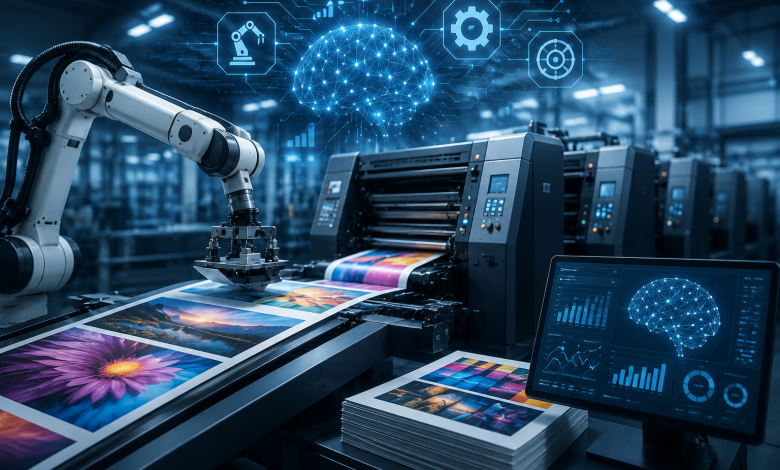
The commercial printing industry, which in past times was depending mostly on labor-heavy offset press machines, manual physical proofing, and strict workflows, nowadays goes through big digital transformation. Because today businesses ask for very fast turnarounds, personalized marketing items, and high working efficiency, printing service providers start using new generation technologies. Leading experts in brand identity and print—for example AlphaGraphics Crystal Lake—are actively bridging this gap connecting modern AI, digital design workflows, and precise physical print production. When AI automation gets integrated inside all stages of the printing lifecycle, the commercial printing area becomes leaner, faster, and adapts very well to modern digital times.
1. AI-Powered Pre-Press: Removing Manual Bottlenecks
In older days, the phase that took maximum time in commercial printing run was pre-press—that detailed work where you prepare digital files before physical printing. Pre-press workers had to manually inspect file resolution, verify color swatches, set bleed lines, fix missing fonts, and arrange imposition layouts so paper waste stays minimum.
Artificial intelligence changed this stage completely by using Automated Preflight Systems:
- Instant Error Detection: Machine learning algorithms automatically analyze incoming vector and raster files inside milliseconds. They catch low-resolution pictures, missing font files, or incorrect RGB-to-CMYK color space conversions before files reach the printing press.
- Auto-Imposition & Nesting: AI layout tools check dimensions of jobs and calculate automatically which layout on sheet is most efficient. When putting different print jobs together on one single master sheet, print providers reduce raw material waste and ink usage by a lot.
- Smart Image Upscaling: Neural networks can now smartly scale up low-resolution customer images, filling in missing pixel data so output stays sharp and high definition without asking customers to send assets again.
2. Dynamic Color Management & Predictive Machine Maintenance
Getting the exact same brand color on different materials—like business cards, vinyl banners, corrugated boxes, and acrylic signage—was always one big challenge during print production. Environment factors like humidity, temperature of press, and paper batch variations can easily change color appearance.
Plaintext
+———————————————————————–+
| AI IN MODERN PRINT MANUFACTURING |
+———————————————————————–+
| 1. Smart Pre-Press –> Automated Preflight & Resolution Fixing |
| 2. Color Precision –> Spectrophotometer Feedback via Machine Learning |
| 3. Predictive Maintenance –> Sensor Anomaly Detection Reduces Downtime |
| 4. Dynamic Logistics –> Automated Web-to-Print & Inventory Sync |
+———————————————————————–+
Modern digital printing presses use inline spectral sensors together with AI feedback loops to keep color accuracy exact:
- Real-Time Color Correction: Closed-loop color management systems scan printed paper sheets continuously at high speed, comparing output with target Pantone numbers and adjusting ink density automatically on the go.
- Predictive Maintenance: Industrial IoT sensors mounted on heavy printing machines feed operational data to machine learning models. These models notice minor vibration changes or thermal anomalies, predicting machine part failures before major breakdown happens—which reduces unplanned downtime almost to zero.
3. Web-to-Print Automation & Variable Data Printing (VDP)
Because e-commerce and multi-location business operations are growing fast, adoption of Web-to-Print (W2P) portals has become faster too. AI is doing a very important job behind the scenes in these portals, altering how corporate clients handle their brand assets.
Hyper-Personalization at Scale
Through AI-based Variable Data Printing (VDP), companies do not have to print 10,000 identical flyers anymore just to bring down per-unit price. AI algorithms process large customer data lists, automatically modifying text, discount codes, images, and localized offers on each printed paper during one continuous printing run.
Automated Inventory & Re-Ordering
For companies having many branches, cloud-based print systems use predictive analytics for checking stock levels of stationery items, promotional boxes, and event items. Whenever inventory goes below the set limit, system triggers re-order workflow automatically, sending job to the nearest regional printing center so shipping time and carbon emission both decrease.
4. Connecting Generative AI Design with Physical Brand Assets
Rise of generative AI design tools (like Adobe Firefly, Midjourney, and Canva AI) allows marketing teams to create design concepts much quicker than before. Still, converting a digital image generated by AI into physical, real marketing items requires special printing knowledge.
The Digital-to-Physical Gap: One image shown on a light-emitting RGB computer screen follows totally different physical rules compared to light reflecting from CMYK ink, foil stamping, or embossed cardstock.
Because of this gap, human design experts working together with AI tools are still necessary:
- Resolution Conversion: AI image generators usually make 72 DPI images meant for web. Advanced AI interpolation software needs to enlarge these graphics to 300+ DPI needed for big-format commercial printing.
- Tactile Enhancements: AI layout tools help designers plan special post-press finishing steps—like spot UV varnish, metallic foils, die-cut packaging shapes, and tactile debossing—making multi-sensory physical brand items that screen cannot recreate.
- Substrate Matching: Smart print algorithms recommend best paper weight and texture based on how much ink is used and how long the physical item needs to last.
5. Sustainability: Reducing Environmental Impact Using Data
Sustainability is top priority for companies today. Although commercial printing industry was criticized earlier for using too much resources, now it uses automation to convert into eco-efficient manufacturing model:
- Paper Waste Reduction: Using AI algorithms to optimize sheet usage and combine multiple client orders on the same sheet, waste made during press setup (make-ready) dropped by up to 80%.
- Eco-Friendly Inks & On-Demand Production: Automated digital printing presses use soy- and water-based eco inks while printing exact requested quantities when needed. This stops the old habit of printing bulk thousands of extra documents that end up in trash when small info changes happen.
Conclusion: Synergy of Human Skill and AI Accuracy
The digital revolution is not replacing the commercial printing industry; rather it gives more power to it. Artificial intelligence and cloud automation transformed commercial printing from reactive manufacturing into proactive, data-driven service systems.
Handling repetitive pre-press checking, optimizing material usage, keeping color precision exact, and making web-to-print workflow smooth—AI gives printing service providers freedom to concentrate on their main goal: helping brands build meaningful, tactile, and long-lasting physical connections with their customers. As physical and digital marketing methods keep coming together, smart technology integration ensures commercial print remains one of most effective tools for brand storytelling.