Across party lines, about two-thirds of Americans want their financial data collected only with their consent — or not at all.
Survey published by Cornell Brooks School Tech Policy Institute (BTPI), Bitcoin Policy Institute, and Fedi.
WASHINGTON, July 22, 2026 /PRNewswire/ — Financial privacy is one of the few issues that unites Americans across party lines, according to a new national survey of 2,200 U.S. adults. Released today by the Cornell Brooks School Tech Policy Institute (BTPI), Bitcoin Policy Institute (BPI) and Fedi, the report “How Americans Think About Financial Privacy,” finds that Republicans, Democrats and Independents hold remarkably similar views on financial privacy, differing by only a few points on nearly every question about who should be able to access their financial information.
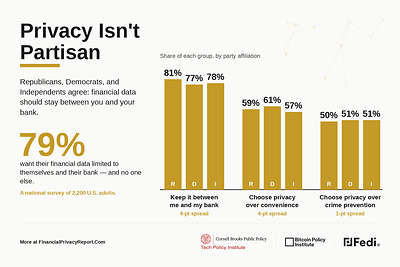
The pattern holds across the survey. On question after question, Republicans, Democrats, and Independents landed within a few points of one another:
- Privacy over convenience: 59% of Republicans, 61% of Democrats, and 57% of Independents chose privacy when forced to choose.
- Privacy over crime prevention: 50%, 51%, and 51%, respectively — a one-point spread.
- Limiting access to themselves and their bank: 81% of Republicans, 77% of Democrats, and 78% of Independents.
- An opt-in standard — data never collected, or collected only with explicit consent: 70% of Republicans, 66% of Democrats, and 68% of Independents.
Additionally, just 11% of Republicans, 14% of Democrats, and 13% of Independents would accept any government access to their financial data. At a moment when little in American politics commands cross-party agreement, financial privacy is an exception.
The survey also found broad support for an opt-in standard. About two-thirds of Americans (68%) said their financial data should either never be collected (35%) or be collected only with their explicit consent each time (33%). Concern about access was widespread rather than directed at any single actor: majorities were concerned about access by foreign governments (70%), the federal government (68%), big technology firms (67%), and advertisers (65%).
“In a political moment defined by division, we found something remarkable: Americans of every political stripe agree that their financial data belongs to them,” said Sarah Kreps, Professor and Director of BTPI at Cornell University and Senior Fellow at BPI. “This isn’t a partisan issue, but rather a shared conviction that runs deeper than the debates that usually divide us.”
The survey also tested how these attitudes affect real choices. Respondents were asked to pick between hypothetical payment platforms that differed in price, how widely merchants accepted them, ease of use, and how they handled user data. How a platform shared data mattered to people’s choices as much as price and merchant acceptance — the three strongest factors. Platforms that shared no data with outside parties were chosen far more often than those that shared data with advertisers.
Other findings include:
- 56% say only they themselves should have access to their personal financial data, and 79% would limit access to themselves and their bank.
- 74% say they would switch or close an account after a serious privacy violation.
- 68% report having experienced at least one privacy or identity breach.
- 77% took at least one step to protect their privacy in the past year — such as refusing to share data with an app (41%) or using cash for privacy (38%) — but few used specialized tools like VPNs (11%) or Signal (4%), indicating some gaps between beliefs and action.
The full report is freely available at https://financialprivacyreport.com/
About the Study
The findings are based on a survey of 2,200 U.S. adults conducted online and weighted to be representative of the U.S. adult population. Sarah Kreps and Renee Sorchik (Cornell University) authored the report. The next study is anticipated in January 2027.
About the Organizations
Based within the Jeb E. Brooks School of Public Policy, the Tech Policy Institute is the home of technology policy and national security research at Cornell University.
The Bitcoin Policy Institute is a nonpartisan, nonprofit research organization dedicated to exploring the policy and societal implications of Bitcoin and emerging monetary networks.
Fedi builds freedom technology for communities worldwide. Its app combines a Bitcoin wallet, chat, and community spaces, powered by the Fedimint decentralized custody protocol.
 View original content to download multimedia:https://www.prnewswire.com/news-releases/financial-privacy-is-rare-common-ground-among-americans-national-survey-finds-302832080.html
SOURCE Bitcoin Policy Institute