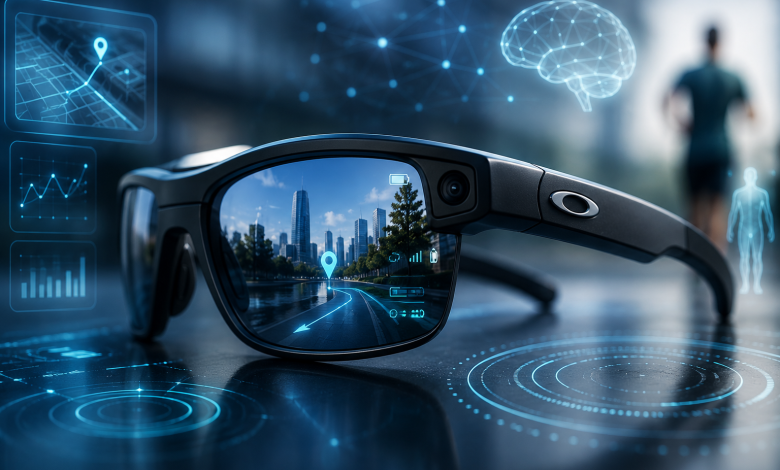
For most of the last decade, “wearable AI” meant a smartwatch counting steps or an earbud answering a text message. That’s changing quickly. A new wave of camera-equipped, AI-assisted eyewear is now shipping at consumer scale, and the pace at which major brands have entered the category suggests this isn’t a passing hardware trend. It’s a signal about where AI is heading next: off the screen and directly into how people see and move through the world.
From Fashion Accessory to Compute Platform
Smart glasses aren’t new as a concept, but 2025 and 2026 marked the point where the category moved from prototype to mainstream retail shelf. Meta’s partnership with Ray-Ban proved there was consumer appetite for camera-and-AI eyewear that didn’t look like a headset. Since then, competitors and brand partners have moved fast to claim their own share of the category, and a steady stream of new AI glasses has followed, including sport-oriented takes on the same core formula built for durability and active use rather than everyday fashion.
The significance for enterprise AI watchers isn’t the eyewear itself. It’s what the hardware enables: a persistent, hands-free camera and voice interface that puts AI directly into a person’s field of view, without requiring them to hold, unlock, or even glance at a separate device.
Why This Matters Beyond Consumer Tech
AI glasses sit at the intersection of two trends enterprise leaders are already tracking closely: multimodal AI and edge compute. A camera mounted at eye level generates a fundamentally different data stream than a phone camera pointed wherever it happens to be aimed. Combined with on-device or near-device processing, that stream becomes usable for real-time object recognition, translation, and contextual assistance, the same underlying capabilities driving progress in computer vision across industrial and retail applications.
This overlap is why hardware companies, chipmakers, and AI labs are all paying close attention to the category, even though it currently ships as a consumer accessory. The lessons learned here, around battery-constrained inference, always-on sensing, and lightweight on-device models, tend to migrate quickly into industrial and enterprise use cases. The same computer vision techniques already reshaping how security cameras interpret footage are a close technical cousin to what’s happening inside a pair of AI glasses, just repackaged for a different form factor and audience.
The Emerging Business Case
Consumer adoption numbers tell only part of the story. The more interesting question for enterprise strategists is what happens once this hardware proves durable and capable enough to leave the consumer aisle. A handful of use cases are already taking shape: field technicians documenting repairs hands-free, warehouse staff flagging safety issues in real time, and trainers recording first-person walkthroughs that translate far better to a new hire than a written manual ever could.
None of these require exotic hardware. They require exactly what’s already shipping at consumer price points: a durable frame, a reliable camera, and an AI assistant that responds quickly enough to stay out of the way. That combination is what turns a lifestyle accessory into a productivity tool, and it’s why procurement conversations about this category are starting earlier than they did for smartwatches or even early AR headsets. A device that’s already been stress-tested by millions of consumer users arrives at the enterprise evaluation stage with far less uncertainty than a purpose-built industrial product would.
The Privacy Question Enterprises Can’t Ignore
Any always-available camera raises governance questions long before it raises technical ones. Unlike a phone raised deliberately to record, glasses can capture footage with no obvious visual cue to bystanders, and regulators have already started responding. The Federal Trade Commission has published guidance on data practices for connected and wearable devices, and several jurisdictions are actively weighing rules around visible recording indicators on smart eyewear.
For enterprises evaluating this category, whether for employee-facing pilots, retail deployments, or field service use cases, this is the part of the roadmap that deserves attention now rather than after adoption accelerates. Manufacturers have responded with visible capture indicators and permission-gated recording, but public trust in the category is still being established, and policy is still catching up to the hardware.
Market Signal, Not Just Product Cycle
What makes this moment worth watching isn’t any single device launch. It’s the volume and speed of investment across the category. Multiple major eyewear and technology brands entering the space within roughly eighteen months of each other suggests a shared read on where consumer AI interfaces are heading, and it echoes a pattern research organizations have tracked before: hardware categories that attract simultaneous investment from several large players tend to graduate from novelty to mainstream faster than single-vendor product lines. Analysis from the Pew Research Center on technology adoption curves has repeatedly shown that multi-vendor competition, rather than any one breakout product, is usually what accelerates a new device category past early adopters.
For enterprise AI teams, that acceleration matters. A hardware category moving from niche to mainstream faster than expected changes assumptions about data capture, employee-facing AI tools, and even how customer-facing AI assistants might eventually be delivered in physical retail or field environments.
What to Watch Next
A few developments will indicate whether AI glasses become a durable computing layer or settle into a smaller niche alongside smartwatches and earbuds:
- On-device model improvements. Battery and thermal constraints currently limit how much processing happens locally versus on a paired phone. Meaningful gains here would expand what glasses can do independently.
- Enterprise-specific hardware variants. Expect purpose-built versions for field service, warehouse operations, and safety-critical roles, distinct from the consumer lifestyle products currently dominating headlines.
- Regulatory clarity. Rules around recording indicators, bystander consent, and data retention will shape how quickly organizations feel comfortable deploying this hardware beyond pilot programs.
None of this guarantees AI glasses replace phones as the primary AI interface. But as a growing list of major brands compete to put cameras and assistants directly into eyewear, the category has clearly moved past the experimental phase, and enterprise AI strategy should account for it as a computing layer worth monitoring closely, not dismissing as a consumer gadget cycle.