At Shanghai’s biggest AI showcase, the brain-computer interface company unveiled technology that lets humans control robots using nothing but neural signals and took aim at a problem that has slowed the broader robotics industry: the shortage of high-quality training data.
SHANGHAI, July 17, 2026 /PRNewswire/ — At the 2026 World Artificial Intelligence Conference (WAIC) in Shanghai — China’s largest annual gathering of AI companies, researchers, and investors — BrainCo, the world’s leading brain-computer interface (BCI) firm, demonstrated something that drew crowds to its booth and raised more than a few eyebrows: A person wearing a lightweight EEG headset, thinking about grabbing a cup, and watching a robotic arm reach out and do exactly that. No button pressed, no words spoken and no physical movements made, the robotic arm was controlled by thought alone.
Translating Human Intent into Robot Action
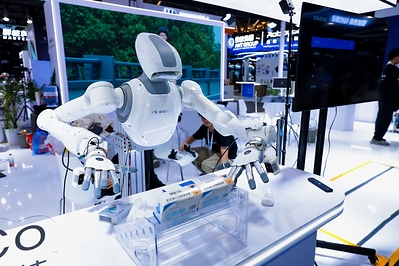
BrainCo showcased at WAIC a Brain-Controlled Robot AI Platform that allows users to direct a robot through neural signals. The technology works in three steps: The user puts on an EEG headset that picks up the wearer’s brain signals, AI algorithms decode those signals to identify motor or control intent, then that intent gets converted into commands for the robot. The entire process takes under 200 milliseconds.
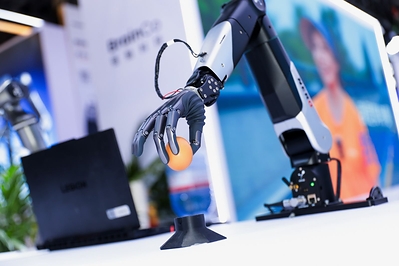
During the WAIC demo, the mind-controlled robotic arm completed tasks that require genuine precision, such as grasping a cup or picking up an apple. BrainCo’s platform is designed to work with a wide range of commercially available robots, from humanoid machines to robotic arms and four-legged robotic dogs, enabling it to slot into robotics R&D pipelines without needing proprietary hardware.
BrainCo describes its underlying framework as “Neuro-Embodied-AI”: BCI decodes intent, the AI layer refines that intent by decoding and figuring out how to break down complex intent into actionable steps, and the robot’s own systems handle physical execution. This latest innovation extends BrainCo’s decade of BCI development in medical rehabilitation further into embodied AI applications.
Closing the Data Gap in Robot Training
BrainCo also debuted at its WAIC booth its Embodied AI Data Collection Solution, which closes one of embodied AI’s most persistent gaps: the lack of high-quality, real-world training data to teach robots complex, dexterous tasks.
Teaching a robot to perform a complex physical task, such as folding laundry, assembling components and handling fragile objects requires enormous amounts of high-quality training data. Collecting that data has been one of the field’s most persistent technical challenges.
BrainCo’s Embodied AI Data Collection Solution is built on proprietary hardware including a dual-arm wheeled data collection platform and a high-precision data collection glove, which records data corpus spanning robot execution, human demonstration, and virtual simulation.
Crucially, it also captures EEG data from the human operator — meaning it records not just what a person’s hands are doing, but what their brain is telling those hands to do.
The result combines the execution quality of real-robot data with the scalability of human-centric demonstration, enabling continuous, high-volume data supply grounded in real-world tasks.
Ten Years in the Making
Founded in 2015, BrainCo has spent the past decade solving the two hardest problems in the BCI industry, capturing the faintest brain signals and precisely decoding the intent, eliminating the gap between science in a lab to what people can access and afford.
“A decade of BCI research has given us the ability to decode what a person intends to do and translate that into machine action,” said Nyx He, Partner and Senior Vice President of BrainCo. “By integrating brain-computer interfaces, AI, and embodied AI, we believe it will define the next chapter of human-machine collaboration.”
Alongside the two platform launches, BrainCo’s booth featured three products spanning embodied AI and rehabilitation: the Revo 3 Dexterous Hand, a 21-degree-of-freedom robotic end-effector with full-palm tactile sensing, sub-millimeter grasping precision, and 70N grip force; the Intelligent Bionic Hand, a 383g prosthetic that decodes neural and electromyographic signals to deliver five-finger independent movement with 0.1° control precision; and the Intelligent Bionic Leg, a smart prosthetic knee joint that uses real-time sensor data and proprietary algorithms to dynamically adapt to the user’s movement state.
BrainCo’s exhibition drew wide attention including a visit from Alexander De Croo, Administrator of the United Nations Development Programme (UNDP), who was introduced to BrainCo’s latest innovations and products at the booth.
For more information on BrainCo, visit brainco.tech.
 View original content to download multimedia:https://www.prnewswire.com/news-releases/brainco-debuts-worlds-first-integrated-brain-to-robot-ai-rd-platform-at-waic-2026-302828515.html
SOURCE BrainCo