New report from Surgical Directions warns that workforce shortages, locum spending, and rising subsidies are reshaping hospital economics nationwide
CHICAGO, July 15, 2026 /PRNewswire/ — Hospital executives have spent years discussing anesthesiologist shortages. What many have not fully recognized is how dramatically those shortages have altered the economics of healthcare delivery.
Across the country, hospitals are paying more for anesthesiology coverage while gaining less workforce stability, less predictability, and less control. According to a newly released white paper from Surgical Directions, anesthesiology has reached a critical inflection point, one that now influences everything from surgical growth and physician recruitment to operating margins and patient access.
The report, Anesthesiology Is No Longer a Vendor Management Problem: A C-Suite Guide to Stabilizing Costs, Improving Control, and Protecting Surgical Access, examines how rising compensation expectations, growing reliance on locum tenens providers, declining reimbursement, and increasing procedural demand have fundamentally changed the role anesthesiology plays within hospitals and health systems.
“Many organizations are still approaching anesthesiology as a contract negotiation or staffing challenge,” said Renaye Jenkins, MBA, Senior Anesthesia Consultant at Surgical Directions and author of the white paper. “The reality is that anesthesiology has become a strategic business issue. It impacts access, growth, physician satisfaction, financial performance, and an organization’s ability to execute its long-term strategy.”
The report highlights a growing trend across healthcare: organizations are facing escalating subsidy requests while simultaneously struggling with recruitment, retention, and dependence on temporary labor. What began as a short-term response to workforce shortages has evolved into a long-term financial burden for many hospitals.
According to Surgical Directions, several market forces are converging simultaneously:
- Demand for surgical and procedural services continues to increase.
- Hospitals are expanding service lines and rebuilding procedural volumes.
- Anesthesiologist, CRNA, and CAA compensation has risen significantly.
- Recruitment timelines continue to lengthen.
- Clinicians increasingly prioritize schedule flexibility and work-life balance.
- Reimbursement pressures persist while labor and operating costs continue to rise.
- Reliance on locum tenens providers has increased across many markets, driving costs substantially higher.
As these pressures intensify, healthcare leaders are asking increasingly urgent questions:
- Are we paying a fair subsidy?
- Is our staffing model sustainable?
- How much are locums truly costing us?
- Would employment provide more control?
- Are we maximizing anesthesiology revenue opportunities?
- Is our contract protecting the organization?
The white paper argues that many hospitals are focused on the wrong question. Rather than asking who should provide anesthesiology services, leaders should first determine what outcomes they are trying to achieve, whether that is cost containment, operational control, workforce stability, physician retention, surgical growth, or improved financial performance.
“The organizations making the most progress are not simply negotiating contracts,” Jenkins said. “They are developing a comprehensive anesthesiology strategy that aligns staffing, governance, finances, operations, and growth objectives.”
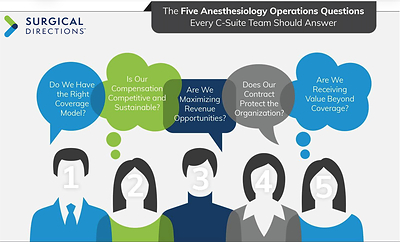
The report outlines five critical areas every healthcare leadership team should evaluate:
- Coverage model optimization
- Compensation competitiveness and sustainability
- Revenue cycle and reimbursement performance
- Contract structure and accountability
- Value creation beyond clinical coverage
How does your organization compare? Healthcare leaders can evaluate their current anesthesiology model using Surgical Directions’ complimentary self-assessment, designed to help organizations identify strengths, uncover potential gaps, and prioritize opportunities across these five critical areas. Access the assessment here: https://www.surgicaldirections.com/anesthesia-strategy/
Surgical Directions sees the highest-performing organizations using anesthesiology strategy as a catalyst for broader perioperative transformation, helping reduce unnecessary costs, improve workforce resilience, strengthen governance, and support long-term surgical growth.
“Organizations that continue reacting to subsidy requests, recruitment challenges, locum expenses, and contract renewals will remain trapped in a cycle of escalating costs and limited control,” Jason Klopotowski, Lead Physician Managing Director added. “Those that take a strategic approach gain visibility, leverage, stability, and the ability to align anesthesiology services with the future of their organization.”
About Surgical Directions
Surgical Directions is a healthcare solutions company specializing in perioperative and procedural care, sterile processing, anesthesiology, and radiology services. With a unique clinician-led model and proprietary analytics platform, Merlin™, the firm empowers hospitals and provider groups to drive measurable improvements in access, efficiency, and financial performance. From supply chain optimization to governance redesign, Surgical Directions delivers peer-to-peer partnership and clinical expertise that helps clients provide quality care and improve margins. Learn more at www.surgicaldirections.com.

 View original content to download multimedia:https://www.prnewswire.com/news-releases/anesthesiology-is-becoming-one-of-healthcares-biggest-strategic-risks-302825466.html
SOURCE Surgical Directions