Companies have already adopted artificial intelligence as a useful tool rather than a futuristic technology. Companies today use AI assistants to draft messages, summarize texts, analyze spreadsheets, write code and automate repetitive tasks. While these features increase productivity, there is also a question of who controls business data entered into AI.
Without appropriate measures, sensitive business data can leak from the company’s control resulting in serious risks to security, compliance and the company’s reputation. The question is not whether companies can implement AI assistants. It is a question of how to adopt them responsibly while protecting sensitive information. AI application development services allow your business to securely leverage AI without losing control over critical data.
Why Data Governance Is Now More Critical Than Ever
Business data is among a company’s most valuable assets. Financial records, contracts, customer data, intellectual property, source code, and strategic documents are some of the competitive advantages of the company.
At the same time, employees tend to use public AI tools to perform daily tasks. According to UpGuard’s 2025 State of Shadow AI Report, 81% of employees confirm using AI tools that have not been officially approved by their company. It is called Shadow AI, which leads to significant visibility problems for IT departments.
Employees are not doing it intentionally. They want to get the job done faster. Salespeople upload customer lists for processing while developers enter source code into AI chatbots to fix bugs. This increases productivity but exposes sensitive information accidentally. Once confidential data is entered in an unmanaged AI platform, the company loses visibility into its storage, processing, and retention.
Understand the Data Policy of Your AI Provider
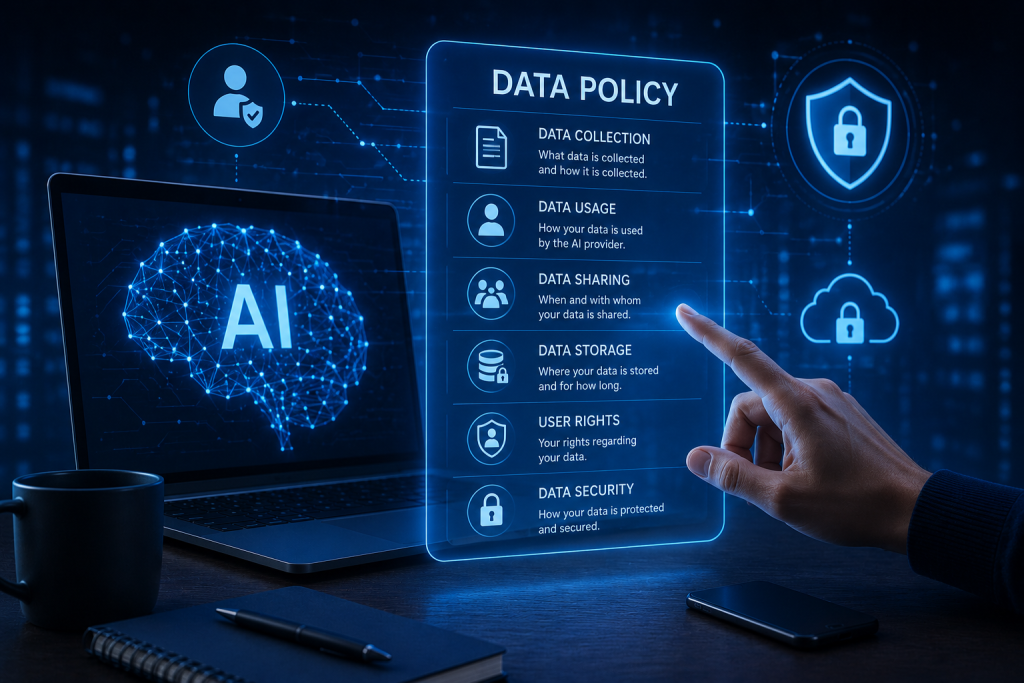
Before adopting AI tools, it’s important to understand how your provider handles business data. Companies offering AI application development services often help organizations choose enterprise AI platforms with stronger privacy controls and compliance features. Consumer AI tools may use prompts to improve their models unless training is disabled or an enterprise plan is used. In contrast, enterprise AI solutions typically provide enhanced contractual privacy, shorter data retention periods, and greater administrative control over business information.
The following questions should be answered when selecting AI assistants:
- Is user data used for model training?
- How long are prompts retained?
- Can administrators control data retention?
- Does the provider offer regional data residency?
- Are audit logs available?
- Is data encrypted both in transit and at rest?
Answering these questions helps businesses strike the right balance between productivity, security, and compliance while choosing the right AI solution.
Create Clear AI Policy
Every company should establish rules for AI use before employees begin using those tools actively. A good AI policy should answer the following questions:
- Which AI platforms can be used by employees?
- What kind of business information must never be entered in public AI tools?
- Which departments require additional restrictions?
- What is the approval process for new AI applications?
The policy should remain simple while covering sensitive information such as customer information, confidential contracts, financial reports, proprietary source code, healthcare/legislative data, etc.
Provide a Secure Alternative to Employees
Blocking access to AI websites does not solve the problem.
Usually, employees move to personal devices and personal accounts. In this case, the usage of AI becomes even more challenging to monitor. It is better to provide employees with a secure alternative.
AI application development services can include:
- Subscriptions to enterprise AI platforms with better privacy controls
- AI workspaces managed by the company
- Internal knowledge assistants
- Tools for secure summarizing of documents
- Role-based access permissions
When employees receive company-approved, helpful AI tools, they are less likely to use unapproved services.
Lower Risks through Technical Controls
Regulations alone do not suffice to protect sensitive data. Technical measures are needed to create another layer of security.
A web application development agency consider implementing:
- SSO authentication
- Multi-factor authentication
- Role-based access controls
- Quick logging and auditing
- DLP solutions
- Data encryption for transit and at-rest protection
Also, consider classifying your business information according to sensitivity level. While public marketing information can be safely shared with any AI service, client databases, legal documents, and financial statements must remain in a protected environment. A combination of regulation and technical controls will help you reduce exposure significantly.
Awareness of Employees is Important Too
Technology alone will not help you mitigate all kinds of risks associated with AI.
Your employees should regularly get guidance on responsible usage of AI tools, such as:
- Identification of sensitive data
- Avoid uploading any confidential information
- Knowledge of approved AI platforms
- Reporting accidental exposures promptly
- Following departmental regulations concerning AI
Training sessions and real-life examples by web application development agency
are more likely to bring results rather than long policy documents. Creating a culture of responsible AI adoption is much better for your business security than establishing strict policies.
Finding the Balance Between Innovation and Security
Adoption of AI does not have to slow down your business innovations. Organizations that properly regulate the use of AI usually adopt AI more quickly because they know exactly which tools they can use.
According to recent research into enterprise AI security, organizations that use AI and have efficient security automation lower their average cost of breaches by about $1.9 million. Our goal is to not restrict AI adoption but to create the environment in which our employees can safely use AI without exposing sensitive information.
Conclusion
With the development of data privacy issues, many organizations are moving towards open-source AI tools. They differ from proprietary AI solutions in that they can be used within your infrastructure and allow you to control all aspects of data handling. Businesses can use retrieval-augmented generation, self-hosted large language models, and secure AI pipelines without exposing sensitive information to third-party providers.
A web application development agency that specialises in enterprise open-source AI adoption, such as OpenSource Technologies, helps your organization develop customized AI assistants that deliver efficiency, scalability, and full data governance. This approach allows businesses to leverage AI innovation while maintaining full control over their most valuable digital assets.