The AI Engineering Summit Tokyo brought together more than 600 AI engineers, product managers, founders, and technology leaders from all over Japan on June 8 and 9, 2026, at Hamamatsucho Convention Hall. Findy Inc., which organized the summit, centered it on a critical turning point: the shift from an era where ‘humans use AI to develop’ to an era where ‘AI builds AI.’ But beneath that technical shift lies a human challenge that few organizations are prepared for. As AI handles implementation, what happens to people’s thinking, judgment, and sense of value inside organizations?
For Ashley Portillo, the summit offered a rare view into how Japan’s engineering community is thinking about AI at the exact moment when companies around the world are trying to move from experimentation to real integration. Japan has become an especially important market to watch. Its engineers are adopting AI tools at rates higher than most countries, its companies are weighing the promise of greater productivity against the risk of shallow implementation, and its long-standing strengths in hardware, manufacturing, and systems thinking give the country a distinct role in the next phase of AI development.
Portillo came to Tokyo asking a question that shapes her consulting work on cognitive adaptation at scale: as organizations adopt AI tools, a gap emerges between technical speed and human adaptation. How do people maintain judgment, stay engaged, and understand their evolved role in this shift?
Inside the summit, that question became more urgent. The conversation was not only about what artificial intelligence can now build. It was about what happens to judgment, learning, trust, and organizational behavior when AI becomes part of the way products are made.
Portillo sat down with Yuichiro Yamada, CEO and co-founder of Findy Inc., Japan’s engineering platform that connects 270,000 engineers with more than 4,000 technology companies. Yamada’s view from inside Japan’s engineering market reveals a paradox that many companies are only beginning to understand. AI is making some people faster. It is making others less effective. The difference is not only technical skill. It is whether people have enough foundational knowledge to use AI without surrendering their own thinking.
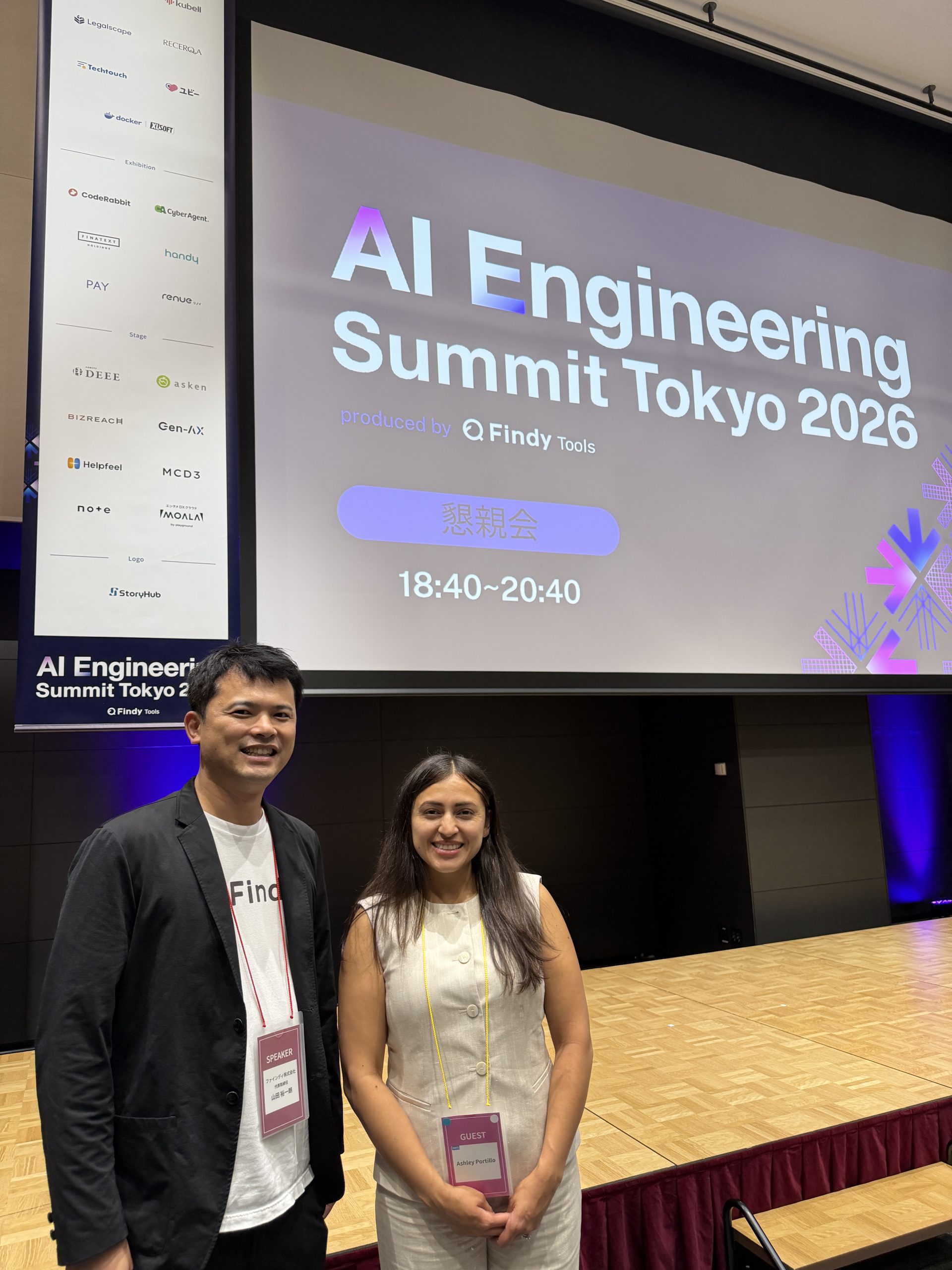
“Senior engineers can improve their productivity by more than 50 percent with AI,” Yamada said. “But for junior engineers, we are seeing productivity decrease after using AI.”
That finding cuts against the simple story many companies tell themselves about adoption. The promise of AI has often been framed as universal acceleration. Give people the tools, train them to use them, and productivity rises. Yamada’s data suggests a more complicated reality. AI can amplify judgment, but it can also expose the absence of it.
For junior engineers, the challenge is not a lack of effort. It is the gap between AI output and the knowledge required to evaluate that output.
“Junior engineers often do not yet have enough computer science knowledge or enough experience developing applications and working with data,” Yamada said.
That distinction matters. A senior engineer can look at AI-generated code and recognize what is missing, what is fragile, and what will create downstream problems. A junior engineer may accept the same output too quickly or spend more time untangling mistakes than they would have spent building from scratch. The tool is the same. The cognitive foundation is not.
Japan offers a particularly useful case study because its engineers are already adopting AI at a high rate. Yamada shared that more than half of Findy’s engineers personally pay for AI tools, often spending more than $60 per month out of pocket. Japan also ranks among the highest countries outside the United States for GitHub Copilot access, and Japanese engineers are heavy users of tools like Claude.ai.
Those numbers suggest motivation, curiosity, and a willingness to experiment. Yet Yamada is careful not to confuse individual enthusiasm with organizational transformation. Personal use does not automatically become company-wide productivity. Early adopters often move quickly, while late adopters lag behind. Senior engineers may gain speed, while junior engineers lose confidence or direction. Enterprises may invest in AI tools, while the habits inside the organization remain largely unchanged.
Findy’s November 2025 research shows why: while individual engineers are faster, organizational metrics have stalled. Review times have actually worsened. PR volume and deployment frequency remain flat. The tools are in place, but the organizational transformation has not followed.
At the summit, Portillo spoke with engineers about what they came to learn. The conference was built around helping engineers figure out ‘how to transform their own company’s development’ in the age of AI. One engineer described the shift as needing to focus on ‘innovation for business’ and developing ‘business acumen.’ Another said the real challenge was learning to ‘differentiate how humans work’ as AI handles more implementation. These weren’t theoretical discussions. They were engineers grappling with what their role actually needs to become when their company transforms.
That gap was one of the clearest themes Portillo tracked at the summit. AI adoption is no longer only a question of access. It is a question of structure.
Yamada’s response has been to build teams focused specifically on AI adaptation.
“We created a team to improve AI adaptation inside the organization,” he said.
That may sound simple, but it marks an important shift. AI implementation cannot be treated as a software rollout alone. Organizations need people who can translate between the tool, the workflow, the employee, and the business outcome. They need feedback loops that show where AI is helping, where it is creating confusion, and where people are outsourcing too much judgment too quickly.
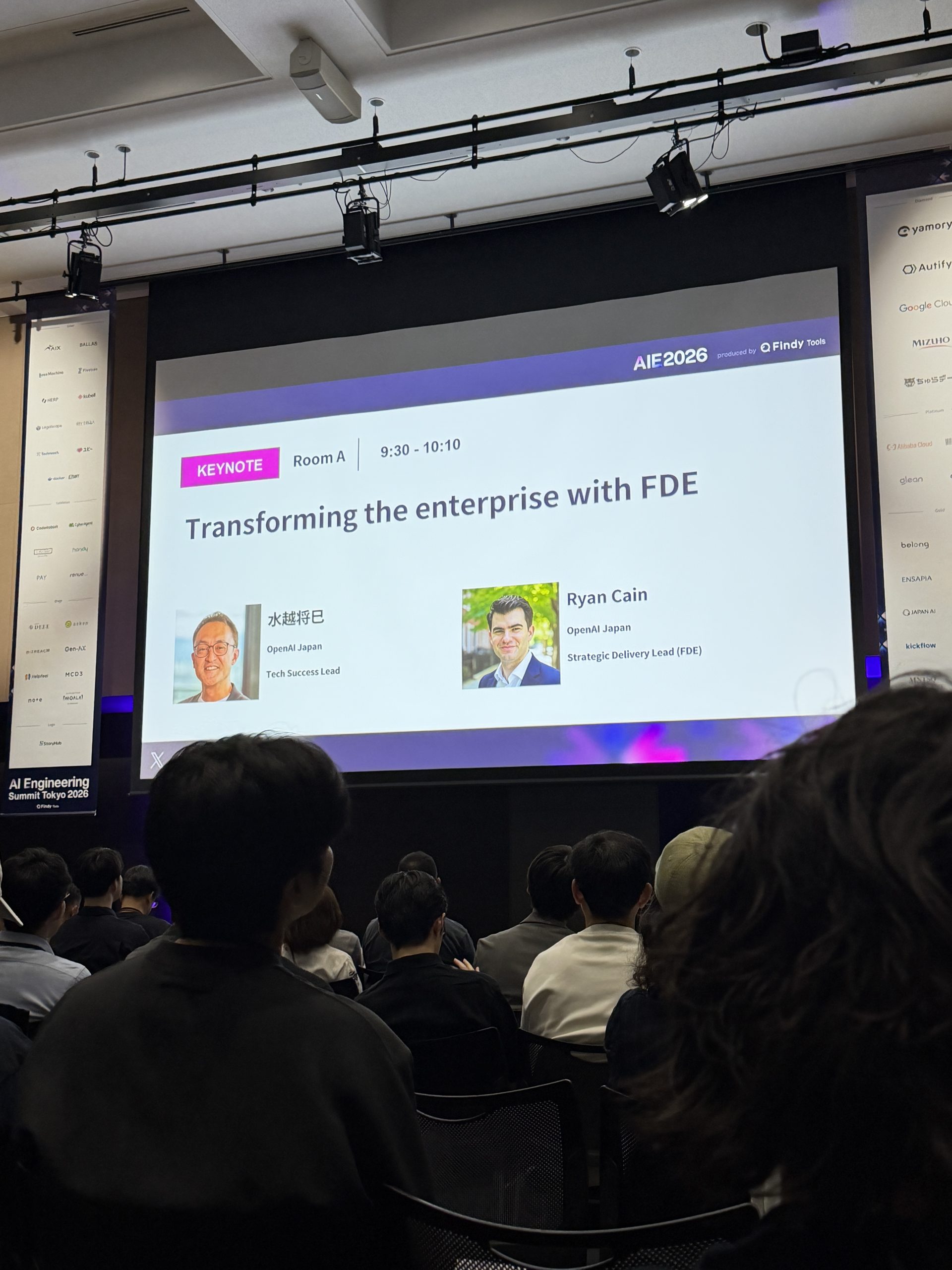
That point connected with another major thread from the summit. In a keynote on Forward Deployed Engineers, Colin Jarvis from OpenAI’s Forward Deployed Engineering team spoke on Transforming the Enterprise with FDE, discussing the importance of trust frameworks and feedback loops in enterprise AI. The idea is not simply that AI systems should be placed inside organizations. They must be embedded in ways that allow teams to learn, evaluate, question, and refine. Without that structure, adoption becomes a performance of innovation rather than a working system.
For Portillo, that is where the human side of AI becomes impossible to separate from the technical side.
“Most organizations are still treating AI adoption as a tool problem,” Portillo said. “But what I heard in Tokyo was that the real challenge is how people think with the tool, how they trust it, and how they keep enough cognitive ownership to know when it is wrong.”
Yamada’s vision for engineers reflects that same shift. As AI lowers the barrier to implementation, engineers may be pushed into broader strategic roles. Writing code will still matter, but the most valuable engineers may be those who can connect technical possibility with product judgment and business direction.
“Engineers can now access both business and technology much more easily than before,” Yamada said. “I hope engineers become not only technology leaders, but also business and product leaders in the future.”
That future depends on engineers continuing to think deeply, not merely prompting faster. Yamada’s most striking point was also his most human. Even as he encourages AI adoption, he wants his team to spend deliberate time away from it.
“I want our staff to think about new technology and new trends by themselves,” he said. “Sometimes I hope they do not use AI for one or two hours, and just think on their own.”
That is not a rejection of AI. It is a warning about dependency. The more capable AI becomes, the more intentional human thinking must become. If organizations use AI to replace reflection, they may gain speed while losing judgment. If they use it to support skilled thinking, they may create the kind of leverage executives have been promised.
Japan’s engineering culture adds another layer to that lesson. The country has deep strengths in manufacturing, hardware, and physical systems, which could give it an advantage as AI moves into robotics, devices, and real-world applications. At the same time, enterprise conservatism and reliance on system integrators can slow organizational change. Japan is not simply adopting AI. It is wrestling with how to adapt without weakening the thinking that makes strong engineering possible.
That is the story Portillo brought back from Tokyo. As AI builds AI, engineers need to adapt cognitively and shift roles. It is the organization’s ability to help people make that shift — to protect their judgment, build their trust, and develop their understanding of their evolved role. Japan is showing how. And organizations everywhere will need help navigating it.
The conversation with Yamada will be available on Portillo’s podcast, Does Anyone Think Anymore?, where she examines how artificial intelligence is changing the way people think, decide, and work inside organizations.
Ashley Portillo helps teams navigate cognitive adaptation at scale as AI takes on more work so people maintain judgment, stay engaged, and understand their evolved role inside the organization. Learn more at ashleyportillo.com.